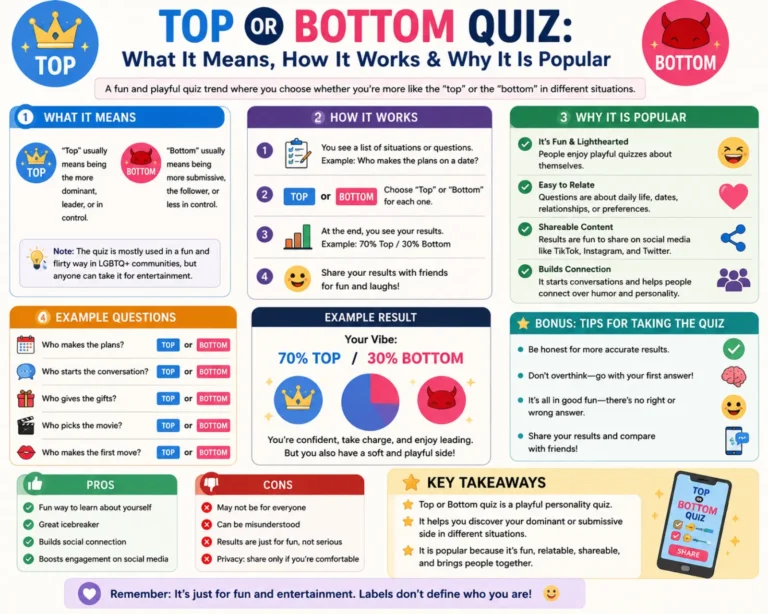
Top or bottom quiz searches often relate to a simple choice between two positions or roles. People use these quizzes for fun, self-discovery, and social conversations. The quiz usually asks questions about habits, choices, or personality traits. Then, it gives a result based on the answers. Some quizzes use “top” and “bottom” as playful labels. Others use the terms for rankings, preferences, or everyday choices. The exact meaning depends on the quiz and its context. This guide explains the phrase in simple terms. You will learn how these quizzes work and what their results can mean. You will also see examples, common mistakes, and useful tips. Most importantly, the guide keeps the topic clear and easy to understand.
Quick Summary
- A top or bottom quiz gives two choices or positions.
- The quiz uses answers to create a simple result.
- “Top” and “bottom” can have different meanings.
- Some quizzes focus on personality or everyday preferences.
- Results usually provide entertainment rather than scientific facts.
- Read the quiz description before interpreting your result.
- Avoid treating a casual quiz as a professional personality test.
What Is a Top or Bottom Quiz?
A top or bottom quiz is an online quiz that sorts answers into two broad categories.
The words “top” and “bottom” can describe position, preference, ranking, or role.
For example, a quiz might ask which option you prefer. Your answers then lead toward one of two results.
Many quizzes use simple scoring systems. Each answer adds points to one category.
At the end, the category with more points becomes your result.
The format makes quizzes quick and easy to share.
However, the phrase does not have one universal definition. Always check the quiz context before assuming its meaning.
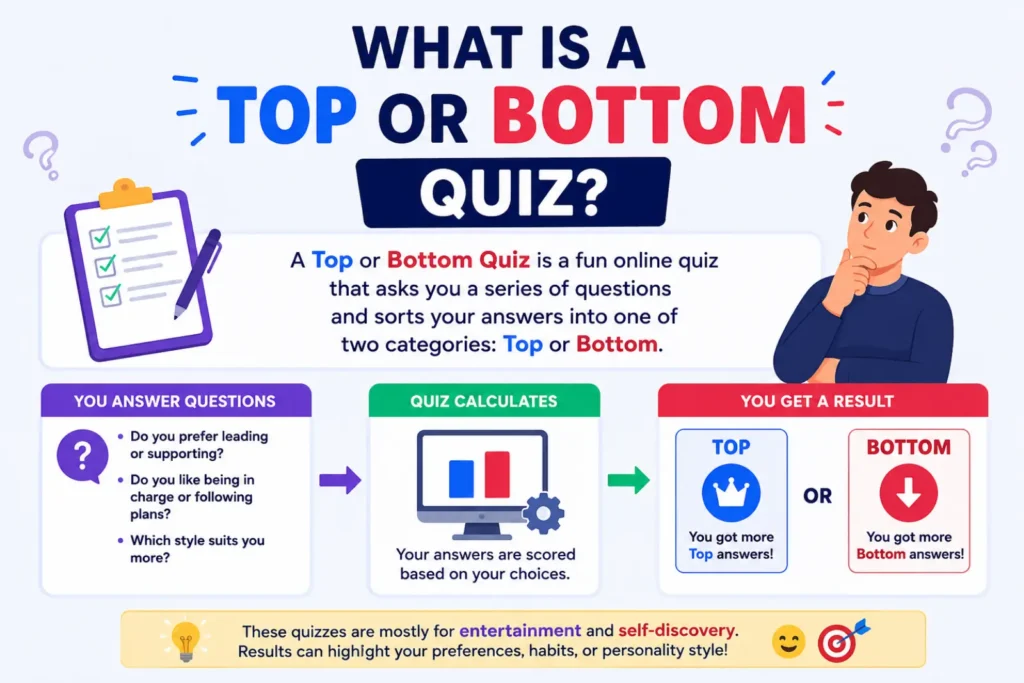
How Does a Top or Bottom Quiz Work?
Most quizzes follow a simple process.
First, the quiz asks several questions. Each question offers two or more answers.
Next, your choices receive hidden points. Some answers may favor “top,” while others favor “bottom.”
The quiz then adds your points. The higher score determines your final result.
Some quizzes use equal scoring. Others use different point values.
For example:
| Answer Pattern | Possible Result |
|---|---|
| Mostly Top choices | Top |
| Mostly Bottom choices | Bottom |
| Balanced choices | Mixed or Flexible |
| No clear pattern | Neutral result |
The scoring method can differ from one quiz to another.
Therefore, results should match the quiz’s own rules.
What Do “Top” and “Bottom” Mean?
The meaning depends on the quiz.
In a ranking quiz, “top” may mean a higher position. “Bottom” may mean a lower position.
In a personality quiz, the terms may represent two different styles.
In a simple preference quiz, they may describe two choices.
Some online content also uses these terms in adult contexts. Those quizzes may not suit every audience.
For a general audience, it is better to focus on neutral meanings. Always consider the age rating and context of a quiz before taking it.
Top or Bottom Quiz vs. Other Personality Quizzes
A top or bottom quiz can look similar to a personality quiz.
However, the goal may differ.
| Quiz Type | Main Purpose | Typical Result |
| Top or bottom quiz | Sort two broad categories | Top or Bottom |
| Personality quiz | Explore personality traits | Personality type |
| Preference quiz | Identify choices | Preferred option |
| Ranking quiz | Order choices | Higher or lower rank |
| Trivia quiz | Test knowledge | Score or grade |
A personality test often uses established traits.
A casual top or bottom quiz usually aims to entertain.
Therefore, you should not treat both formats as equally scientific.
Real-Life Examples of Top or Bottom Quizzes
You can find many neutral examples online.
A classroom activity could ask students to choose between two study habits. The result could label one choice “top” and another “bottom.”
A social media quiz might ask users to choose between two weekend activities.
A team-building activity could use two categories to group preferences.
A ranking game could also use top and bottom positions.
For example, imagine these questions:
- Do you prefer planning ahead or acting spontaneously?
- Do you prefer leading or supporting?
- Do you prefer busy places or quiet spaces?
The quiz could group your answers into two simple profiles.
These examples show how flexible the format can be.
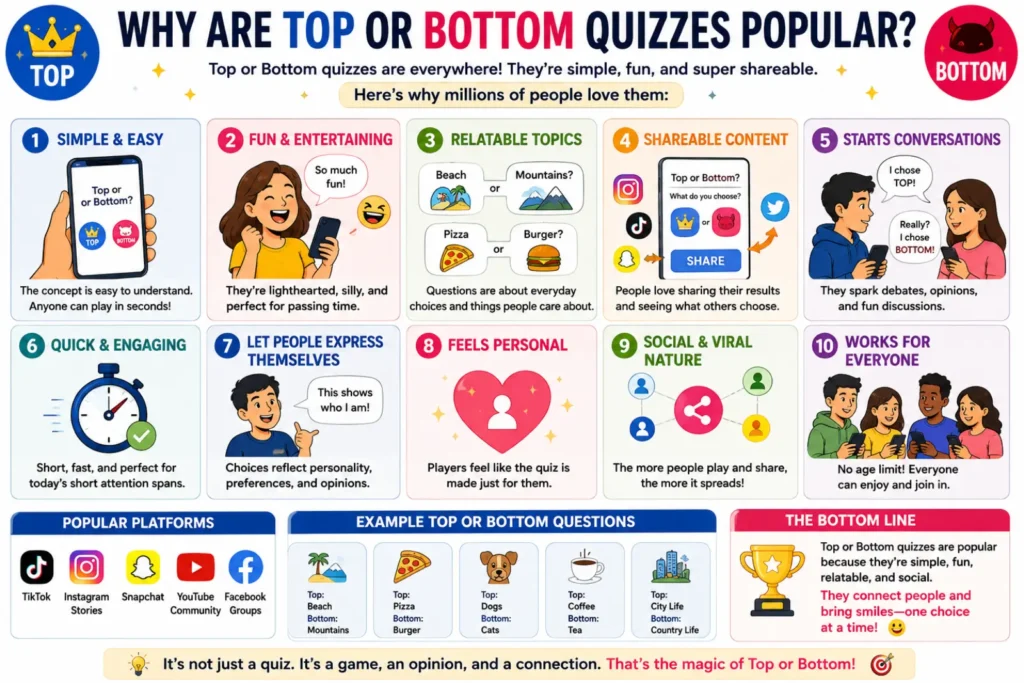
Why Are Top or Bottom Quizzes Popular?
Short quizzes create fast feedback.
People also enjoy comparing results with friends. Social sharing can make a simple quiz more engaging.
The two-result format makes the outcome easy to understand.
Quizzes also require little time. Many take only a few minutes.
Another reason involves curiosity. People naturally want to learn how a quiz describes them.
Still, entertainment value does not equal scientific accuracy.
A quiz can be fun without being a reliable psychological assessment.
Common Mistakes When Taking a Top or Bottom Quiz
People often make simple mistakes when answering quizzes.
1. Looking for a “correct” answer
Most personality-style quizzes do not have one correct answer.
Choose the option that best matches you.
2. Changing answers to get a desired result
This can make the result less meaningful.
Answer honestly if you want a result that reflects your choices.
3. Ignoring the quiz instructions
Different quizzes use different scoring systems.
Read the instructions before starting.
4. Taking the result too seriously
A casual online quiz cannot fully describe a person.
Use results as entertainment or a conversation starter.
5. Ignoring the quiz context
Some terms have different meanings in different communities.
Check the surrounding content before interpreting the result.
Tips for Getting a Better Quiz Result
You can make your quiz experience more useful with a few simple steps.
Read every question carefully. Small wording differences can change your answer.
Answer naturally. Choose what you would really do.
Avoid overthinking. Your first reasonable answer may reflect your preference better.
Check the scoring method. This helps you understand the final result.
Compare results carefully. Two quizzes may use the same words differently.
Treat results as general clues. They should not define your personality.
These tips can improve your experience without making the quiz complicated.
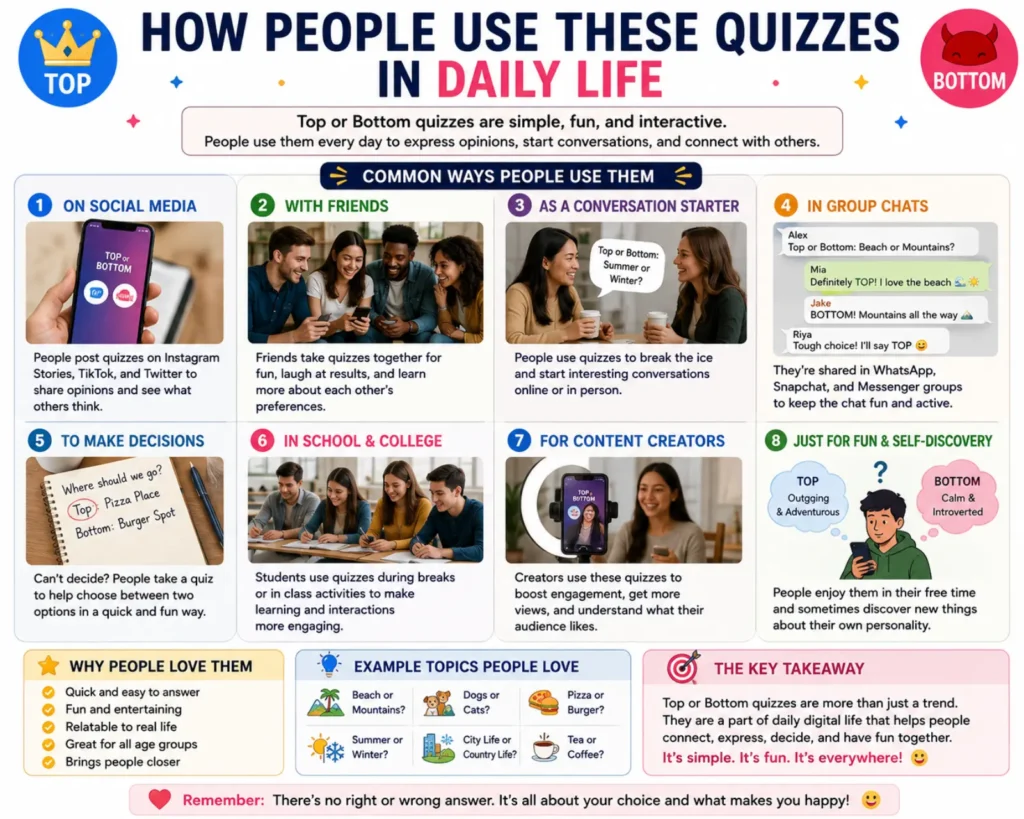
How People Use These Quizzes in Daily Life
People can use simple quizzes for games, learning, and conversation.
Teachers may use quiz formats to start classroom discussions.
Friends may use them as icebreakers.
Content creators may use them to increase audience interaction.
Families can also create simple preference quizzes for fun.
For example, a family could create a “top or bottom” food preference game. Everyone chooses between two options.
The final results can create a light conversation.
The key is to keep the activity suitable for the audience.
Top or Bottom Quiz Synonyms and LSI Keywords
Search engines understand related terms and topic connections.
Useful semantic keywords include:
- top or bottom test
- top or bottom personality quiz
- top or bottom test
- top vs bottom quiz
- two-choice quiz
- personality preference quiz
- online personality quiz
- fun personality test
- preference test
- quiz results
- personality categories
- online quiz questions
- quiz scoring system
- personality quiz meaning
- two-option personality test
Use these terms naturally.
Avoid repeating the primary keyword in every paragraph.
Good SEO content answers the reader’s question rather than forcing keywords into sentences.
Expert Insights: How to Interpret Quiz Results
A quiz result works best as a starting point.
It can help you notice preferences or discuss differences with others.
However, a casual quiz usually lacks the research behind professional assessments.
Experts often look at reliability, validity, sample size, and scoring methods.
A trustworthy assessment explains how researchers developed and tested it.
A casual internet quiz may not provide this information.
Therefore, use quiz results with a balanced view.
The result can describe one set of answers. It cannot describe every part of your personality.
This distinction also improves E-E-A-T quality. Clear limits make content more trustworthy.
Are Top or Bottom Quizzes Accurate?
Accuracy depends on the quiz.
A professionally developed assessment may use tested questions and scoring methods.
A casual social media quiz may simply use entertainment-based questions.
Look for information about the quiz creator, purpose, scoring, and evidence.
If a quiz makes strong psychological claims without evidence, be cautious.
A fun result can still be enjoyable. Just avoid treating it as a diagnosis or scientific conclusion.
FAQs About Top or Bottom Quizzes
What is a top or bottom quiz?
It is a quiz that places answers into two broad categories. The exact meaning depends on its context.
How does a top or bottom quiz work?
You answer several questions. The quiz then uses your choices to calculate a result.
Is a top or bottom quiz a personality test?
Sometimes, but not always. Many online quizzes use personality-style questions for entertainment.
Are top or bottom quizzes accurate?
Accuracy varies. Casual quizzes often lack scientific testing or professional validation.
Can I make my own top or bottom quiz?
Yes. You can create questions with two clear choices and assign points to each category.
Why do people take these quizzes?
People often take them for fun, curiosity, social sharing, or conversation.
What should I do with my quiz result?
Use it as a general insight or entertainment. Do not let a casual result define you.
Are all top or bottom quizzes the same?
No. The terms can have different meanings across websites and communities.
Conclusion
A top or bottom quiz offers a simple way to sort answers into two broad categories. The terms can describe rankings, preferences, positions, or personality-style results. Their exact meaning depends on the quiz and its audience. Most casual quizzes focus on fun and quick feedback. They can also help start conversations with friends, classmates, or online communities. Still, you should not treat every quiz as a scientific personality assessment. Check the quiz instructions and scoring method first. Then, answer questions honestly and enjoy the result. The best approach keeps expectations realistic. A quiz can offer an interesting snapshot without defining who you are. In short, understand the context, enjoy the process, and treat the final result as a simple guide.