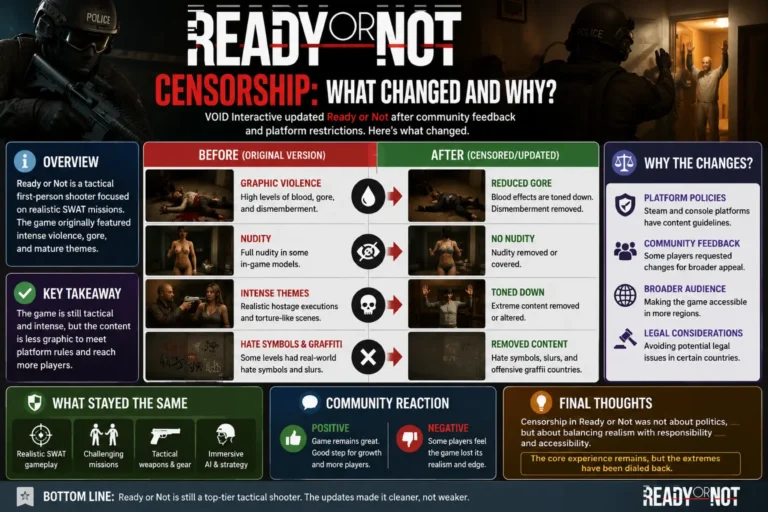
Ready or Not censorship has become a popular topic among players and gaming fans. The debate started after changes appeared in some mature content. These changes were linked to console certification requirements. Some players felt the changes affected the game’s original experience. Others saw them as normal adjustments for platform approval. The changes included certain visual assets, nudity, and sensitive scenes. Some of these changes also affected the PC version. This made the discussion even bigger among the game’s community. But what exactly changed, and why did it happen? This guide explains the Ready or Not censorship controversy in simple terms. We will cover the main changes, PC and console differences, and developer statements. By the end, you will have a clear view of what really happened.
The topic also matters because Ready or Not is known for its serious and realistic approach. Players expect its missions and visual details to feel intense and authentic. Even small changes can therefore attract attention from the community. Some players wanted the original content to remain available on PC. Others understood the need to follow console platform rules. This difference in opinion created a heated debate across gaming communities. Understanding both sides helps separate confirmed changes from rumors and online claims.
Quick Summary
- ready or Not censorship refers to changes made for console certification.
- VOID Interactive announced the changes in June 2025.
- Some nudity received additional coverage.
- Some visual evidence received less explicit textures.
- One child-related animation changed to a less violent-looking scene.
- Some asset changes also reached the PC version.
- Cross-play and shared assets helped explain the wider changes.
- The game remained an adults-only title on major rating systems.
- Players strongly debated whether these changes counted as censorship.
- The changes did not remove the game’s entire mature tone.
What Does Ready or Not Censorship Mean?
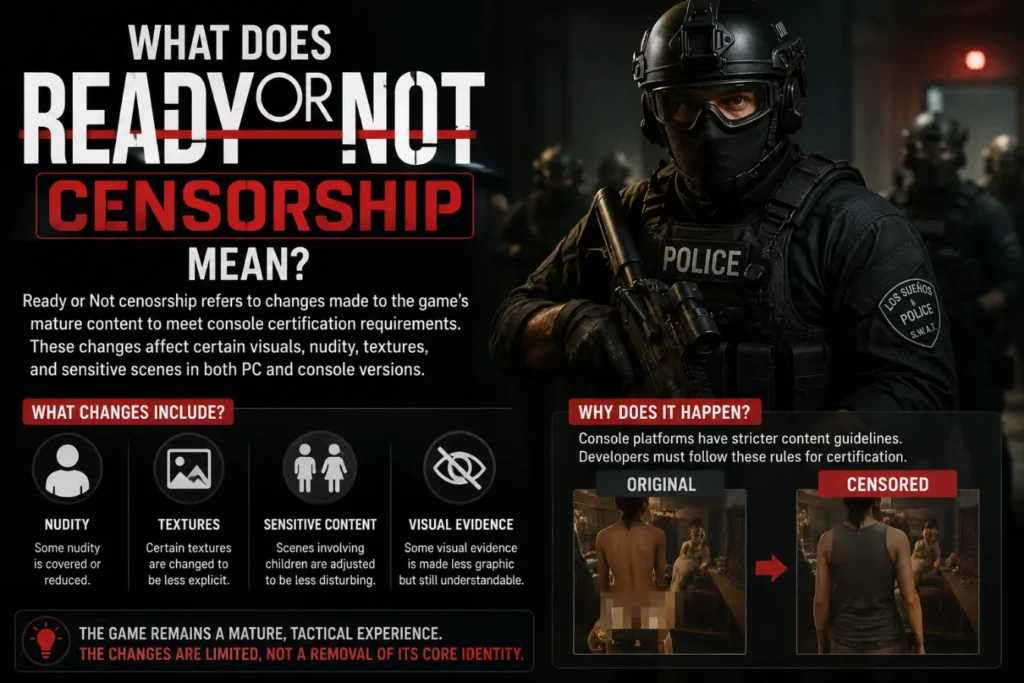
Ready or Not censorship means changes to certain mature visual content in the game.
The term became popular among players after VOID announced its console certification changes.
The developer said console platforms had additional content requirements.
These requirements existed even though the game kept its mature age ratings.
Some changes involved textures.
Others involved character assets or animations.
Therefore, the term does not describe a complete rewrite of the game.
Instead, it describes a limited set of content changes connected to the console release.
Why Was Ready or Not Censored?
The main reason was console certification.
Ready or Not launched on PlayStation 5 and Xbox Series X|S in July 2025.
Before release, VOID needed to complete the certification process for those platforms.
VOID said it changed content only when required by its platform partners.
The studio also wanted to keep the game’s original tone.
This explains why the changes focused on specific mature elements instead of the whole game.
The developer said maintaining separate assets could also create technical problems.
Different assets could increase bugs and make future updates harder.
Cross-play added another reason.
Shared game content helps different platforms work together more reliably.
What Content Changed?
The most important confirmed changes fall into a few categories.
1. Nudity
Some examples of explicit nudity received additional coverage.
VOID specifically mentioned several civilians and one suspect.
The goal was to make those scenes less explicit for console certification.
2. Child-Related Visual Content
Some content involving children also changed.
One example came from the Twisted Nerve mission.
An animation changed from a more disturbing appearance to an unconscious or sleeping state.
VOID described this as part of its approach to handling sensitive content involving children.
3. Explicit Evidence
Some visual evidence became less direct.
VOID explained that certain textures were changed on console.
The developer said these changes still allowed players to understand the situation through other clues.
4. Graphic Visual Effects
Some visual effects connected to violence also received changes.
However, the game’s overall mature identity remained.
Reports from the period noted that the changes were limited rather than a complete removal of violent content.
Did the PC Version Get Censored Too?
Yes, some changes reached PC.
This became one of the biggest complaints from PC players.
VOID explained that simple texture changes could remain console-only.
However, larger asset changes were harder to separate.
The studio gave two main reasons.
First, separate assets could increase bugs and maintenance work.
Second, different assets could create problems for cross-play.
This means the situation was more complex than “console version censored, PC version untouched.”
Some PC players therefore felt that the console launch changed the version they already owned.
PC vs Console: What Is Different?
| Area | PC | Console |
|---|---|---|
| Mature tone | Still present | Still present |
| Nudity | Some changes may remain | Some nudity is covered |
| Certain textures | Some original versions remain | Some textures were changed |
| Sensitive child-related content | Some changes also reached PC | Changed for certification |
| Cross-play | Supported | Supported |
| Age rating | Mature content | Mature content |
| Overall game identity | Tactical and mature | Tactical and mature |
The important point is that the differences are not simply “uncensored PC” versus “censored console.”
Some changes affect both versions.
VOID explained that certain asset changes could not easily remain platform-specific.
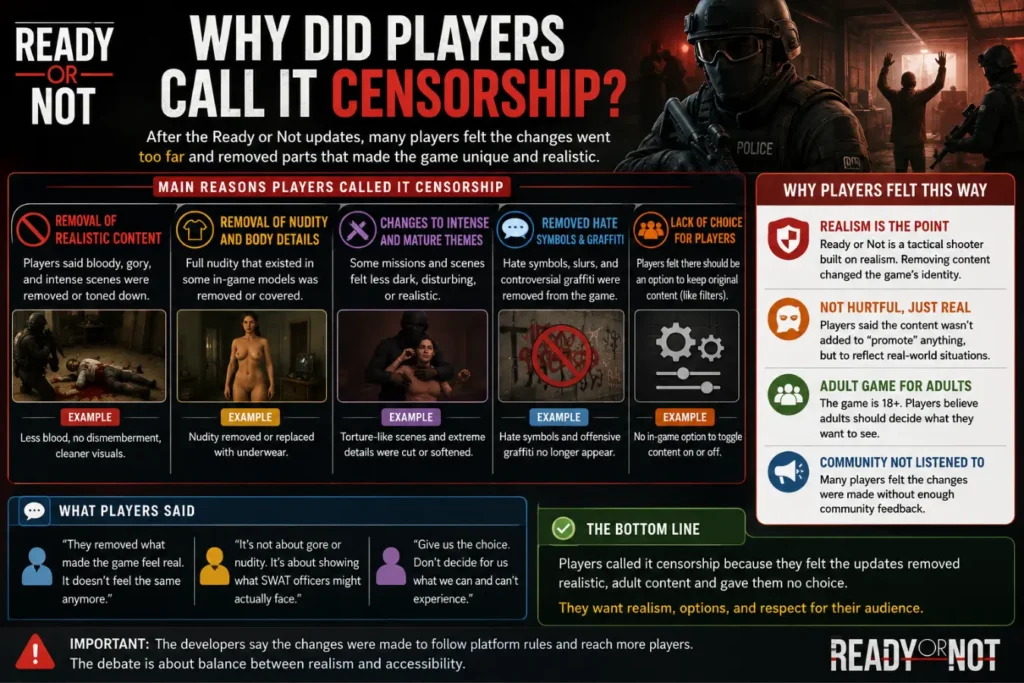
Why Did Players Call It Censorship?
The word “censorship” has a broader meaning in gaming discussions.
Some players use it whenever content changes after release.
Others use it only when an outside platform or authority forces a developer to remove content.
In this case, players saw the changes as a loss of the original version.
The timing made the debate stronger.
The changes appeared shortly before the console launch.
Steam users then posted many negative reviews about the decision.
VOID, however, presented the changes as certification work.
So both descriptions reflect different views of the same event.
What Did VOID Interactive Say?
VOID’s official explanation is important for understanding the issue.
The studio said it made changes when its platform partners required them.
It also said the changes aimed to preserve the game’s original tone.
VOID noted that the console versions still carried mature ratings.
The studio listed ESRB M, PEGI 18, and USK 18 for the console release.
The developer also stressed that many changes were small.
Some changes involved textures that players might not notice during normal play.
This official explanation provides a useful counterpoint to claims that the entire game had been rewritten.
Real-Life Example: Why Cross-Play Matters
Imagine a game with two different versions of the same character model.
One player sees version A.
Another player sees version B.
Both players then enter the same multiplayer session.
That can create technical problems.
Developers must keep many game systems synchronized.
This includes animations, textures, models, lighting, and other assets.
VOID said this was one reason some changes appeared on PC too.
This does not prove that every change was technically unavoidable.
It does explain why maintaining separate versions can become difficult.
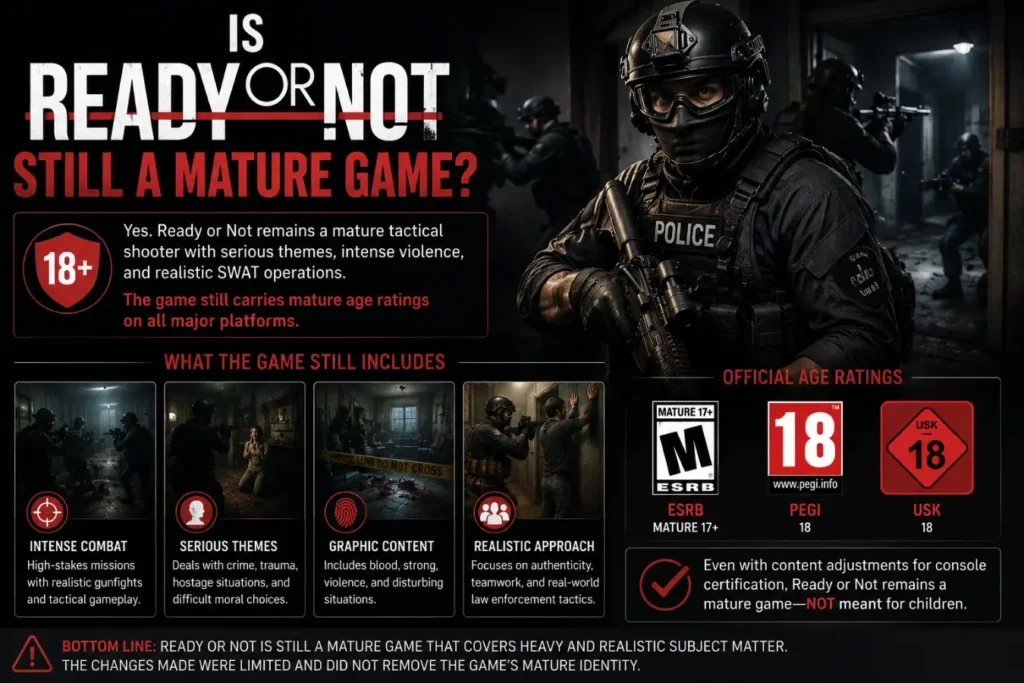
Is Ready or Not Still a Mature Game?
Yes.
The censorship debate should not create the impression that the game became family-friendly.
Ready or Not remains a mature tactical game with serious themes.
Its missions can include disturbing situations and strong violence.
The console release also retained mature age classifications.
VOID specifically confirmed its console ratings as ESRB M, PEGI 18, and USK 18.
Therefore, “censored” does not mean “made suitable for children.”
It means that certain mature depictions became less explicit.
Common Misunderstandings About Ready or Not Censorship
Myth 1: The entire game was censored
This is inaccurate.
The confirmed changes focused on specific assets, textures, nudity, and sensitive scenes.
The game’s overall identity remained mature.
Myth 2: Only console players were affected
This is also inaccurate.
Some asset changes appeared on PC.
VOID explained that shared assets and cross-play made some separation difficult.
Myth 3: The game became family-friendly
It did not.
The game retained mature ratings and mature themes.
Myth 4: Every graphic scene was removed
That is not supported by the developer’s explanation.
The changes were selective.
Some scenes became less explicit rather than disappearing completely.
Myth 5: “Censorship” is an objective label
It is partly a matter of interpretation.
The changes themselves are factual.
Calling them censorship reflects an opinion about why and how they happened.
Common Mistakes When Researching the Topic
Many articles and social posts mix confirmed facts with player reactions.
Here are common mistakes to avoid.
Mistake 1: Treating rumors as official information
Always check developer statements first.
Mistake 2: Saying PC received no changes
Some changes did reach PC.
Mistake 3: Saying everything was removed
The developer described the changes as limited.
Mistake 4: Ignoring cross-play
Cross-play helps explain why shared assets matter.
Mistake 5: Confusing censorship with age ratings
A mature rating does not mean every mature scene must remain unchanged.
Mistake 6: Using old information as current information
The controversy began in 2025.
Game updates can change details later.
For a current article, always check recent developer updates before publishing.
Tips for Understanding the Controversy
Use these simple rules when researching Ready or Not censorship.
- Start with official developer statements.
- Separate confirmed changes from player complaints.
- Check whether a change affects PC, console, or both.
- Look at the date of every source.
- Avoid judging the entire game from one altered scene.
- Remember that platform certification can affect content.
- Treat community opinions as opinions, not facts.
This approach creates a much clearer picture.
Ready or Not Censorship: Synonyms and Related Search Terms
People use many different phrases when searching for this topic.
Useful semantic keywords include:
- Ready or Not censored
- Ready or Not censorship controversy
- Ready or Not PC censorship
- Ready or Not console censorship
- Ready or Not content changes
- Ready or Not uncensored
- Ready or Not console differences
- Ready or Not gore changes
- Ready or Not nudity changes
- Ready or Not certification changes
- Ready or Not mature content
- Ready or Not content removal
- Ready or Not PC vs console
- Ready or Not censorship explained
- why was Ready or Not censored
These phrases help describe the same topic from different search intents.
Expert Insights: Why This Controversy Matters
The Ready or Not censorship debate shows how platform certification can shape game development.
Modern games often launch across several systems.
Each platform can have different certification requirements.
Developers must balance creative goals with technical and business needs.
Cross-play adds another layer to that problem.
Shared multiplayer environments work best when players use compatible assets.
VOID’s explanation highlights this challenge directly.
From an editorial perspective, the strongest coverage should avoid extreme claims.
A good article should explain what changed first.
Then it should explain why players reacted.
Finally, it should present the developer’s response.
That approach creates a more trustworthy and useful resource.
It also helps readers separate evidence from online speculation.
Frequently Asked Questions
Is Ready or Not censored?
Yes, certain mature visual elements were changed for console certification.
Some asset changes also appeared on PC.
Why was Ready or Not censored?
VOID Interactive said the changes helped meet console platform certification requirements.
The developer also wanted to maintain cross-platform compatibility.
Is Ready or Not censored on PC?
Some changes affect PC.
However, not every console change applies to the PC version.
Is the console version less violent?
Some mature visual content is less explicit.
However, the game remains a mature tactical shooter.
Did Ready or Not censorship affect nudity?
Yes.
VOID confirmed that some explicit nudity received additional coverage.
Did Ready or Not censorship affect child-related content?
Yes.
VOID changed some sensitive child-related material, including an animation on Twisted Nerve.
Why did PC players complain about censorship?
Some PC players believed the console launch changed content they already had.
The issue became especially controversial because some changes also reached PC.
Is “Ready or Not censorship” still relevant?
Yes.
The topic remains useful because players continue to discuss the differences between versions and the game’s content history.nd the site’s gaming expertise.
Conclusion
Ready or Not censorship became controversial after changes were introduced for the game’s console certification.
The changes focused on selected mature content.
These included some nudity, sensitive evidence, and child-related material.
Some asset changes also appeared on PC.
VOID Interactive explained that platform requirements caused the changes.
The studio also pointed to cross-play and development concerns.
The debate comes down to more than one simple question.
Players can view the changes as censorship.
The developer views them as limited certification adjustments.
Both perspectives help explain the controversy.
The most important fact is that Ready or Not remains a mature game.
The changes did not erase its serious themes or overall identity.
For accurate research, rely on official statements and dated sources.
That gives readers a clearer view of what actually changed.