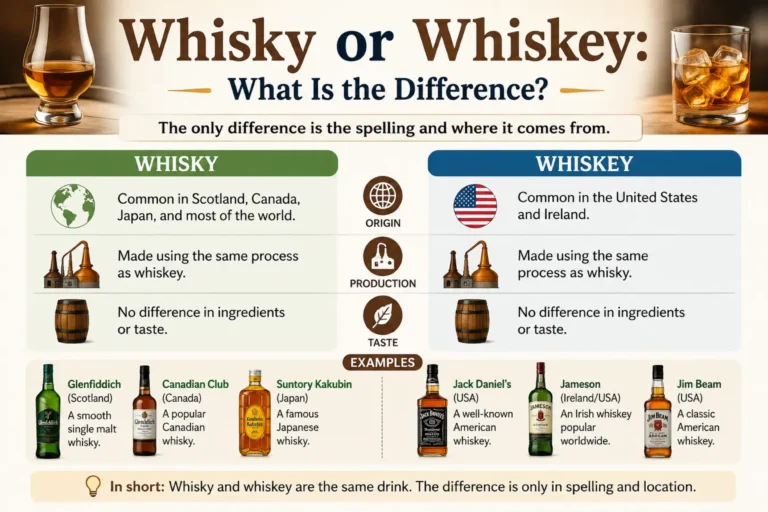
Whisky or whiskey may look like two names for the same drink. In many cases, they do mean the same type of spirit. However, the spelling often tells you where it comes from. Whisky usually refers to Scotch, Canadian, or Japanese styles. Whiskey usually refers to Irish or American styles.
The difference comes from language, history, and local tradition. It does not simply describe two completely different drinks. Some countries and producers follow their own naming rules. Therefore, the label can give you a useful clue about origin.
This guide explains whisky and whiskey in simple terms. You will learn the spelling rules, key differences, examples, and common mistakes. You will also find answers to popular questions about the two terms.
Quick Summary
- Whisky and whiskey describe the same broad type of distilled spirit.
- Whisky is common in Scotland, Canada, and Japan.
- Whiskey is common in Ireland and the United States.
- Spelling often reflects regional tradition.
- The terms can differ in production rules between countries.
- Scotch whisky always uses the spelling “whisky.”
- Irish whiskey uses the spelling “whiskey.”
- American whiskey usually uses the spelling “whiskey.”
- The spelling alone does not tell you every production detail.
- Always check the country and producer for the most accurate meaning.
What Does Whisky or Whiskey Mean?
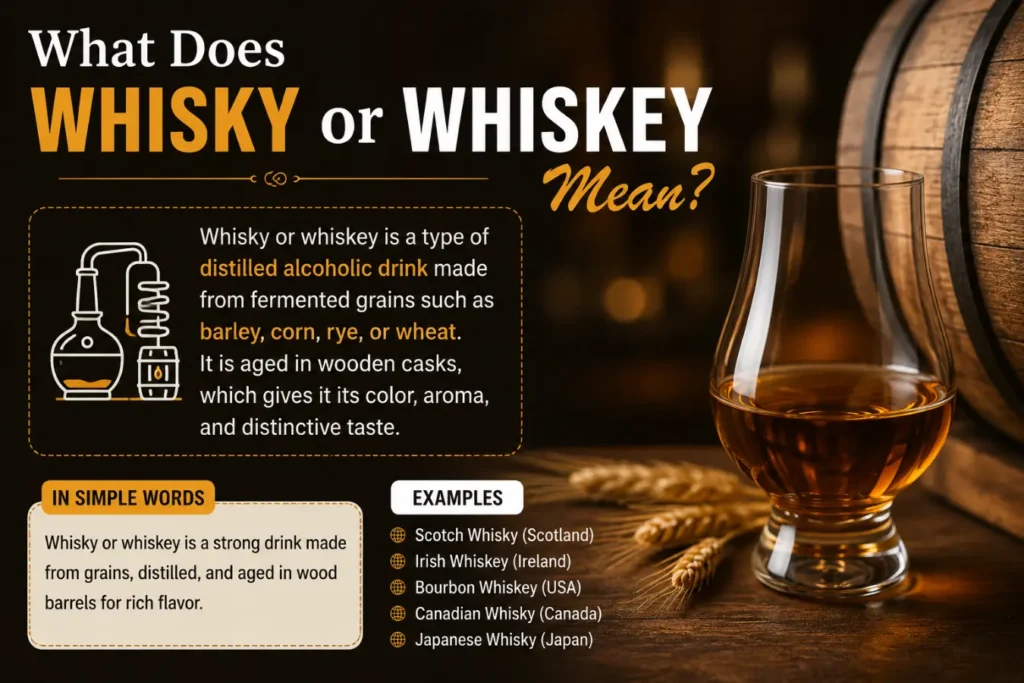
Whisky and whiskey are names for spirits made from fermented grain mash. Producers distill the liquid and usually mature it in wooden casks.
Different grains can create different styles. Common grains include barley, corn, rye, and wheat.
The word itself has a long history. It developed from older Gaelic and related terms for distilled spirits.
Today, spelling often depends on regional tradition. That makes whisky vs whiskey more about naming customs than pronunciation.
The broad category includes many regional styles. Scotch whisky, Irish whiskey, bourbon, rye whiskey, Canadian whisky, and Japanese whisky all fit within this wider family.
Whisky vs Whiskey: The Main Difference
The easiest rule is based on geography.
| Term | Commonly used in | Example |
|---|---|---|
| Whisky | Scotland | Scotch whisky |
| Whisky | Canada | Canadian whisky |
| Whisky | Japan | Japanese whisky |
| Whiskey | Ireland | Irish whiskey |
| Whiskey | United States | American whiskey |
| Whiskey | United States | Bourbon whiskey |
| Whiskey | United States | Rye whiskey |
This rule works well for general writing. However, some producers have unique naming traditions.
Therefore, avoid treating the spelling as an absolute scientific rule. Country, law, and producer traditions also matter.
Why Do Some Countries Use “Whisky” and Others Use “Whiskey”?
The spelling developed differently across regions.
Irish and American usage commonly adopted whiskey. Scottish usage generally kept whisky.
Historical language changes helped create these differences. Trade, migration, and local writing traditions also played a role.
The United States has another interesting detail. Some American brands use “whisky” on their labels. Therefore, even within one country, exceptions exist.
The safest approach is simple. Follow the spelling used by the specific producer or regional style.
Whisky and Whiskey: Are They Made Differently?
Sometimes, yes.
Production rules can vary by country. These rules may cover ingredients, distillation, maturation, labeling, and minimum aging periods.
For example, Scotch whisky follows rules connected with Scotch whisky production. Bourbon follows different American requirements.
However, the spelling itself does not create the production difference.
You should think of spelling as a regional clue, not a complete production guide.
Scotch Whisky vs Irish Whiskey
Scotch whisky and Irish whiskey are two major regional styles.
whisky comes from Scotland. production follows detailed legal requirements. Scotch can include single malt, single grain, blended malt, blended grain, and blended whisky categories.
Irish whiskey comes from Ireland. Irish whiskey also follows specific production and labeling requirements.
The spelling provides an easy clue:
- Scotland → whisky
- Ireland → whiskey
Their production methods and traditions can differ as well. However, individual products vary greatly.
American Whiskey: Bourbon, Rye, and More
American whiskey includes several well-known categories.
Bourbon is an American whiskey category with specific legal requirements. Its grain recipe must contain at least 51% corn.
Rye whiskey uses rye as the primary grain under U.S. rules.
Other American whiskey styles also exist. These include Tennessee whiskey and several craft whiskey categories.
In American English, whiskey is the usual spelling.
However, individual American producers can choose different naming traditions. Always check the official label when precision matters.
Canadian and Japanese Whisky
Canada generally uses whisky.
Canadian whisky has its own production history and labeling traditions. It often features a range of grain-based styles.
Japan also generally uses whisky.
Japanese whisky developed strong links with Scottish whisky-making traditions. Today, Japanese whisky has its own identity and production standards.
These examples show why geography matters when choosing between whisky or whiskey.
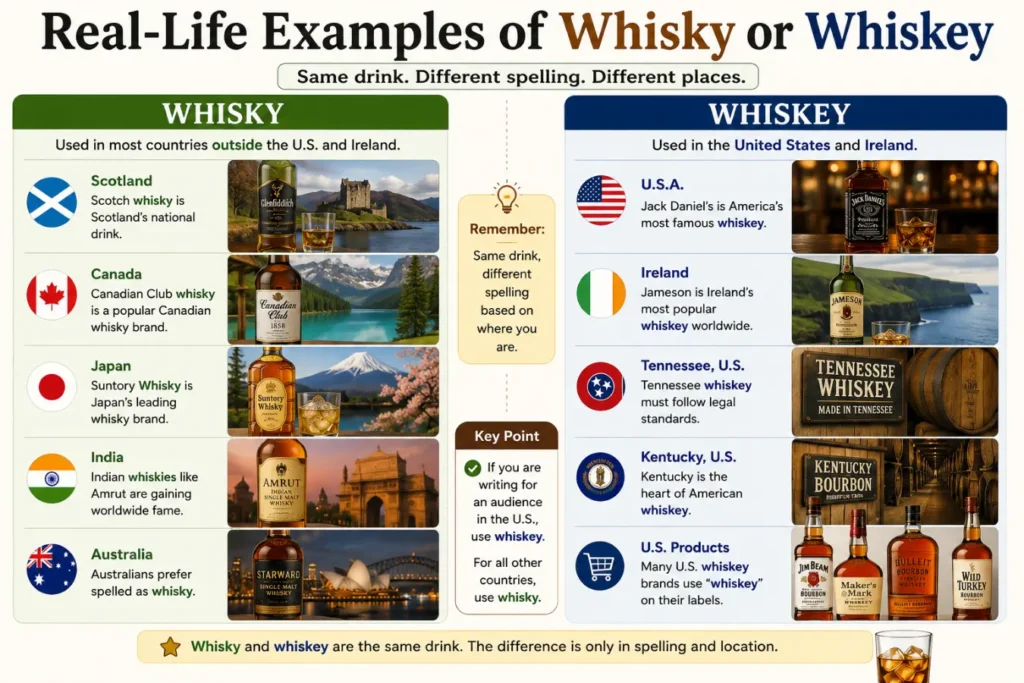
Real-Life Examples of Whisky or Whiskey
Consider these common writing situations.
Example 1: Writing About Scotland
Correct:
Scotch whisky has a long history in Scotland.
Incorrect:
Scotch whiskey has a long history in Scotland.
The standard term is Scotch whisky.
Example 2: Writing About Ireland
Correct:
Irish whiskey has a distinctive place in Irish culture.
The standard term is Irish whiskey.
Example 3: Writing About Bourbon
Correct:
Bourbon is a type of American whiskey.
The spelling whiskey fits standard American usage.
Example 4: Writing About Japan
Correct:
Japanese whisky has become an important category in the global spirits market.
The standard spelling is generally whisky.
These examples make the regional rule easier to remember.
Common Mistakes With Whisky and Whiskey
Many writers make simple spelling mistakes. Here are the most common ones.
1. Using One Spelling Everywhere
Do not assume “whisky” works for every country.
Check the regional style first.
2. Assuming Spelling Shows Quality
The spelling does not tell you whether a product has higher quality.
It mainly reflects language and tradition.
3. Calling Bourbon “Scotch”
Bourbon and Scotch belong to different regional traditions.
Bourbon comes from the United States. Scotch comes from Scotland.
4. Ignoring Brand Spelling
Some producers use unusual or traditional spellings.
When discussing a specific product, follow its official name.
5. Treating Whisky and Whiskey as Completely Different Spirits
They belong to the same broad family.
Their differences often come from regional rules and production traditions.
Tips for Remembering Whisky vs Whiskey
A simple memory trick can help.
Think of the “e” in whiskey as appearing in Ireland and the United States.
So:
- Ireland → whiskey
- United States → whiskey
- Scotland → whisky
This trick works for many common examples.
Still, remember that producers can create exceptions. Use the official spelling when writing about a specific brand.
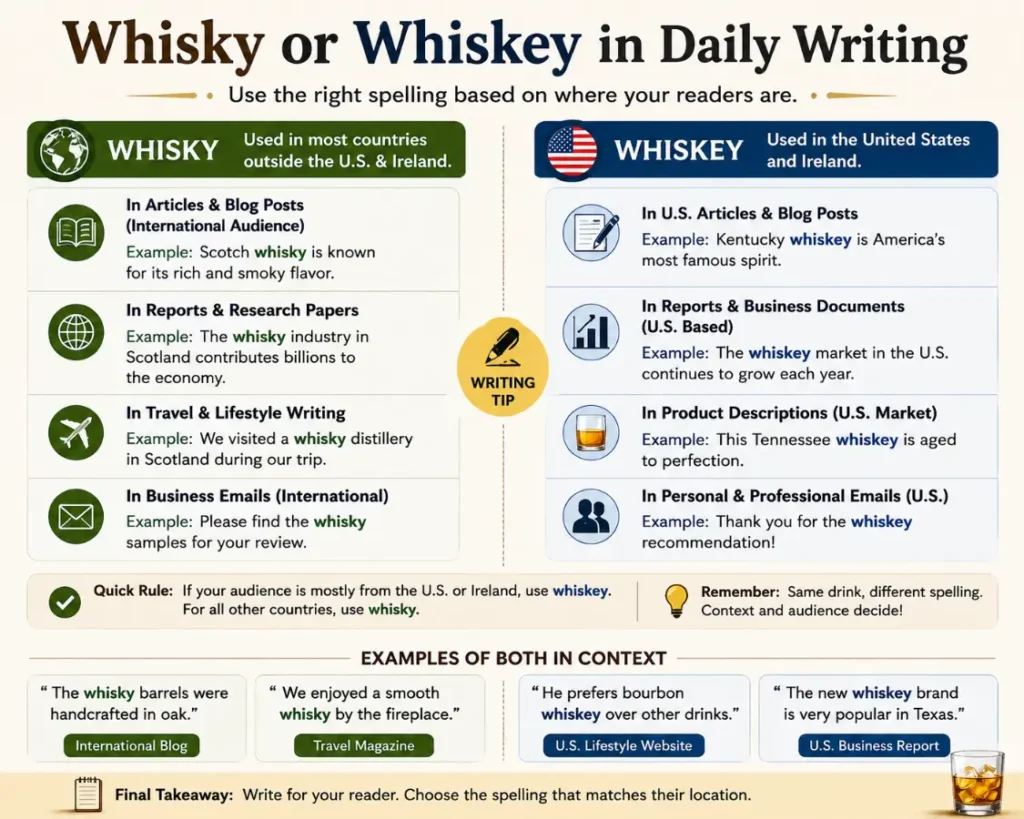
Whisky or Whiskey in Daily Writing
The correct choice depends on context.
If you write about Scotland, use whisky.
write about Ireland, use whiskey.
If you write about American bourbon, use whiskey.
If you write about Canada or Japan, whisky is generally appropriate.
For general discussions, you can use both terms when explaining the difference. You do not need to repeat both words in every sentence.
Natural writing matters more than keyword repetition.
Synonyms and Related Terms
There are several related words and phrases around this topic.
Useful semantic keywords include:
- whisky
- whiskey
- whisky vs whiskey
- whisky or whiskey
- whiskey vs whisky
- Scotch whisky
- Irish whiskey
- American whiskey
- bourbon
- rye whiskey
- Canadian whisky
- Japanese whisky
- grain spirit
- distilled spirit
- whisky spelling
- whiskey spelling
- regional whisky terms
- whisky terminology
- whiskey terminology
- whisky definition
- whiskey definition
These terms help search engines understand the topic’s context.
However, writers should use them naturally. Keyword stuffing can make an article harder to read.
Expert Insights: Why the Difference Matters
From an editorial perspective, spelling accuracy builds trust.
A reader may notice a spelling error immediately. This can weaken the credibility of an otherwise useful article.
Country-specific terminology also matters for search intent. Someone searching for “Scotch whisky” wants different information from someone searching for “bourbon whiskey.”
Good content should match that intent.
For brands, product pages, and technical articles, use the producer’s official terminology. For educational articles, explain regional differences clearly.
One more point matters for responsible publishing. Alcohol content should remain factual and educational for younger audiences. Laws about alcohol use vary by country. People should follow the laws where they live.
Frequently Asked Questions
Is whisky and whiskey the same thing?
They describe the same broad family of distilled spirits. The spelling often depends on regional tradition.
Which is correct, whisky or whiskey?
Both spellings are correct. Use the spelling that matches the country, style, or producer.
Why does Scotch use whisky?
Scotland traditionally uses the spelling whisky. The term has become part of Scotch’s established identity.
Why does Irish whiskey have an “e”?
Irish producers traditionally use whiskey. This spelling also became common in the United States.
Is bourbon whisky or whiskey?
Bourbon is a type of American whiskey. Therefore, whiskey is the standard spelling in this context.
Does whisky taste different from whiskey?
Spelling does not determine taste. Production methods, ingredients, maturation, and regional traditions affect the final character.
Is Japanese whisky spelled with an “e”?
Japanese producers generally use whisky. This tradition reflects the country’s historical links with Scotch whisky production.
Which spelling should I use in an article?
Use the spelling that matches your subject. Follow the official spelling for specific brands or products.
conclusion
In the debate over whisky or whiskey, both spellings are correct. The main difference comes from regional language and tradition. Whisky is commonly used in Scotland, Canada, and Japan. Whiskey is more common in Ireland and the United States.
The spelling can also provide a clue about the drink’s origin. However, it does not explain every difference in production, flavor, or quality. Different countries follow their own rules and traditions.
When writing about a specific drink, always use the spelling preferred by its producer or region. For example, use Scotch whisky, Irish whiskey, and American whiskey.
Ultimately, there is no single spelling that works everywhere. The best choice depends on context. Remember the country, check the official name, and use the correct regional spelling.