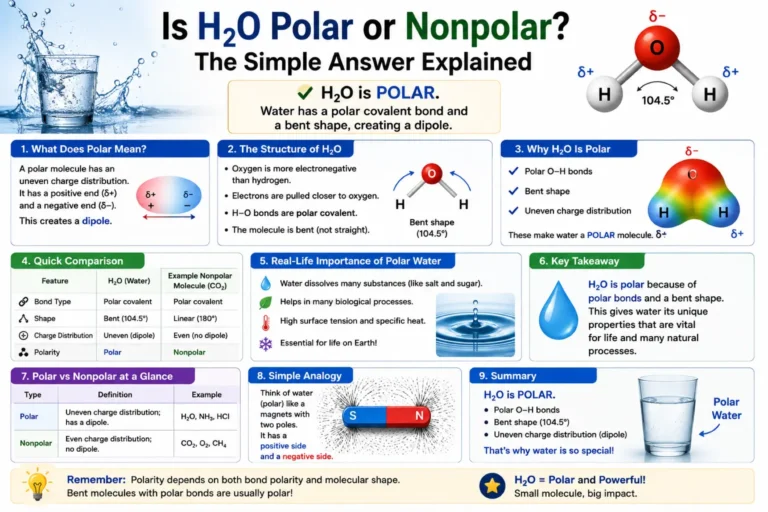
Is H2O polar or nonpolar? H2O, or water, is a polar molecule. This happens because water has an uneven charge across its structure. Oxygen pulls electrons more strongly than hydrogen does. As a result, oxygen gains a slight negative charge. The hydrogen atoms gain slight positive charges. Water also has a bent molecular shape. This shape keeps the charges from canceling each other out. Together, these features make water polar. Understanding water’s polarity helps explain many of its unique properties. It also explains why water mixes well with some substances. In this guide, you will learn why H2O is polar. You will also see simple examples, comparisons, and common mistakes. By the end, the answer should feel easy to remember.
Quick Summary
- H2O is a polar molecule.
- Water contains two hydrogen atoms and one oxygen atom.
- Oxygen attracts shared electrons more strongly than hydrogen.
- This creates partial positive and negative charges.
- Water has a bent molecular shape.
- Its shape prevents the charges from canceling out.
- Water’s polarity helps it dissolve many ionic and polar substances.
- Polarity also explains water’s surface tension and hydrogen bonding.
What Does Polar Mean in Chemistry?
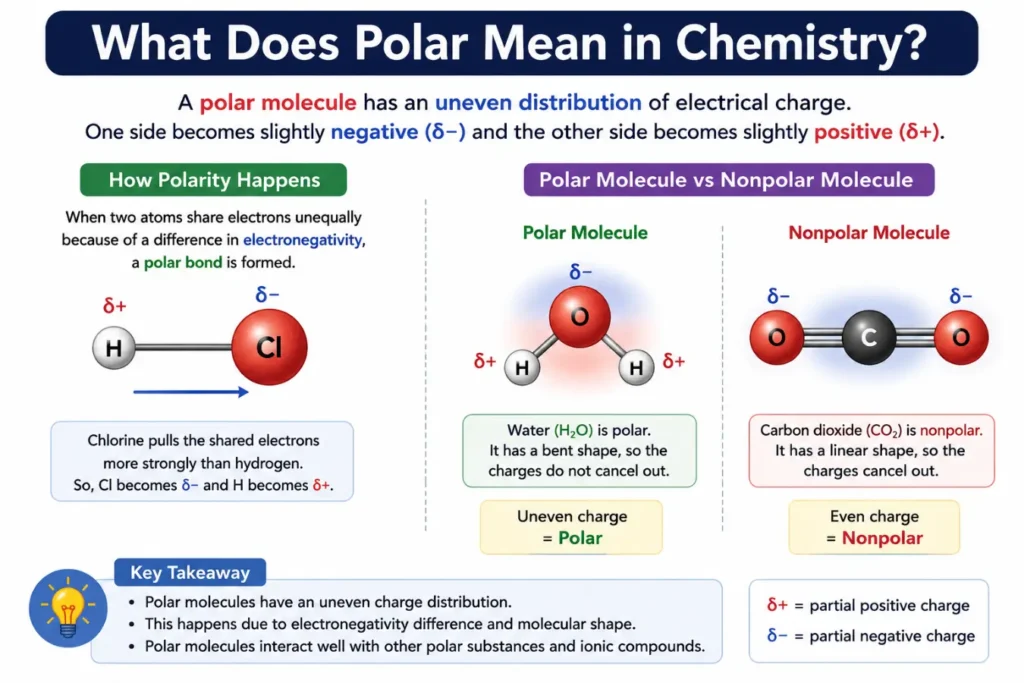
A polar molecule has an uneven distribution of electrical charge.
One side becomes slightly more negative. Another side becomes slightly more positive.
This difference comes from how atoms share electrons.
Atoms do not always pull shared electrons equally. The ability to attract electrons is called electronegativity.
When two atoms have different electronegativities, their shared electrons may move closer to one atom.
This creates partial charges.
Chemists often use the symbols δ− and δ+ for these partial charges.
A polar molecule does not have a full electrical charge. Instead, it has separated partial charges.
Is H2O Polar or Nonpolar?
H2O is polar.
Water has two O–H bonds. Oxygen attracts the shared electrons more strongly than hydrogen.
Therefore, each O–H bond is polar.
However, bond polarity alone does not determine molecular polarity.
You must also consider the molecule’s shape.
Water has a bent shape, not a straight shape.
Because of this shape, the two bond dipoles point in different directions without fully canceling.
The oxygen side remains slightly negative. The hydrogen side remains slightly positive.
Therefore, H2O has a net dipole moment.
Simple answer: H2O is polar because it has polar O–H bonds and a bent molecular shape.
Why Is Water Polar?
Three main ideas explain water’s polarity:
- Oxygen has higher electronegativity.
- The O–H bonds are polar.
- The molecule has a bent shape.
Oxygen pulls the shared electrons toward itself.
This gives oxygen a partial negative charge.
The hydrogen atoms then have partial positive charges.
Water also contains two lone pairs of electrons on oxygen.
These lone pairs affect the molecule’s shape.
The result is a bent structure.
If water were linear, the bond dipoles could cancel.
But water is not linear.
Therefore, its dipoles combine and create an overall molecular dipole.
What Is the Molecular Shape of H2O?
H2O has a bent molecular geometry.
The oxygen atom sits between the two hydrogen atoms.
However, the hydrogen atoms do not form a straight line.
The oxygen atom has two bonding pairs and two lone pairs.
These electron pairs repel one another.
The lone pairs push the O–H bonds closer together.
This creates the familiar bent shape of water.
The H–O–H bond angle is about 104.5 degrees.
This bent geometry plays a major role in water’s polarity.
How Electronegativity Makes H2O Polar
Electronegativity measures how strongly an atom attracts shared electrons.
Oxygen has a higher electronegativity than hydrogen.
Therefore, oxygen pulls electrons closer to itself.
The O–H bond becomes polar.
Oxygen gets a partial negative charge.
Hydrogen gets a partial positive charge.
Think of the electrons as spending more time near oxygen.
The charges are not equal on both sides of the molecule.
This uneven distribution creates a dipole.
Water therefore has a permanent molecular polarity.
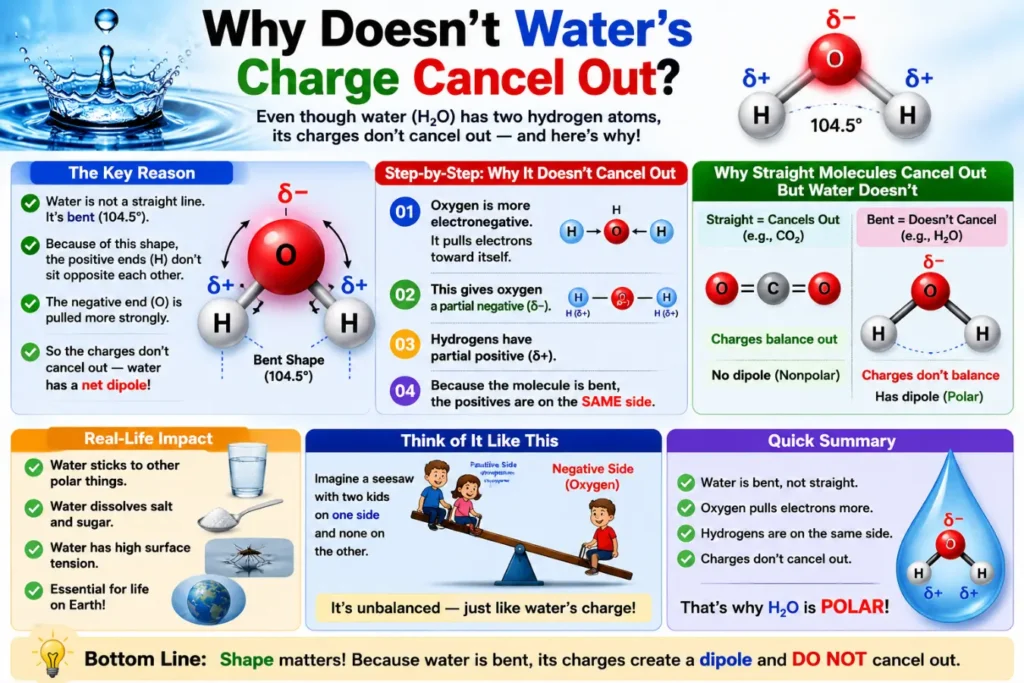
Why Doesn’t Water’s Charge Cancel Out?
This is a common chemistry question.
Water contains two O–H bonds.
Some students think the two bonds should cancel because they point in different directions.
That would happen only if the molecule had the right symmetrical shape.
Water has a bent shape.
The two bond dipoles point partly toward the same general region.
They do not cancel completely.
Instead, they combine into a net dipole.
That net dipole makes H2O polar.
Easy Memory Trick
Remember:
Polar bonds + bent shape = polar water.
This shortcut works well for basic chemistry questions.
H2O Polar vs Nonpolar: Comparison Table
| Feature | Polar H2O | Nonpolar Molecule |
|---|---|---|
| Charge distribution | Uneven | Even or balanced |
| Dipole moment | Present | Usually absent |
| Molecular shape | Bent | Depends on molecule |
| H2O example | Yes | No |
| Electron attraction | Uneven between O and H | Often more balanced |
| Water behavior | Mixes with many polar substances | Not typical of nonpolar substances |
A molecule can contain polar bonds but still be nonpolar.
For example, carbon dioxide has polar C=O bonds.
However, CO₂ has a linear and symmetrical shape.
Its bond dipoles cancel.
Therefore, CO₂ is nonpolar.
Water has a bent shape, so its dipoles do not cancel.
H2O vs CO2: Why Are They Different?
H2O and CO₂ both contain oxygen.
Yet they have different molecular polarities.
Water has a bent shape.
CO₂ has a linear shape.
The polar bonds in CO₂ point in opposite directions.
They cancel each other.
Water’s O–H bonds do not cancel.
Therefore:
- H2O = polar
- CO₂ = nonpolar
This comparison shows why molecular shape matters.
You cannot determine polarity by looking at bonds alone.
Real-Life Examples of Water’s Polarity
Water’s polarity affects many everyday experiences.
1. Salt Dissolving in Water
Table salt contains charged ions.
Water molecules surround these ions.
The positive and negative parts of water interact with the ions.
This helps salt dissolve.
2. Sugar Dissolving in Water
Sugar contains several polar groups.
Water can interact with these groups.
As a result, sugar dissolves well in water.
3. Oil and Water
Oil is mostly nonpolar.
Water is polar.
Their different properties make them separate instead of mixing evenly.
This creates the familiar oil-and-water effect.
4. Water Droplets
Water molecules attract one another.
This attraction contributes to surface tension.
It helps water form rounded droplets.
Why Does Water Dissolve So Many Substances?
Water is often called a universal solvent.
This name needs some care.
Water does not dissolve everything.
However, it dissolves many ionic and polar substances.
Its polarity helps explain this behavior.
The partially charged ends of water molecules attract charged particles.
Water can also form hydrogen bonds with many polar molecules.
These interactions help pull particles apart and surround them.
This process allows many substances to dissolve in water.
Common Mistakes About H2O Polarity
Mistake 1: “H2O Is Nonpolar Because It Has No Overall Charge”
This is incorrect.
A molecule can have no overall charge and still be polar.
Polarity concerns charge distribution, not total charge.
Mistake 2: “Two Polar Bonds Always Cancel”
Not always.
Molecular shape determines whether bond dipoles cancel.
Water has a bent structure.
Therefore, its dipoles do not cancel.
Mistake 3: “Oxygen and Hydrogen Share Electrons Equally”
They do not.
Oxygen attracts the shared electrons more strongly.
This creates polar O–H bonds.
Mistake 4: “Only the Bonds Matter”
Molecular geometry matters too.
Always consider both bond polarity and molecular shape.
Tips for Identifying Polar Molecules
Use this simple process during chemistry problems:
Step 1: Draw the Lewis Structure
Identify the atoms, bonds, and lone pairs.
Step 2: Check Electronegativity
Look for meaningful differences between bonded atoms.
Step 3: Identify Bond Polarity
Ask whether each bond has an uneven electron distribution.
Step 4: Find the Molecular Shape
Use the Lewis structure and electron-pair arrangement.
Step 5: Check for Symmetry
Ask whether the bond dipoles cancel.
Step 6: Decide Molecular Polarity
If the dipoles do not cancel, the molecule is polar.
For H2O, the result is clear:
Polar bonds + bent geometry = polar molecule.
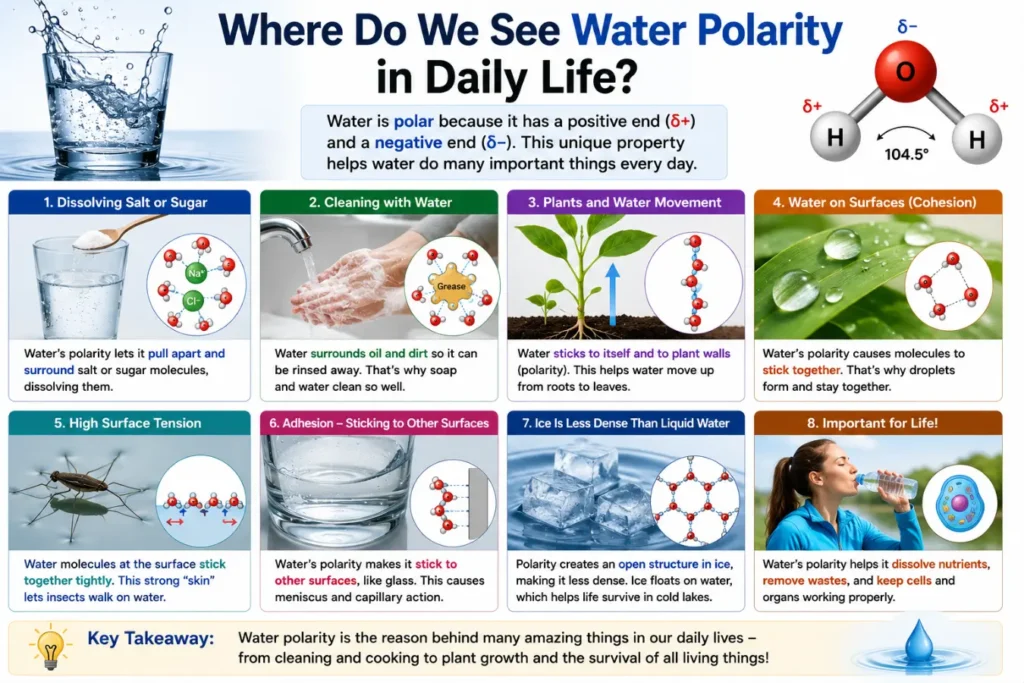
Where Do We See Water Polarity in Daily Life?
Water polarity affects many natural and everyday processes.
It helps water interact with minerals in soil.
It also helps living cells move dissolved substances.
Blood and other body fluids contain large amounts of water.
Many biological reactions occur in watery environments.
Water also supports hydrogen bonding.
This property contributes to water’s unusual physical behavior.
For example, water has relatively high surface tension.
It also has a high boiling point compared with similar small molecules.
These properties connect closely to intermolecular attractions.
H2O Polarity and Hydrogen Bonding
Water molecules can form hydrogen bonds with one another.
The slightly positive hydrogen side can attract the slightly negative oxygen side of another water molecule.
These attractions are not the same as the strong covalent bonds inside one water molecule.
Instead, they are intermolecular forces.
Hydrogen bonding helps explain several important water properties.
These include surface tension, cohesion, and water’s relatively high boiling point.
Therefore, H2O polarity has effects far beyond a chemistry classroom.
Synonyms and Related Search Terms
People may search for the same topic in different ways.
Useful semantic keywords include:
- Is water polar?
- Is H2O a polar molecule?
- Is H2O polar or nonpolar?
- Why is water polar?
- H2O molecular polarity
- water molecule polarity
- H2O dipole moment
- polarity of water
- H2O Lewis structure
- H2O molecular geometry
- water bond polarity
- polar vs nonpolar molecules
- why H2O is polar
- Is water polar or nonpolar and why?
- Does H2O have polar bonds?
These terms describe closely related chemistry concepts.
Use them naturally rather than repeating the primary keyword.
Expert Insight: Why H2O Polarity Matters
Understanding polarity gives you a useful chemistry foundation.
It helps explain solubility, intermolecular forces, and molecular interactions.
It also helps you understand biology and environmental science.
A strong way to analyze polarity is to separate two questions.
First, ask whether the bonds are polar.
Second, ask whether the molecular geometry cancels those bond dipoles.
This approach prevents many common mistakes.
For H2O, both clues point to the same answer.
The O–H bonds are polar.
The molecule is bent.
Therefore, H2O has a net dipole.
Expert tip: Never decide molecular polarity from electronegativity alone. Always check molecular geometry.
Frequently Asked Questions
Is H2O polar or nonpolar?
H2O is polar. Its O–H bonds are polar, and its bent shape prevents their dipoles from canceling.
Why is H2O a polar molecule?
Oxygen attracts shared electrons more strongly than hydrogen. Water’s bent shape creates an uneven charge distribution.
Does H2O have polar bonds?
Yes. Both O–H bonds are polar because oxygen has greater electronegativity than hydrogen.
What shape is H2O?
H2O has a bent molecular shape. Its bond angle is about 104.5 degrees.
Is water polar because of its shape?
Shape is one major reason. Water’s bent shape keeps its polar bond dipoles from canceling.
Is H2O more polar than CO2?
Yes, in terms of overall molecular polarity. H2O has a net dipole, while the linear CO₂ molecule has canceling bond dipoles.
Why does water mix with some substances but not oil?
Water is polar, while oil is mostly nonpolar. Their different molecular properties prevent them from mixing evenly.
How can I remember that H2O is polar?
Remember this phrase: “Water bends, so its dipoles stay.”
Conclusion
So, is H2O polar or nonpolar? H2O is polar.
Its polarity comes from two key factors.
First, oxygen attracts electrons more strongly than hydrogen.
This makes the O–H bonds polar.
Second, water has a bent molecular shape.
The bond dipoles therefore do not cancel.
Instead, water has a net dipole.
This polarity explains many important properties of water.
It helps water dissolve many polar and ionic substances.
It also supports hydrogen bonding between water molecules.
When solving polarity questions, remember to check both bonds and molecular shape.
Do not look at electronegativity alone.