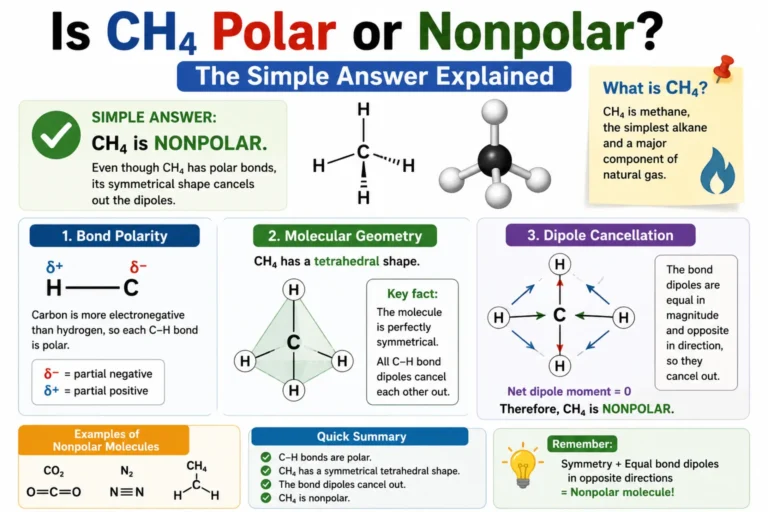
Is CH4 polar or nonpolar? CH4, or methane, is a nonpolar molecule. This result comes from its molecular shape and bond arrangement. Methane contains one carbon atom and four hydrogen atoms. The carbon atom forms four C–H bonds with hydrogen atoms. These bonds point toward the corners of a tetrahedral shape. The bond polarities balance each other because of this symmetrical structure. As a result, methane has no overall dipole moment.
Understanding CH4 polarity helps explain many chemistry concepts. It also makes molecular geometry easier to understand. In this guide, you will learn why CH4 is nonpolar. You will also see how electronegativity and molecular shape affect polarity. Simple examples will make the concept easier to remember. By the end, you can quickly decide whether CH4 is polar or nonpolar.
Quick Summary
- CH4 is a nonpolar molecule.
- CH4 stands for methane.
- Methane contains one carbon and four hydrogen atoms.
- Its molecular shape is tetrahedral.
- The four C–H bonds point in different directions.
- Their small bond polarities cancel out.
- CH4 has no net dipole moment.
- Molecular symmetry makes CH4 nonpolar.
- Methane is also a simple example of a nonpolar covalent molecule.
What Does CH4 Mean?
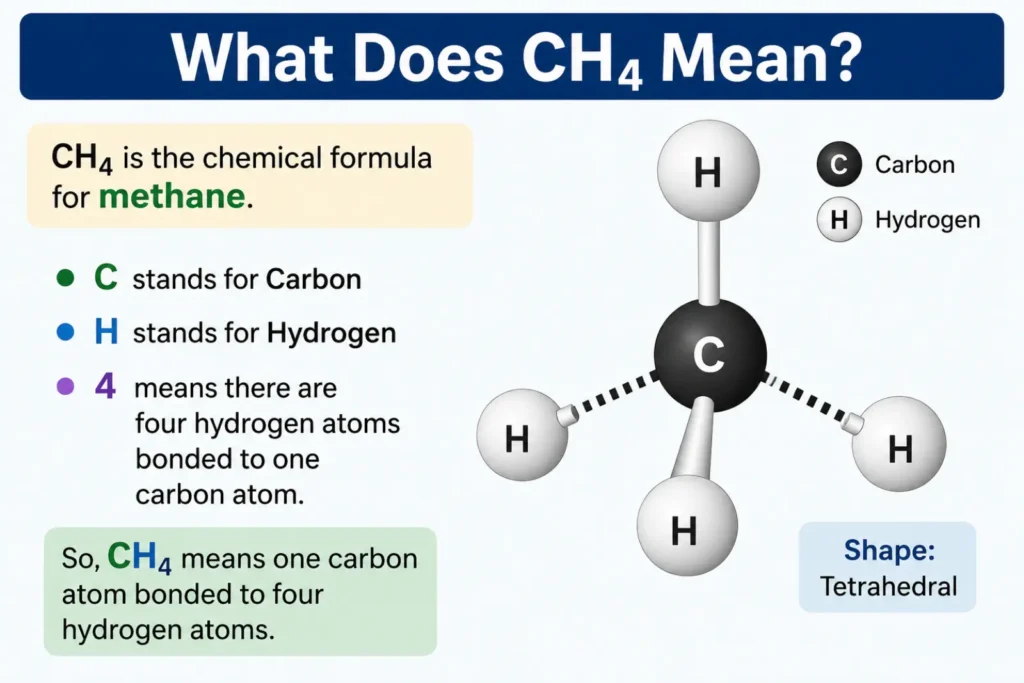
CH4 is the chemical formula for methane.
Methane contains two elements:
- One carbon atom
- Four hydrogen atoms
Carbon sits at the center of the molecule. Four hydrogen atoms surround the carbon atom.
Methane belongs to the alkane family. It has only single covalent bonds.
The carbon atom shares electrons with each hydrogen atom. This sharing creates four C–H bonds.
The formula looks simple. However, its three-dimensional shape explains its polarity.
Is CH4 Polar or Nonpolar?
CH4 is nonpolar.
The main reason is its symmetrical tetrahedral structure.
Each C–H bond has a small difference in electronegativity. Carbon attracts electrons slightly more strongly than hydrogen.
This can make each C–H bond slightly polar.
However, bond polarity does not always make a molecule polar.
You must also consider the molecule’s shape.
In CH4, the four bonds point in balanced directions. Their bond dipoles cancel each other.
Therefore, methane has zero net dipole moment.
Answer: CH4 is nonpolar.
Why Is CH4 Nonpolar?
CH4 is nonpolar because its four C–H bonds arrange symmetrically around carbon.
Think of four arrows pointing away from the carbon atom.
Each arrow represents a bond dipole.
The arrows point in different directions. Their effects balance one another.
This creates no overall charge separation across the molecule.
Therefore, CH4 does not have a permanent molecular dipole.
This idea gives us a useful rule:
A symmetrical molecule can have polar bonds but still be nonpolar.
That rule helps explain many chemistry questions.
What Is the Molecular Shape of CH4?
CH4 has a tetrahedral molecular geometry.
The carbon atom sits in the center. The four hydrogen atoms occupy the four corners of a tetrahedron.
The H–C–H bond angle is about 109.5 degrees.
This arrangement keeps the bonding pairs as far apart as possible.
The shape creates strong molecular symmetry.
That symmetry allows the individual bond dipoles to cancel.
So, molecular geometry plays a major role in determining CH4 polarity.
Are the C–H Bonds in CH4 Polar?
The C–H bonds have a small difference in electronegativity.
Carbon has a slightly higher electronegativity than hydrogen.
Therefore, the shared electrons stay slightly closer to carbon.
This gives the C–H bond a small polar character.
However, the entire CH4 molecule remains nonpolar.
Why?
Because all four C–H bonds have the same basic arrangement around carbon.
Their individual dipoles cancel.
So remember this distinction:
Polar bonds do not always produce a polar molecule.
CH4 Polarity Explained With Electronegativity
Electronegativity measures how strongly an atom attracts shared electrons.
Carbon has a higher electronegativity than hydrogen.
Therefore, carbon pulls the shared electrons slightly toward itself.
This creates a small bond dipole.
However, methane has four identical C–H bonds.
The bonds spread evenly around the central carbon atom.
Their dipole effects cancel.
As a result, CH4 has no overall molecular dipole.
This explains why methane is classified as a nonpolar molecule.
CH4 vs Other Common Molecules
| Molecule | Shape | Polar or Nonpolar? | Main Reason |
|---|---|---|---|
| CH4 | Tetrahedral | Nonpolar | Symmetrical structure |
| CO2 | Linear | Nonpolar | Bond dipoles cancel |
| H2O | Bent | Polar | Dipoles do not cancel |
| NH3 | Trigonal pyramidal | Polar | Asymmetrical structure |
| BF3 | Trigonal planar | Nonpolar | Symmetrical structure |
| CH3Cl | Tetrahedral | Polar | Different atoms break symmetry |
This comparison shows why molecular shape matters.
CH4 and CO2 both have polar bonds. Yet both molecules are nonpolar.
Water has polar bonds too. But its bent shape prevents cancellation.
CH4 vs CO2: Why Are Both Nonpolar?
CH4 and CO2 are both nonpolar molecules.
However, their shapes differ.
CH4 has a tetrahedral shape. CO2 has a linear shape.
In CO2, the two C=O bond dipoles point in opposite directions.
They cancel because the molecule is linear and symmetrical.
In CH4, four C–H bond dipoles cancel through its tetrahedral arrangement.
Thus, both molecules have zero net dipole moment.
The cancellation happens through different molecular geometries.
Real-Life Examples of CH4
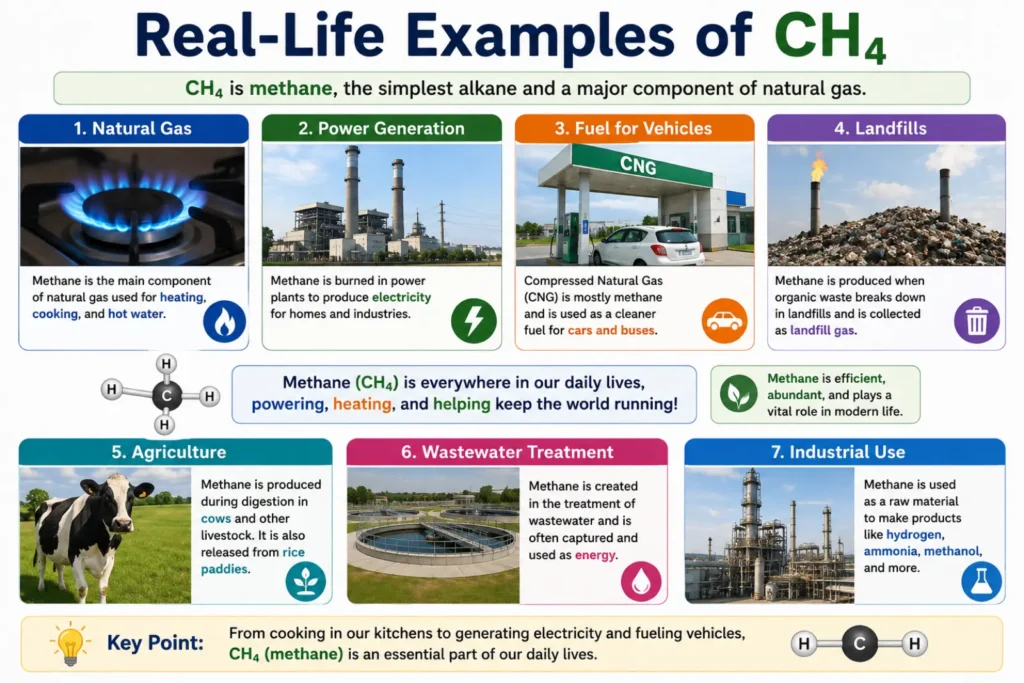
Methane occurs naturally in several places.
It forms when organic material breaks down without much oxygen.
Methane also exists in natural gas.
Some microorganisms produce methane in wetlands and other environments.
Methane also plays an important role in energy production.
For example, natural gas contains methane as its main component.
Its chemical properties make methane useful as a fuel.
Its nonpolar nature also affects how it interacts with other substances.
How Does CH4 Polarity Affect Solubility?
Polarity affects how substances interact with one another.
Polar substances often interact well with other polar substances.
Nonpolar substances tend to interact better with other nonpolar substances.
CH4 is nonpolar.
Therefore, it does not mix easily with highly polar substances such as water.
This idea connects with the chemistry rule:
“Like dissolves like.”
The rule does not explain every case. However, it provides a useful starting point.
Common Mistakes About CH4 Polarity
Students often make a few common mistakes.
Mistake 1: “C–H bonds have polarity, so CH4 is polar.”
This conclusion misses molecular geometry.
A molecule can contain polar bonds and still be nonpolar.
Mistake 2: Ignoring molecular shape
Polarity depends on both bond polarity and molecular arrangement.
Always check the shape before deciding.
Mistake 3: Thinking every tetrahedral molecule is nonpolar
Not every tetrahedral molecule has the same atoms.
For example, CH3Cl has a tetrahedral shape but is polar.
Different surrounding atoms can destroy symmetry.
Mistake 4: Looking only at electronegativity
Electronegativity helps identify bond polarity.
It does not alone determine molecular polarity.
You must also consider dipole cancellation.
Tips to Remember That CH4 Is Nonpolar
Use these simple steps during a chemistry test:
- Identify the molecule.
- Find the central atom.
- Identify the surrounding atoms.
- Determine the molecular geometry.
- Check the bond polarity.
- Look for symmetry.
- Decide whether dipoles cancel.
- State the final polarity.
For CH4, the process is simple.
The molecule has four identical surrounding atoms. Its shape is tetrahedral. The structure is symmetrical.
Therefore, the dipoles cancel.
CH4 = nonpolar.
CH4 Polarity: A Simple Trick
Try this memory trick:
“Four same bonds, balanced shape, no net dipole.”
CH4 has four hydrogen atoms around one carbon atom.
The structure remains highly symmetrical.
That symmetry balances the bond dipoles.
Therefore, methane is nonpolar.
For exams, remember:
CH4 → tetrahedral → symmetrical → dipoles cancel → nonpolar.
CH4 Polarity and Molecular Dipole Moment
A dipole moment measures charge separation within a molecule.
Polar molecules have a net dipole moment.
Nonpolar molecules have no permanent net dipole moment.
For CH4, the four bond dipoles cancel each other.
Therefore, methane has a net dipole moment of zero.
This gives another way to identify its polarity.
If the molecular dipoles cancel completely, the molecule is nonpolar.
CH4 in Daily Life
Methane has several practical uses.
It is a major component of natural gas.
People use natural gas for heating and cooking.
Methane can also generate electricity.
It also serves as an important chemical starting material.
Scientists study methane because it affects Earth’s atmosphere.
Methane absorbs infrared radiation and contributes to the greenhouse effect.
Thus, CH4 matters beyond basic chemistry lessons.
Synonyms and Related Search Terms
These related terms can help cover the broader search topic naturally:
- Is methane polar or nonpolar?
- CH4 polar or nonpolar molecule
- methane polarity
- CH4 molecular geometry
- methane molecular shape
- CH4 dipole moment
- C–H bond polarity
- methane electronegativity
- CH4 Lewis structure
- tetrahedral molecules
- polar and nonpolar molecules
- molecular polarity
- bond dipole
- net dipole moment
- methane chemical properties
These terms also help readers find related chemistry information.
Expert Insight: Why Molecular Shape Matters
A chemistry expert would not determine polarity from bonds alone.
The correct approach considers bond polarity and molecular geometry together.
First, identify differences in electronegativity.
Then, determine the three-dimensional molecular shape.
Finally, check whether the bond dipoles cancel.
CH4 provides a classic example.
Its C–H bonds have slight polarity. Yet its tetrahedral structure creates complete dipole cancellation.
This principle applies to many other molecules.
Learning this method is more useful than memorizing individual answers.
Frequently Asked Questions
Is CH4 polar or nonpolar?
CH4 is nonpolar. Its tetrahedral structure makes the bond dipoles cancel.
Why is methane nonpolar?
Methane has a symmetrical tetrahedral structure. The four C–H bond dipoles cancel each other.
Does CH4 have polar bonds?
The C–H bonds have a small difference in electronegativity. However, the molecule itself is nonpolar.
What is the shape of CH4?
CH4 has a tetrahedral molecular shape. Its bond angles are about 109.5 degrees.
Does CH4 have a dipole moment?
CH4 has no net dipole moment because its bond dipoles cancel.
Is methane soluble in water?
Methane has very low solubility in water. Its nonpolar nature contributes to this behavior.
Is CH4 a polar covalent molecule?
The C–H bonds have slight polar character. However, CH4 as a whole is classified as nonpolar.
Is CH4 more polar than H2O?
No. Water is polar, while CH4 is nonpolar. Their molecular shapes cause this difference.
Conclusion
Is CH4 polar or nonpolar? CH4 is nonpolar.
Methane has four C–H bonds around one carbon atom. The molecule has a symmetrical tetrahedral shape. Each C–H bond has a small difference in electronegativity. However, the four bond dipoles cancel each other.
Therefore, methane has no net dipole moment. This makes CH4 a nonpolar molecule.
The key lesson involves more than electronegativity. You must also consider molecular geometry. A molecule can contain slightly polar bonds and still be nonpolar.
For CH4, the easiest pattern to remember is simple:
Tetrahedral shape + symmetry + dipole cancellation = nonpolar CH4.