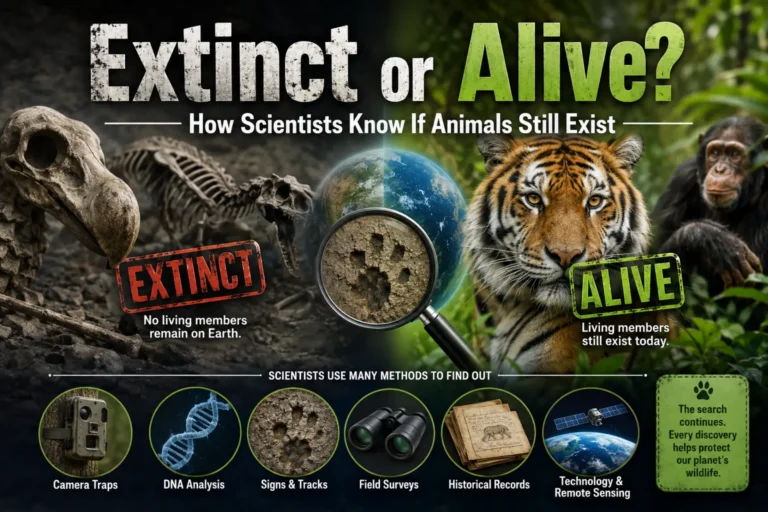
Extinct or alive is a fascinating topic about animals and plants that may have disappeared or survived against the odds. Some species become extinct when no living members remain anywhere on Earth. Others become extremely rare because of habitat loss, hunting, climate change, disease, or natural threats.
Sometimes, scientists believe a species has disappeared for many years. Then, an unexpected discovery proves that it is still alive. These rare events are called rediscoveries, and they can provide hope for wildlife conservation.
In this guide, we explore what extinct and alive really mean. We will also look at famous species that were rediscovered, animals currently at risk, and how scientists search for missing wildlife. Understanding these stories helps us see why protecting endangered species and their habitats is so important.
Quick Summary
- Extinct means no living members of a species remain.
- Alive means the species still has living members.
- Scientists need strong evidence before declaring a species extinct.
- Some animals return after scientists lose sight of them.
- These animals are called rediscovered species.
- Habitat loss remains a major threat to many species.
- Conservation can help endangered animals survive.
- A lack of sightings does not always prove extinction.
What Does “Extinct or Alive” Mean?
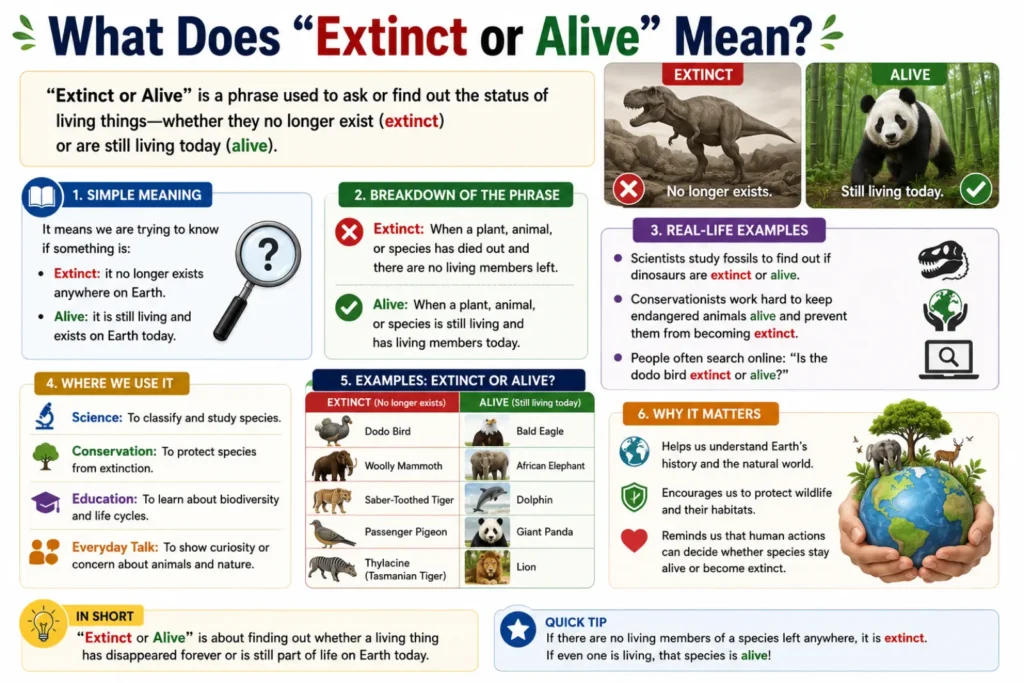
The phrase “extinct or alive” asks whether a species still exists today.
An animal is alive when living members still exist somewhere. They may live in forests, oceans, deserts, mountains, or other habitats.
An animal is extinct when no living members remain anywhere on Earth.
This question sounds simple. However, scientists sometimes need many years to find the answer.
Some animals live in remote places. Others have very small populations. Some species also hide well from humans.
Therefore, scientists carefully study all available evidence.
What Is an Extinct Species?
An extinct species has no surviving living members.
For example, the dodo became extinct centuries ago. No living dodos exist today.
The woolly mammoth also became extinct thousands of years ago. Scientists study fossils and other remains to understand it.
Extinction happens naturally sometimes. However, human activity can speed up the process.
Common causes include:
- Habitat destruction
- Hunting
- Pollution
- Climate change
- Invasive species
- Disease
- Loss of food sources
Once a species becomes truly extinct, scientists cannot bring back its natural population.
What Does It Mean When an Animal Is Alive?
An animal remains alive when at least one living member of its species exists.
Scientists may confirm this through:
- Direct sightings
- Camera-trap photographs
- Video recordings
- DNA evidence
- Physical remains
- Reliable observations
- Scientific surveys
A single report may not always prove survival.
For example, someone may report seeing a rare animal. Scientists then investigate the claim.
They may search the area for more evidence.
Strong evidence can confirm that the species still lives.
How Do Scientists Know If a Species Is Extinct?
Scientists use several methods to study species survival.
First, they examine historical records. These records show where people previously found the species.
Next, scientists search the animal’s known habitat.
They may use cameras, drones, environmental DNA, or tracking methods.
Researchers also study signs such as:
- Footprints
- Nests
- Droppings
- Feathers
- Feeding marks
- DNA traces
- Vocal sounds
Scientists usually need extensive searches before declaring extinction.
This process helps prevent mistakes.
Extinct or Alive: Key Differences
| Feature | Extinct | Alive |
|---|---|---|
| Living members | None remain | At least some remain |
| Evidence | Fossils or historical records | Recent evidence |
| Natural population | No longer exists | Still exists |
| Conservation | Cannot protect a natural population | Protection may help |
| Example | Dodo | Blue whale |
The biggest difference is simple.
Extinct species have no living members. Living species still have at least one surviving member.
Animals Once Thought Extinct but Found Alive
Some animals disappear for decades.
Scientists may search for them without success.
Then, someone discovers a living population.
These animals often receive attention as rediscovered species.
The Coelacanth
Scientists once believed the coelacanth disappeared millions of years ago.
Then, fishermen found a living coelacanth in the twentieth century.
This discovery changed scientific understanding.
The Takahe
The takahe is a flightless bird from New Zealand.
People once believed it had become extinct.
Later, researchers found a surviving population.
Conservation programs then helped protect the species.
The Fernandina Giant Tortoise
Scientists found evidence of a giant tortoise on Fernandina Island.
Researchers later confirmed that the species still survives.
This discovery showed why scientists continue searching remote habitats.
These examples prove an important point.
A species can disappear from human view without becoming extinct.
Why Do Animals Become Extinct?
Extinction usually happens when a species cannot survive changing conditions.
Human activity often creates serious pressure.
Habitat Loss
Animals need suitable places to live.
Farming, roads, cities, and construction can destroy natural habitats.
Hunting and Overuse
Some animals face heavy hunting pressure.
People may hunt them for food, trade, or other reasons.
Climate Change
Changing temperatures can affect food, water, and breeding conditions.
Some species cannot adapt quickly enough.
Pollution
Plastic, chemicals, and other pollutants can damage ecosystems.
Pollution may harm animals directly or destroy their food sources.
Invasive Species
New species can compete with native animals.
They may also introduce diseases.
Together, these threats can reduce populations.
Small populations face a higher risk of extinction.
Is a Rare Animal Extinct or Alive?
A rare animal is not automatically extinct.
Some species have very small populations.
They may live in places that humans rarely visit.
For example, an animal may live in:
- Deep forests
- High mountains
- Underground areas
- Deep oceans
- Remote islands
Scientists may not see these animals often.
However, new evidence can prove that they remain alive.
This is why “not seen” does not always mean “extinct.”
Common Mistakes About Extinct or Alive Animals
Many people misunderstand extinction.
Here are common mistakes to avoid.
Mistake 1: Assuming No Sightings Mean Extinction
A species may remain hidden for years.
Scientists need stronger evidence before confirming extinction.
Mistake 2: Believing Every Reported Sighting
Not every sighting is accurate.
People can mistake one animal for another.
Scientists must verify the evidence.
Mistake 3: Confusing Endangered With Extinct
An endangered animal still exists.
An extinct animal has no living members.
These terms have very different meanings.
Mistake 4: Thinking Extinction Happens Suddenly
Extinction often develops over many years.
Populations may slowly decline before disappearing completely.
Mistake 5: Ignoring Conservation Success
Some endangered animals recover with protection.
Conservation can help species avoid extinction.
How to Check If an Animal Is Extinct or Alive
You can follow a simple process.
Step 1: Check Reliable Scientific Sources
Look for information from trusted wildlife organizations and scientific databases.
Step 2: Check the Species’ Conservation Status
Experts often classify species by population and extinction risk.
Step 3: Look for Recent Evidence
Recent photographs, videos, DNA, or confirmed sightings can show survival.
Step 4: Check the Date of the Last Confirmed Record
Old records do not prove that an animal still lives today.
Step 5: Avoid Unverified Online Claims
Social media posts can spread false information.
Always check the source.
Extinct or Alive in Daily Life
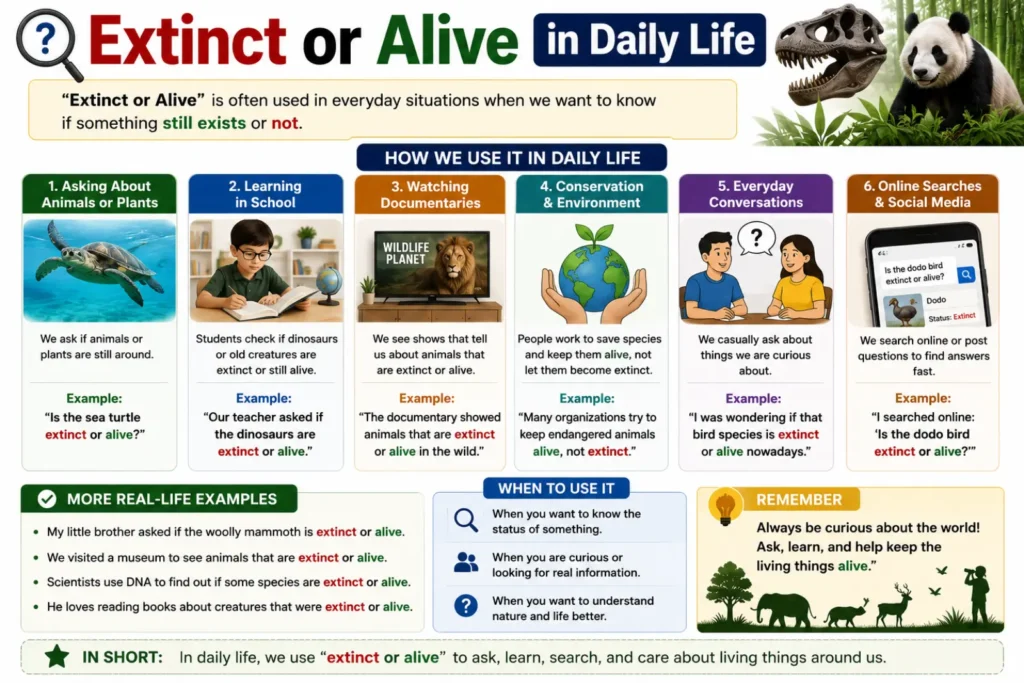
People use the phrase “extinct or alive” in many ways.
For example, someone may ask:
- Is this animal extinct or alive?
- Is this ancient species still alive?
- Are dinosaurs extinct or alive?
- Is this rare bird still alive?
- Which animals became extinct recently?
These questions often show curiosity about wildlife.
They also help people learn about conservation.
The phrase can also appear in quizzes, documentaries, educational websites, and wildlife discussions.
Extinct or Alive: Important Synonyms and LSI Keywords
Using related terms helps search engines understand the topic.
Useful semantic keywords include:
- extinct animals
- living species
- endangered species
- species extinction
- recently extinct animals
- rediscovered animals
- animals thought to be extinct
- rare wildlife
- extinct vs endangered
- species survival
- wildlife conservation
- last confirmed sighting
- extinct species list
- animals still alive today
Use these terms naturally.
Avoid repeating the primary keyword too often.
Good SEO focuses on meaning and helpful information.
Expert Insight
Experts study extinction because every species plays a role in nature.
Animals help ecosystems function.
They may spread seeds, control populations, or provide food for other species.
When one species disappears, the ecosystem can change.
Scientists also study rare species to prevent future extinctions.
Early conservation action can make a major difference.
The most important lesson is simple:
Scientists should not declare a species extinct without careful research.
A missing species may still survive in an unexplored habitat.
Real-Life Scenarios: Extinct or Alive?
Scenario 1: A Rare Bird Disappears
Scientists have not seen a rare bird for ten years.
They search its habitat and find fresh feathers.
The bird may still be alive.
More research can confirm its status.
Scenario 2: A Species Has No Recent Evidence
Scientists search its entire known habitat.
They find no animals, tracks, DNA, or other signs.
After extensive research, experts may consider extinction.
Scenario 3: A “New” Discovery Appears
People discover an animal believed extinct.
Scientists study the animal and compare its DNA.
If the evidence matches, the species may receive official recognition as rediscovered.
Frequently Asked Questions
What does “extinct or alive” mean?
It asks whether a species still has living members or has completely disappeared.
What is the difference between extinct and endangered?
An extinct species has no living members. An endangered species still exists but faces a high risk of extinction.
Can an extinct animal come back?
A species can only return naturally if living members still exist. A rediscovery can reveal that scientists previously missed a surviving population.
How long must scientists search before declaring extinction?
There is no single time period for every species. Scientists consider evidence, habitat, population history, and search efforts.
Can scientists find animals thought to be extinct?
Yes. Some species return to scientific attention after long periods without confirmed sightings.
Is a rare animal always endangered?
Not always. However, a small population often faces greater risks.
Why do animals become extinct?
Habitat loss, hunting, pollution, climate change, disease, and invasive species can cause extinction.
Why is preventing extinction important?
Every species supports its ecosystem in some way. Protecting wildlife also protects natural habitats and biodiversity.
Conclusion
The question “extinct or alive” helps us understand the survival of species. Extinct animals have no living members anywhere on Earth. Living species still have surviving members, even when populations remain very small.
Scientists use sightings, DNA, photographs, tracks, and other evidence to study species survival. They also search remote habitats before confirming extinction.
Some animals disappear for decades and later return to scientific attention. These rediscoveries remind us that nature still holds many secrets.
The best takeaway is simple: a species may be rare without being extinct. Careful research helps scientists find the truth. Conservation also gives threatened animals a better chance to survive.