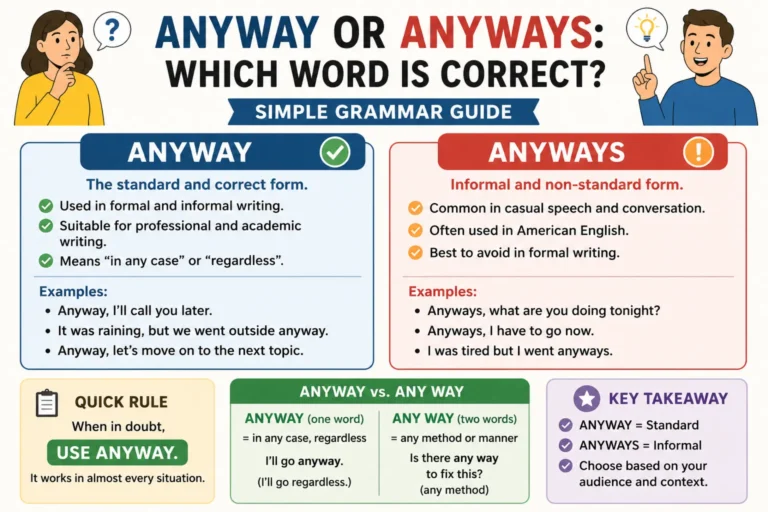
Anyway or anyways is a common English question. Many people use both words in daily speech. However, they do not always sound equally natural. Anyway is the standard choice in formal and informal English. Anyways is common in casual speech, especially in American English. Some speakers also use it for style or emphasis. But many grammar experts consider it nonstandard in formal writing. This guide explains the difference in simple terms. You will learn the correct meaning, usage, examples, and common mistakes. You will also see when to use anyway instead of anyways. By the end, choosing the right word will feel easy. Let us settle the anyway or anyways debate once and for all.
Quick Summary: Anyway or Anyways?
- Anyway is the standard form.
- Anyways is informal and less accepted in formal writing.
- Use anyway in school, work, and professional writing.
- Use anyways mainly in casual speech or informal conversations.
- Both words can mean “in any case” or “regardless.”
- Anyway often helps change the topic.
- Anyway can also mean “despite that.”
- When unsure, choose anyway.
What Does “Anyway” Mean?
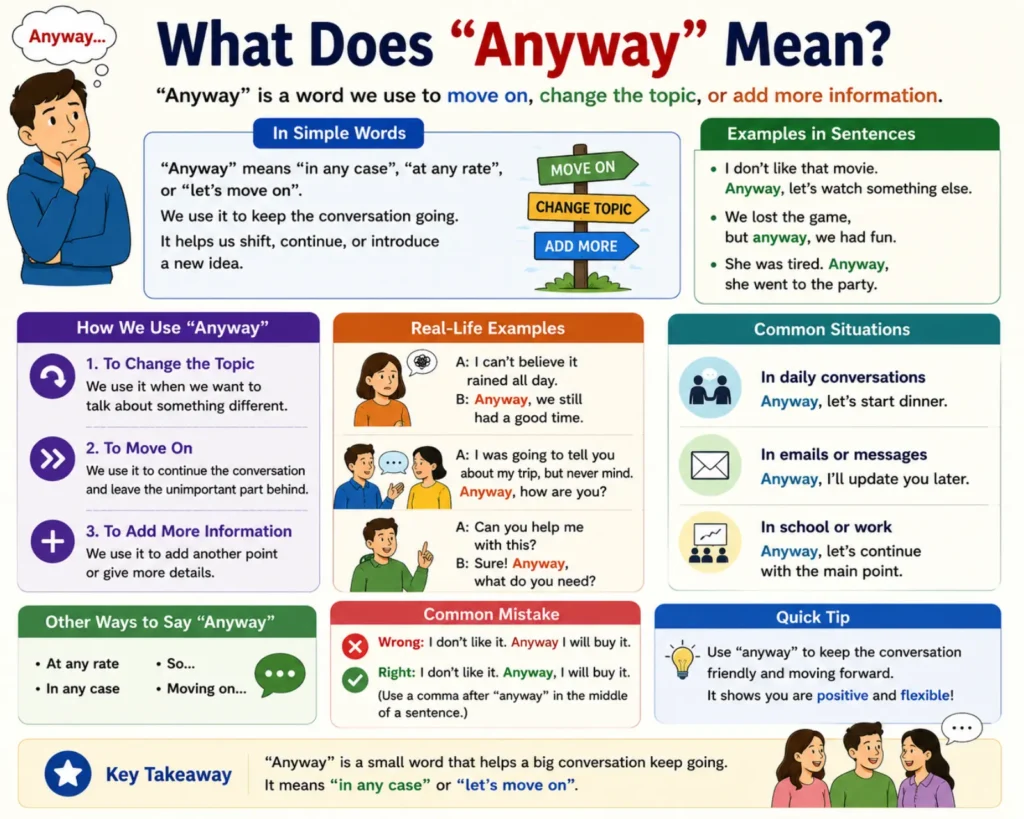
Anyway usually means “in any case,” “regardless,” or “despite that.”
It can show that something does not change the result.
Example:
It was raining, but we went outside anyway.
Here, anyway means “despite the rain.”
It can also help someone return to the main topic.
Example:
Anyway, let us talk about your new project.
In this sentence, anyway changes the conversation.
The word can also dismiss a minor detail.
Example:
I forgot the exact date. Anyway, the event was successful.
The speaker moves past the forgotten detail.
What Does “Anyways” Mean?
Anyways has the same basic meaning as anyway.
However, it sounds more casual.
Many people use it in everyday conversation.
Example:
Anyways, what are you doing tonight?
This sentence sounds informal and conversational.
You may hear anyways in movies, social media, and casual conversations.
However, it may sound less polished in formal writing.
For that reason, anyway remains the safer choice.
Anyway or Anyways: Which One Is Correct?
Anyway is the standard and generally preferred form.
Use it in formal writing, academic work, business communication, and professional content.
Anyways is common in informal English.
Some dictionaries recognize it as an informal variant.
However, many style guides still prefer anyway.
Simple rule:
When you are unsure, use “anyway.”
It works in almost every situation.
Examples:
- Anyway, I need to leave now. ✅
- Anyways, I need to leave now. Informal
- The plan failed, but we continued anyway. ✅
- The plan failed, but we continued anyways. Casual
Anyway vs. Anyways: Comparison Table
| Feature | Anyway | Anyways |
|---|---|---|
| Standard English | Yes | Less standard |
| Formal writing | Recommended | Usually avoid |
| Casual speech | Common | Common |
| Meaning | In any case or regardless | Usually the same |
| Professional writing | Best choice | Less suitable |
| Social media | Natural | Natural |
| Academic writing | Preferred | Usually avoid |
The main difference involves style and formality.
The meaning usually stays the same.
Anyway or Anyways in Real-Life Examples
Understanding real situations makes the difference easier.
1. Changing the Topic
Anyway, how was your weekend?
This usage moves the conversation forward.
Anyways also appears in casual speech.
Anyways, how was your weekend?
The second sentence sounds more relaxed.
2. Showing That Something Did Not Matter
I missed the first bus, but I arrived on time anyway.
Here, the missed bus did not change the final result.
3. Ending a Conversation
Anyway, I should get back to work.
This phrase can signal a conversation ending.
4. Returning to the Main Point
We had several problems. Anyway, the project finished successfully.
The speaker returns to the main idea.
How to Use “Anyway” Correctly
The word anyway has several common uses.
Use 1: Meaning “Regardless”
She was tired, but she finished the work anyway.
This means she finished despite feeling tired.
Use 2: Changing the Subject
Anyway, let us discuss the next question.
This usage helps shift the conversation.
Use 3: Returning to a Topic
Anyway, where were we?
This phrase returns to the previous discussion.
Use 4: Showing Little Importance
I do not know who said it. Anyway, it does not matter.
The speaker dismisses the small detail.
Use 5: Ending a Thought
It was not perfect, but I enjoyed it anyway.
The word adds a sense of acceptance.
How to Use “Anyways” Correctly
Use anyways mainly in relaxed conversations.
It often appears at the beginning of a sentence.
Examples:
Anyways, I have to go now.
Anyways, what happened next?
I was not sure about the plan, but I went anyways.
These sentences sound casual.
They may work well in texts, chats, and social media posts.
However, choose anyway for formal writing.
Avoid “anyways” in:
- Academic essays
- Business reports
- Formal emails
- Job applications
- Legal documents
- Professional articles
- School assignments
In these situations, anyway sounds more standard.
Why Do People Say “Anyways”?
Language changes through everyday use.
People often add -s to words during casual speech.
The same pattern appears in other informal expressions.
Some speakers use anyways for emphasis.
Others use it because they hear it frequently.
Regional speech also influences word choice.
In some English-speaking communities, anyways sounds completely natural.
However, formal English usually favors anyway.
So, the word choice often depends on context.
Common Mistakes With Anyway and Anyways
Mistake 1: Using “Anyways” in Formal Writing
Anyways, the results show a clear trend.
This sentence sounds casual.
Better:
Anyway, the results show a clear trend.
Mistake 2: Thinking “Anyways” Has a Different Meaning
Both words usually express the same idea.
The main difference involves tone and standard usage.
Mistake 3: Overusing “Anyway”
Some writers place anyway in every paragraph.
This can make writing sound repetitive.
Use it only when it adds meaning.
Mistake 4: Confusing “Anyway” With “Any Way”
These forms have different meanings.
Anyway
Means “regardless” or “in any case.”
I will go anyway.
Any way
Means “any method” or “any possible method.”
Is there any way to fix this problem?
This difference matters.
Anyway vs. Any Way: An Important Difference
Many learners confuse these two expressions.
“Anyway” as One Word
We decided to continue anyway.
Meaning: We continued regardless.
“Any way” as Two Words
Is there any way to contact her?
Meaning: Is there any method to contact her?
Quick Test
Ask yourself this question:
Do I mean “regardless”?
If yes, use anyway.
Do I mean “any method”?
If yes, use any way.
Compare:
I will finish the work anyway.
Is there any way to finish the work faster?
The meanings clearly differ.
Anyway or Anyways in Daily Life
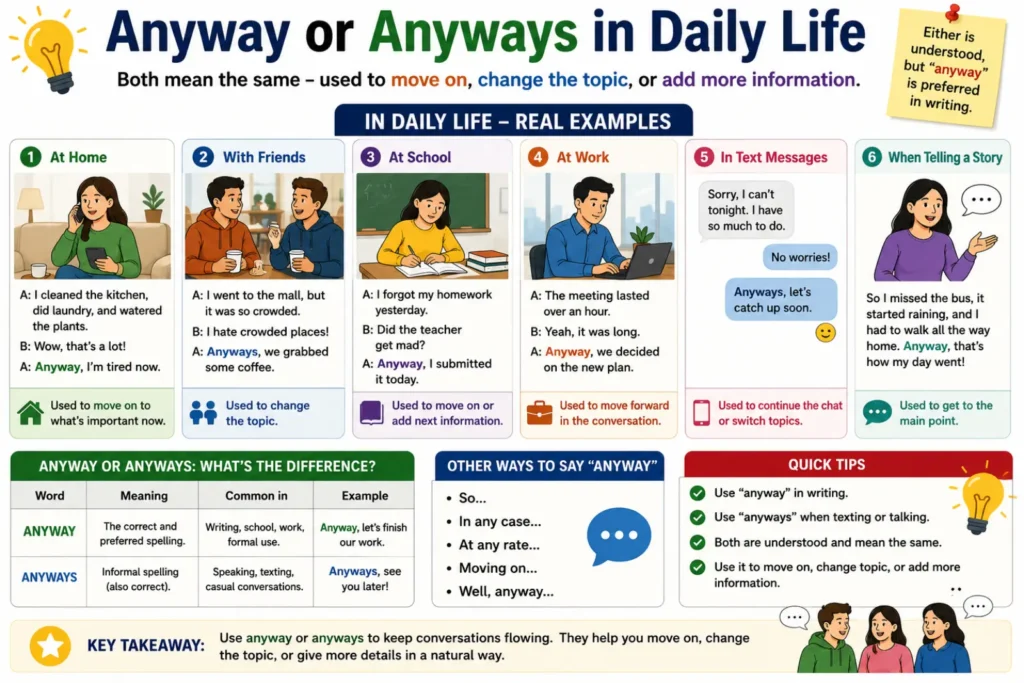
You can hear both forms in everyday conversations.
However, anyway remains more versatile.
In Text Messages
Anyway, I will call you later.
Both forms may sound natural.
In Social Media
Anyways, here is what happened.
This casual style is common online.
At School
Anyway, the experiment produced interesting results.
Use anyway in assignments.
At Work
Anyway, let us review the final proposal.
Use anyway in professional communication.
In Conversation
I was busy, but I went anyway.
This sounds natural and standard.
Synonyms and Related Words
Several words and phrases share similar meanings.
Synonyms for “Anyway”
- Regardless
- In any case
- Nevertheless
- Still
- Even so
- At any rate
- All the same
Each synonym has a slightly different tone.
Examples:
It was difficult. Nevertheless, we continued.
It was difficult. Even so, we continued.
It was difficult. We continued anyway.
These sentences share a similar meaning.
Related Search Terms
Natural semantic variations include:
- anyway meaning
- anyways meaning
- anyway vs anyways grammar
- is anyways a word
- is anyways grammatically correct
- anyway or anyways which is correct
- when to use anyway
- anyway definition and examples
- any way vs anyway
- informal English words
These phrases help explain the topic clearly.
Expert Tips for Choosing the Right Word
Here are simple expert-style grammar tips.
Tip 1: Choose “Anyway” by Default
It works in both formal and informal settings.
Tip 2: Match the Word to Your Audience
Casual speech allows more flexibility.
Professional writing needs greater precision.
Tip 3: Avoid “Anyways” in Important Documents
The word may sound less polished.
Tip 4: Check the Meaning
Do not confuse anyway with any way.
Tip 5: Read the Sentence Aloud
Natural language often becomes easier to identify.
If the sentence sounds too casual, use anyway.
Expert Insight
Good grammar depends on more than dictionary definitions.
Context also shapes how readers understand a word.
Anyway gives writers a safe, standard choice.
Anyways can add a casual conversational tone.
Therefore, strong writers choose based on audience and purpose.
Is “Anyways” Grammatically Correct?
Anyways is widely used in informal English.
Some dictionaries list it as an informal variant of anyway.
However, many formal writing standards prefer anyway.
Therefore, calling anyways completely “wrong” oversimplifies the issue.
The better answer depends on context.
Use anyway for formal and professional writing.
Use anyways when casual speech matches your style.
Is “Anyways” a Real Word?
Yes, anyways appears in English usage.
Many people use it in everyday speech.
However, it remains less formal than anyway.
Some speakers also use it for regional or conversational effect.
So, it is a real word in modern usage.
Still, anyway remains the standard choice.
Which Is Better in Formal Writing?
Anyway is better for formal writing.
Use it in:
- Essays
- Reports
- Articles
- Business emails
- Applications
- Presentations
- Professional documents
Example:
Anyway, the data supports the original conclusion.
This sentence sounds clear and professional.
Less Formal:
Anyways, the data supports the original conclusion.
The meaning remains clear.
However, the tone sounds more conversational.
Frequently Asked Questions
Is “anyway” or “anyways” correct?
Anyway is the standard form. Anyways is informal and less commonly preferred in formal writing.
Is “anyways” grammatically wrong?
Not always. People commonly use it in informal English. However, anyway is safer for formal writing.
Can I use “anyways” in an essay?
You can, but it usually sounds too informal. Anyway is the better choice for academic writing.
What is the difference between anyway and anyways?
The meaning is usually the same. The main difference involves formality and style.
Is “anyways” American English?
It appears frequently in American English. However, people use it in other English-speaking regions too.
Should I say “anyway” in a professional email?
Yes. Anyway is the preferred choice in professional communication.
What is the difference between “anyway” and “any way”?
Anyway means “regardless.” Any way means “any method or manner.”
Which word should English learners use?
English learners should usually choose anyway. It works in almost every context.
conclusion
The answer is simple.
Anyway is the standard and safest choice.
Use it in formal writing, professional communication, schoolwork, and most online content.
Anyways is common in casual speech.
It can sound natural in conversations, texts, and informal posts.
However, it may sound less polished in formal situations.
The two words usually share the same basic meaning.
The main difference involves tone and accepted usage.
Also remember the difference between anyway and any way.
The first means “regardless.”
The second means “any method.”
When you face the anyway or anyways question, choose anyway when unsure. It works almost everywhere. Use anyways only when a casual tone fits your audience. That simple rule will help you write clearer English.