Freshman or freshmen is a common grammar question for students, teachers, and English learners. Many people use these words interchangeably, but they have different meanings. Using the correct word makes your writing clear and professional.
The good news is that the difference is simple. Freshman refers to one person, while freshmen refers to more than one person. Once you know this rule, you can avoid common mistakes in school, college, and everyday writing.
In this guide, you’ll learn the meaning of each word, when to use them, common grammar mistakes, real-life examples, and expert tips. By the end, you’ll know exactly whether to write freshman or freshmen in any sentence.
Quick Summary
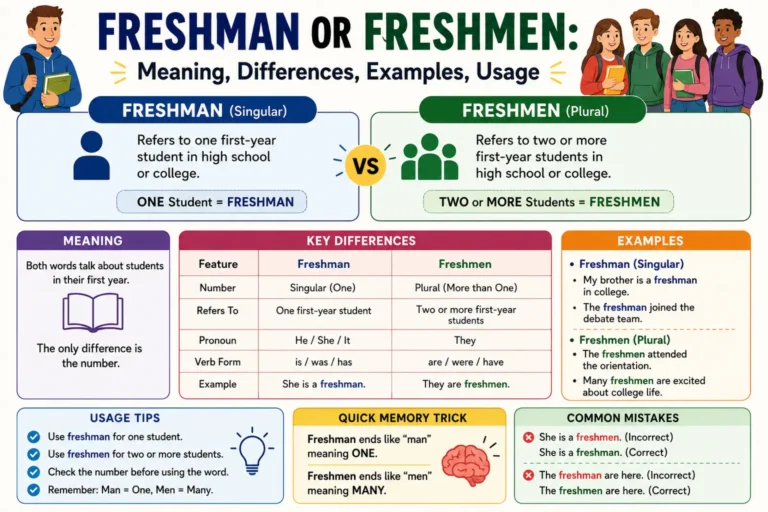
- Freshman = one first-year student.
- Freshmen = two or more first-year students.
- Both words usually describe students in high school or college.
- Use freshman for singular nouns.
- Use freshmen for plural nouns.
- Remember: One = freshman, Many = freshmen.
What Does Freshman Mean?
A freshman is a student in the first year of high school or college.
The word refers to one person.
Examples
- Emma is a freshman at college.
- My brother became a freshman this year.
- Every freshman attended the orientation.
- The freshman joined the soccer team.
A freshman is just beginning a new academic journey.
What Does Freshmen Mean?
Freshmen is the plural form of freshman.
It refers to two or more first-year students.
Examples
- The freshmen met their teachers.
- Hundreds of freshmen attended the welcome event.
- Freshmen often need help finding classrooms.
- The university welcomed new freshmen today.
Whenever you talk about a group, use freshmen.
Freshman vs Freshmen
Although the words look similar, they serve different purposes.
| Feature | Freshman | Freshmen |
|---|---|---|
| Meaning | One first-year student | More than one first-year student |
| Number | Singular | Plural |
| Refers To | One person | A group of students |
| Example | Sarah is a freshman. | Sarah and Jake are freshmen. |
Easy Rule
- One student = Freshman
- Two or more students = Freshmen
This simple rule works every time.
Why Do People Confuse Freshman and Freshmen?
Many English learners confuse these words because they differ by only two letters.
Here are the main reasons:
- They sound similar.
- People type quickly.
- Some writers forget singular and plural forms.
- English has many irregular plural words.
Fortunately, remembering one simple rule solves the problem.
Freshman = One
Freshmen = Many
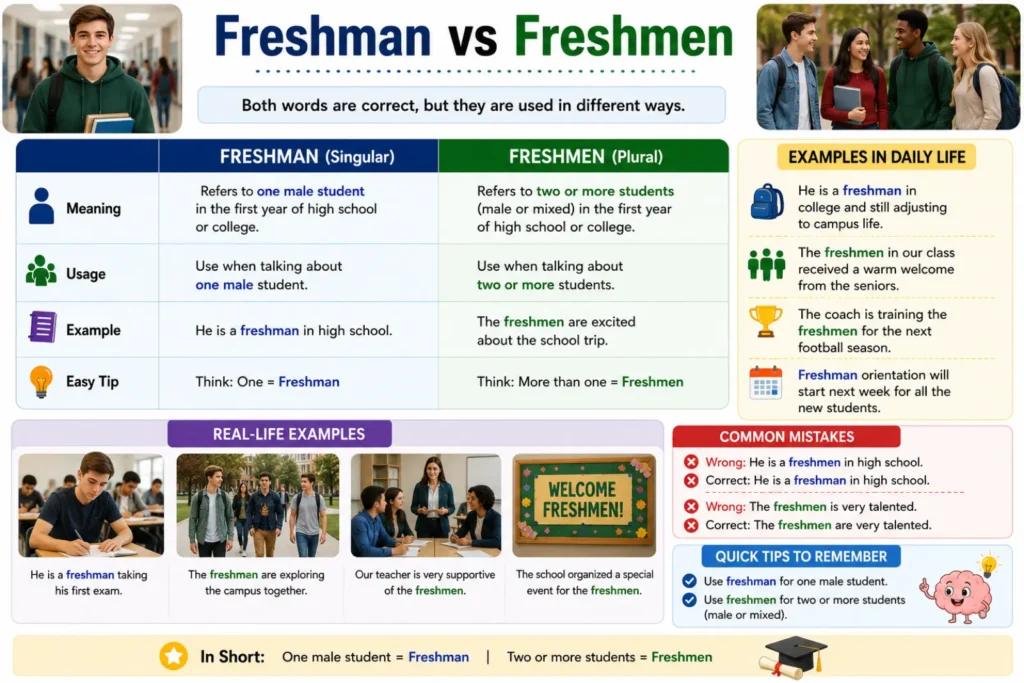
Real-Life Examples
Let’s see how these words appear in everyday situations.
At School
- My sister is a freshman this year.
- The freshmen attended the school assembly.
At College
- Every freshman received a student ID.
- Freshmen explored the campus together.
During Sports
- The freshman joined the basketball team.
- Several freshmen made the varsity team.
On Social Media
- I can’t believe I’m finally a freshman!
- Welcome, freshmen! Have an amazing first year.
When Should You Use Freshman?
Use freshman whenever you talk about one first-year student.
Examples:
- He is a freshman at Harvard.
- The freshman completed the assignment.
- Our neighbor is a freshman in high school.
- Every freshman receives a handbook.
If only one student is involved, choose freshman.
When Should You Use Freshmen?
Use freshmen whenever you refer to two or more first-year students.
Examples:
- The freshmen attended orientation.
- Many freshmen live on campus.
- Freshmen should arrive early.
- Teachers welcomed the freshmen warmly.
If the subject is plural, use freshmen.
Freshman or Freshmen in Everyday Writing
You may use these words in many situations.
Examples include:
- School assignments
- College applications
- University websites
- Student newspapers
- Emails
- Social media posts
- Academic reports
Using the correct word helps readers understand your message immediately.
Simple Memory Trick
Need an easy way to remember?
Think about these clues:
- Freshman ends like man. It means one person.
- Freshmen ends like men. It means many people.
Just remember:
Man = One
Men = Many
This trick helps you choose the correct word every time.
Common Mistakes When Using Freshman and Freshmen
Many writers mix up freshman and freshmen. These mistakes are easy to fix once you know the rule.
Mistake 1: Using freshmen for one student
❌ She is a freshmen.
✅ She is a freshman.
Mistake 2: Using freshman for several students
❌ The freshman attended the welcome event.
✅ The freshmen attended the welcome event.
Mistake 3: Forgetting Subject-Verb Agreement
❌ The freshmen is excited.
✅ The freshmen are excited.
❌ The freshman are excited.
✅ The freshman is excited.
Always match the noun with the correct verb.
Tips to Remember the Difference
These simple tips can help you avoid mistakes.
- Freshman = One student
- Freshmen = More than one student
- Think of man → one person.
- Think of men → many people.
- Read your sentence aloud.
- Check whether the noun is singular or plural.
With practice, choosing the correct word becomes automatic.
Freshman or Freshmen in Daily Life
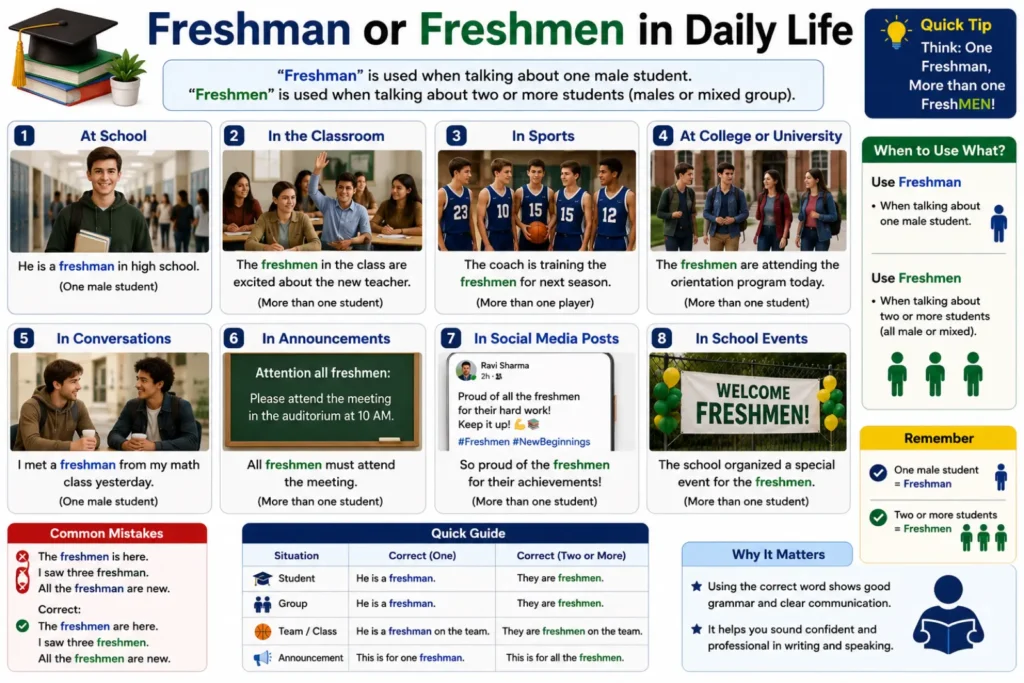
These words appear in many everyday situations.
At School
Teachers welcome new freshmen every year.
At College
Students often introduce themselves by saying, “I’m a freshman.”
In News Articles
Schools report how many freshmen enrolled.
On Social Media
Students post messages like:
- “I’m officially a freshman!”
- “Good luck to all freshmen this semester.”
Correct grammar makes your writing look more polished and professional.
Synonyms and Related Words
Depending on your audience, you can use these alternatives.
Synonyms for Freshman
- First-year student
- First-year college student
- First-year high school student
- New student
- Beginner student
Many colleges now prefer first-year student because it is gender-neutral.
LSI and Semantic Keywords
Search engines understand related words as well as your primary keyword. Including them naturally helps improve SEO.
Use terms such as:
- freshman vs freshmen
- freshman meaning
- freshmen meaning
- difference between freshman and freshmen
- first-year student
- college freshman
- high school freshman
- freshman grammar
- freshmen grammar
- singular and plural nouns
- English grammar rules
- correct word usage
- grammar examples
- common English mistakes
Use these naturally throughout your article instead of forcing them into every paragraph.
Expert Insight
Grammar may seem like a small detail, but it shapes how others see your writing.
Students, teachers, employers, and admissions officers all notice clear communication. Using freshman and freshmen correctly shows that you understand basic English grammar.
Many universities now use the term first-year student in official publications because it is inclusive. However, freshman and freshmen are still widely accepted in everyday English, journalism, and casual conversation. Knowing both forms helps you write for different audiences with confidence.
(FAQs)
1. What is the difference between freshman and freshmen?
Freshman refers to one first-year student. Freshmen refers to two or more first-year students.
2. Is freshman singular or plural?
Freshman is singular.
Example:
My sister is a freshman.
3. Is freshmen singular or plural?
Freshmen is plural.
Example:
The freshmen attended orientation.
4. Can I use freshman for college and high school?
Yes. The word can describe a first-year student in either high school or college.
5. Is first-year student the same as freshman?
Yes. Both describe someone in the first year of study. Many schools now prefer first-year student because it is gender-neutral.
6. Which word is more formal?
First-year student is often preferred in formal or official writing. Freshman remains common in everyday English.
7. How can I remember the difference?
Remember this simple rule:
- Man = One = Freshman
- Men = Many = Freshmen
8. Are freshman and freshmen still used today?
Yes. Both words are still widely used in schools, colleges, newspapers, and everyday conversations, although some institutions prefer first-year student.
conclusion
Choosing between freshman or freshmen is easier than it looks. The only difference is the number of students you are talking about. Use freshman for one first-year student and freshmen for two or more.
This small grammar rule can improve your writing in school, college, and professional settings. It also helps readers understand your message without confusion.
If you ever feel unsure, remember this simple trick:
One student = Freshman
Many students = Freshmen
With regular practice, you’ll use both words correctly every time.