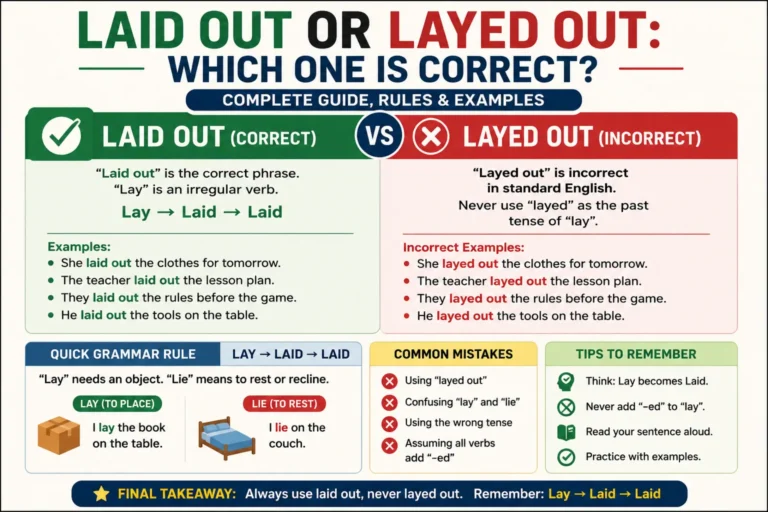
Laid out or layed out is a common grammar question. Many English learners and native speakers get confused by these words. They look similar, but only one is correct in standard English.
The correct phrase is laid out. The phrase layed out is almost always incorrect. The confusion happens because English verbs can change in unusual ways. Learning the difference helps you write with confidence.
In this guide, you will learn the meaning of laid out, why layed out is wrong, and when to use each form correctly. You will also see simple examples, a comparison table, common mistakes, and expert grammar tips. By the end, you will know exactly which phrase to use.
Quick Summary Box
- Laid out is the correct phrase.
- Layed out is incorrect in standard English.
- Lay is the present tense verb.
- Laid is the past tense and past participle of lay.
- Use laid out when something was arranged or placed.
- Never use layed out in formal writing.
- Remember: Lay → Laid → Laid.
What Does “Laid Out” Mean?
Laid out means arranged, organized, placed, or presented in a clear way.
People use it when they describe putting something in order or explaining something carefully.
Examples
- She laid out the clothes for tomorrow.
- The teacher laid out the lesson plan.
- They laid out the rules before the game.
- He laid out the tools on the table.
Is “Layed Out” Correct?
No.
Layed out is not correct in standard English grammar.
Many people assume adding -ed creates the past tense. However, the verb lay is irregular.
The correct forms are:
- Present: Lay
- Past: Laid
- Past Participle: Laid
Because of this rule, you should always write laid out, not layed out.
Why Do People Say “Layed Out”?
Many English verbs form the past tense by adding -ed.
Examples include:
- Walk → Walked
- Jump → Jumped
- Clean → Cleaned
People expect lay to become layed.
However, English has many irregular verbs.
The verb lay follows its own pattern.
That is why laid is the correct past tense.
Laid Out vs Layed Out: Comparison Table
| Feature | Laid Out | Layed Out |
|---|---|---|
| Correct Grammar | ✅ Yes | ❌ No |
| Standard English | ✅ Yes | ❌ No |
| Used by Native Writers | ✅ Yes | Rarely |
| Accepted in School | ✅ Yes | ❌ No |
| Accepted in Business Writing | ✅ Yes | ❌ No |
| Should You Use It? | Always | Never |
Understanding the Verb “Lay”
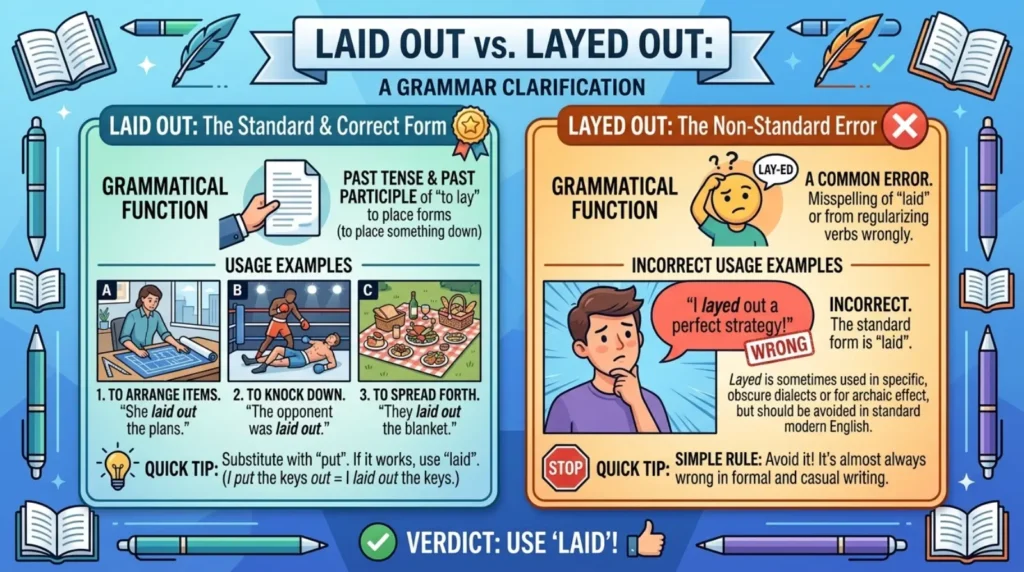
The verb lay means to put or place something somewhere.
It usually needs an object.
Examples
- I lay the book on the desk.
- She lays the baby in the crib.
- They lay the cards on the table.
Past tense:
- I laid the book on the desk yesterday.
Simple Grammar Rule to Remember
The easiest way to remember the rule is this:
Lay → Laid → Laid
Never write:
❌ Layed
Always write:
✅ Laid
This simple rule works almost every time.
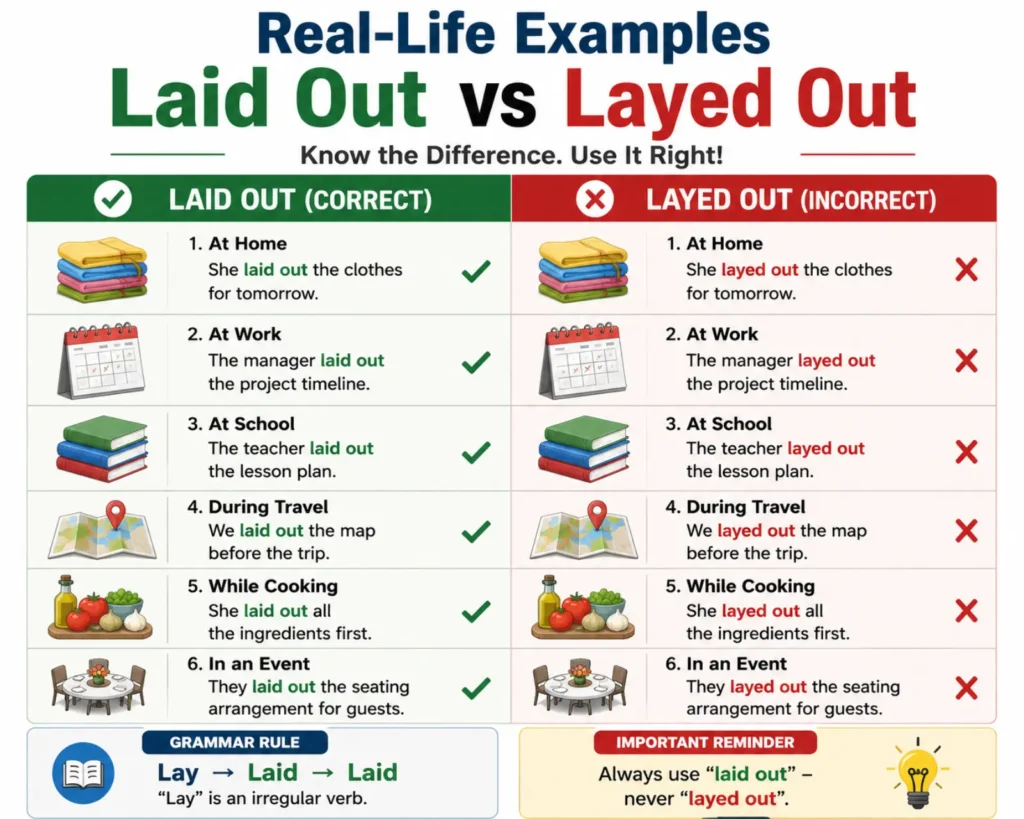
Real-Life Examples
Here are common situations where people use laid out.
At Home
Mom laid out everyone’s clothes.
At Work
The manager laid out the project timeline.
At School
The teacher laid out today’s lesson.
During Travel
We laid out the map before driving.
While Cooking
She laid out all the ingredients first.
Common Mistakes to Avoid
Many writers make these grammar mistakes.
Writing “Layed Out”
This is the most common mistake.
Correct:
- She laid out the plans.
Incorrect:
- She layed out the plans.
Confusing “Lay” and “Lie”
These verbs have different meanings.
Lay
Means to place something.
Lie
Means to rest or recline.
Example:
- I lay the phone on the desk.
- I lie on the couch.
Using the Wrong Tense
Remember the verb forms.
Present:
- Lay
Past:
- Laid
Past Participle:
- Laid
Tips to Remember the Correct Form
These tricks make grammar easier.
- Think: Lay becomes Laid.
- Never add -ed to lay.
- Read your sentence aloud.
- Use grammar tools to double-check.
- Practice with short sentences every day.
How Is “Laid Out” Used in Daily Life?
People use laid out in many situations.
Examples include:
- Planning events
- Organizing documents
- Decorating rooms
- Preparing meals
- Explaining ideas
- Creating business plans
- Writing reports
- Designing websites
The phrase appears in both spoken and written English.
Similar Expressions and Synonyms
These phrases have similar meanings.
Synonyms
- Arranged
- Organized
- Presented
- Displayed
- Positioned
- Spread out
- Prepared
- Planned
- Set up
- Explained
LSI Keywords and Related Search Terms
Use these naturally throughout your writing.
Related Keywords
- laid meaning
- laid vs lay
- lay or laid
- layed meaning
- correct grammar
- English grammar rules
- past tense of lay
- laid definition
- grammar mistakes
- lay verb forms
- grammar examples
- proper English writing
- grammar checker
- common English errors
Expert Insights
Grammar experts agree that laid out is the correct phrase in modern English.
Major dictionaries and style guides recognize laid as the past tense of lay.
Using the correct form improves your writing. It also helps readers trust your work.
Whether you write emails, blog posts, essays, or business documents, proper grammar creates a stronger impression.
Small grammar improvements often make writing sound more professional.
(FAQs)
Is “laid out” correct?
Yes. Laid out is the correct phrase in English.
Is “layed out” ever correct?
No. Standard English does not accept layed out.
Why is “laid” correct instead of “layed”?
Because lay is an irregular verb. Its past tense is laid.
What does “laid out” mean?
It means arranged, organized, explained, or placed.
Is “laid out” formal?
Yes. You can use it in formal and informal writing.
What is the past tense of “lay”?
The past tense is laid.
How can I remember the difference?
Remember this pattern:
Lay → Laid → Laid
Do grammar checkers flag “layed out”?
Yes. Most grammar tools suggest replacing layed out with laid out.
Conclusion
Many people search for laid out or layed out because the words sound similar. However, the answer is simple. Laid out is the correct phrase, while layed out is incorrect in standard English. The verb lay follows an irregular pattern, so its past tense is laid, not layed. Once you remember Lay → Laid → Laid, choosing the right form becomes easy. Using correct grammar improves your writing, builds credibility, and helps readers understand your message. Whether you write for school, work, or online, using laid out shows attention to detail. Keep practicing with real examples, and this grammar rule will soon become second nature.