The greater or equal to sign is one of the most useful math symbols. It helps compare two numbers or values. You will see it in school, exams, spreadsheets, programming, and real life.
Many students confuse this symbol with other comparison signs. However, learning it is easy once you know what it means. This guide explains everything in simple words. You will learn the definition, symbol, examples, common mistakes, and practical uses.
By the end of this article, you will know exactly when and how to use the greater or equal to sign with confidence.
Quick Summary
Featured Snippet: Greater or Equal to Sign
- The greater or equal to sign is ≥.
- It means one value is greater than or equal to another value.
- Example: 8 ≥ 5 means 8 is greater than 5.
- Example: 5 ≥ 5 means both numbers are equal.
- It combines the greater than (>) and equal to (=) symbols.
- It is widely used in mathematics, algebra, programming, statistics, and spreadsheets.
What Is the Greater or Equal to Sign?
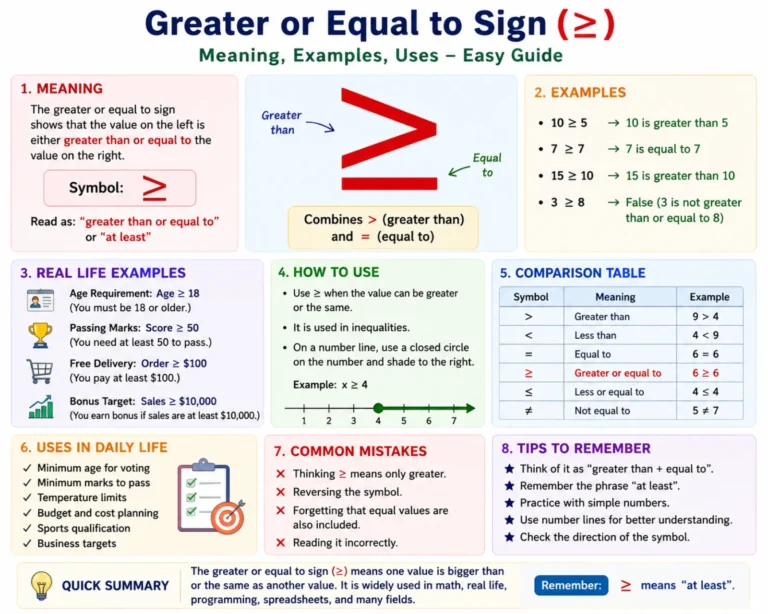
The greater or equal to sign (≥) compares two numbers or expressions.
It tells us that the number on the left is either:
- Bigger than the number on the right, or
- Exactly equal to it.
Formula
A ≥ B
This means:
- A is greater than B, or
- A equals B.
Examples
- 10 ≥ 4 ✔
- 9 ≥ 9 ✔
- 3 ≥ 7 ✘
What Does the Greater or Equal to Sign Mean?
The symbol ≥ combines two ideas into one.
- Greater than (>)
- Equal to (=)
Instead of writing two separate conditions, you use one symbol.
For example:
Age ≥ 18
This means a person must be:
- Older than 18, or
- Exactly 18 years old.
How to Read the Greater or Equal to Sign
You can read the symbol in different ways.
| Symbol | Read As | Meaning |
|---|---|---|
| ≥ | Greater than or equal to | Bigger or the same |
| x ≥ 20 | x is greater than or equal to 20 | x is at least 20 |
| Score ≥ 80 | Score is greater than or equal to 80 | Minimum score is 80 |
People often say “at least” when they see this symbol.
Greater or Equal to Sign vs Other Comparison Symbols
Understanding similar symbols helps avoid mistakes.
| Symbol | Meaning | Example |
|---|---|---|
| > | Greater than | 9 > 4 |
| < | Less than | 4 < 9 |
| = | Equal to | 6 = 6 |
| ≥ | Greater than or equal to | 6 ≥ 6 |
| ≤ | Less than or equal to | 4 ≤ 4 |
| ≠ | Not equal to | 5 ≠ 7 |
Key Difference
- > means only greater.
- ≥ means greater or equal.
Real-Life Examples of the Greater or Equal to Sign
You use this symbol more often than you think.
School Grades
Pass marks:
Score ≥ 50
Anyone scoring 50 or more passes.
Age Requirement
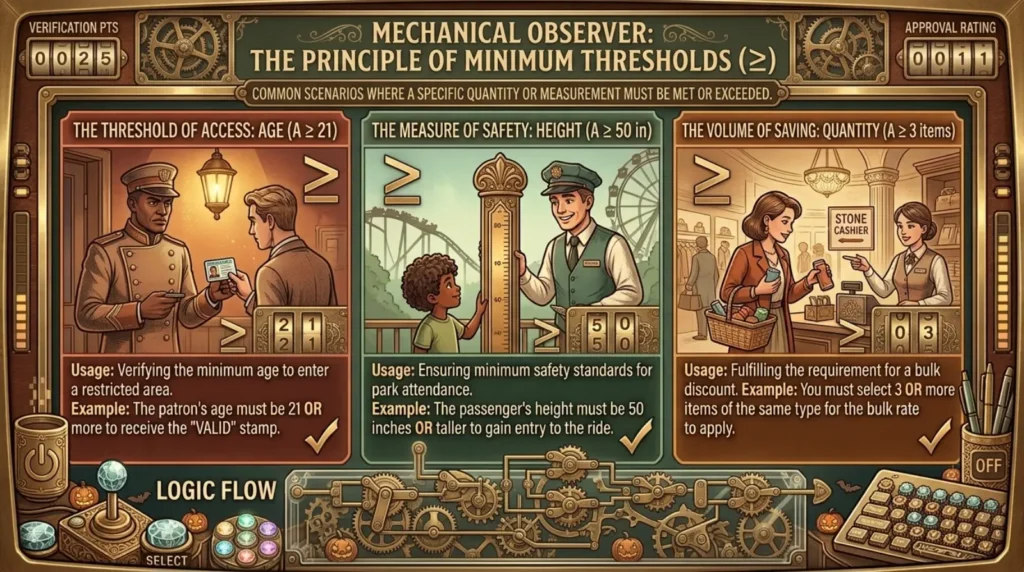
Driving license:
Age ≥ 18
People aged 18 or older can apply.
Shopping
Free delivery:
Order ≥ $100
Orders of $100 or more qualify.
Sports
Qualification:
Points ≥ 30
Teams with 30 or more points qualify.
Business
Bonus eligibility:
Sales ≥ $10,000
Employees reaching this target earn bonuses.
How to Use the Greater or Equal to Sign in Math
This symbol appears in many math topics.
Algebra
Example:
x ≥ 7
Possible values:
- 7
- 8
- 9
- 10
Inequalities
Example:
2x ≥ 12
Solve:
Divide both sides by 2.
x ≥ 6
Graphs
On a number line:
- Put a closed circle on the number.
- Shade toward larger numbers.
Example:
x ≥ 4
The circle is filled at 4.
Greater or Equal to Sign in Programming
Many programming languages use this operator.
Examples include:
- Python
- Java
- JavaScript
- C++
- C#
Example:
if age >= 18:
    print("Eligible")
The program checks whether the age is 18 or higher.
Greater or Equal to Sign in Excel and Google Sheets
Spreadsheets use the symbol in formulas.
Example:
=A1>=50Result:
- TRUE
- FALSE
Another example:
=IF(A1>=60,"Pass","Fail")This checks whether the score meets the passing mark.
Common Mistakes When Using the Greater or Equal to Sign
Many beginners make simple errors.
1. Mixing ≥ with >
Wrong idea:
≥ means only greater.
Correct:
It also includes equality.
2. Reversing the Symbol
Incorrect:
5 ≤ 7 when you mean 7 is greater.
Always check the direction.
3. Forgetting Equal Values
Example:
10 ≥ 10
This is correct.
Many students think it is wrong.
4. Reading It Incorrectly
Do not read:
“Greater and equal.”
Read:
“Greater than or equal to.”
Tips to Remember the Greater or Equal to Sign
These tricks make learning easier.
- Think of it as greater than plus equal.
- Remember the phrase at least.
- Practice with simple numbers.
- Compare objects around you.
- Use number lines for visual learning.
The more you practice, the easier it becomes.
Synonyms and Related Keywords
These terms relate to the greater or equal to sign.
LSI Keywords
- greater than or equal to symbol
- ≥ symbol
- inequality symbol
- comparison operator
- math symbols
- greater than sign
- less than or equal to sign
- inequality examples
- mathematical comparison
- algebra inequality
- comparison symbols
- greater than or equal operator
- at least symbol
- numeric comparison
- inequality notation
These keywords help readers understand related concepts.
When Should You Use the Greater or Equal to Sign?
Use it whenever equality is allowed.
Examples include:
- Minimum age
- Minimum score
- Minimum salary
- Product weight
- Attendance requirement
- Temperature limits
- Budget planning
- Business goals
Whenever you mean at least, this symbol is usually the correct choice.
Expert Insights:
The greater or equal to sign builds a strong foundation in mathematics. Students use it in algebra, geometry, calculus, statistics, and data analysis. Professionals rely on it in finance, engineering, programming, and business reporting.
Understanding this symbol also improves logical thinking. It helps you compare values, set limits, and solve real-world problems accurately. Learning comparison symbols early makes advanced math and coding much easier.
(FAQs)
What is the greater or equal to sign?
The greater or equal to sign is ≥. It means one value is greater than or equal to another value.
How do you type the greater or equal to sign?
You can insert it using your device’s symbol menu, character map, or keyboard shortcuts, depending on your operating system and application.
What is an example of the greater or equal to sign?
15 ≥ 10 means 15 is greater than 10.
Another example is 10 ≥ 10, which means both values are equal.
What is the difference between > and ≥?
The > symbol means only greater.
The ≥ symbol means greater or equal.
Is 8 greater than or equal to 8?
Yes.
8 ≥ 8 is true because both numbers are equal.
Where is the greater or equal to sign used?
It is used in mathematics, algebra, programming, statistics, spreadsheets, finance, engineering, and everyday comparisons.
What does “at least” mean in math?
“At least” usually means greater than or equal to (≥).
For example:
Age ≥ 18
Conclusion
The greater or equal to sign is a simple but powerful comparison symbol. It tells you that one value is either larger than another or exactly the same. You will find it in mathematics, programming, spreadsheets, science, and everyday situations. Once you understand that ≥ means greater than or equal to, solving inequalities and comparing numbers becomes much easier. Practice with real-life examples, remember the phrase “at least,” and pay attention to the direction of the symbol. With regular practice, you will recognize and use the greater or equal to sign quickly and accurately in both schoolwork and real-world tasks.