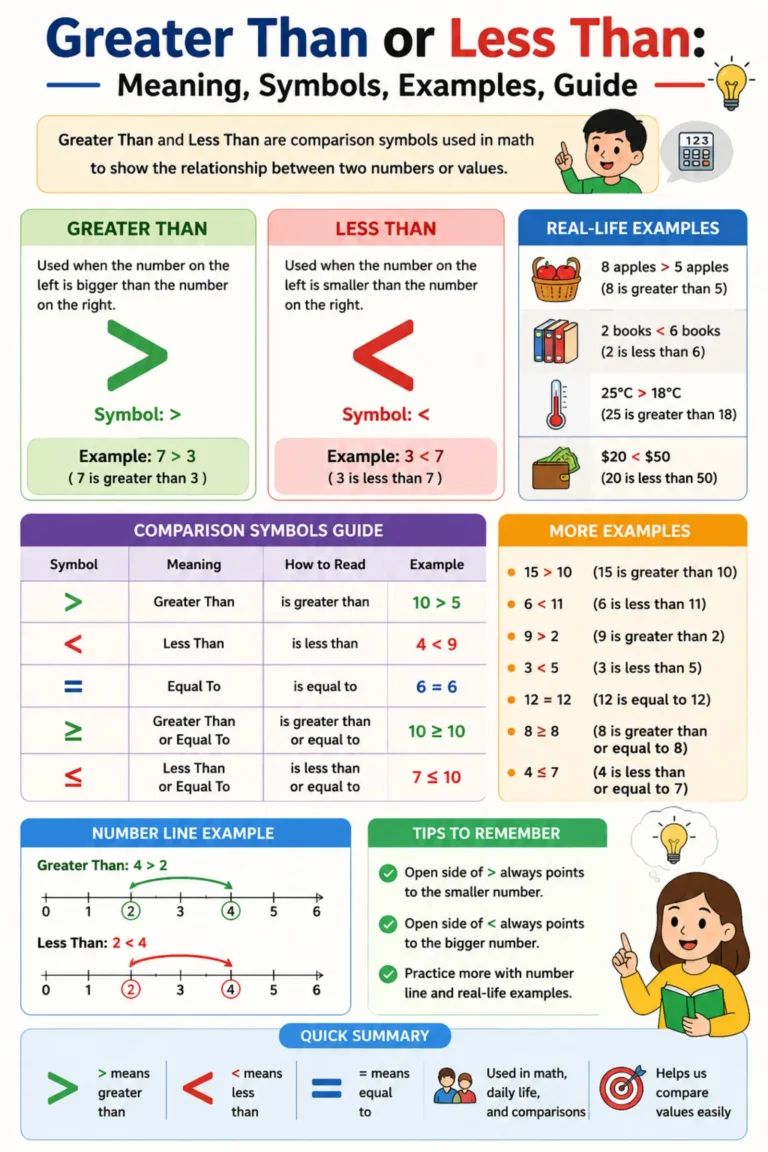
Greater than or less than is one of the first math concepts students learn. It helps us compare two numbers quickly and correctly. You use these symbols in school, shopping, budgeting, and many daily tasks. Learning them is simple when you know what each symbol means. Many students confuse the signs at first. However, a few easy tricks can solve that problem. This guide explains everything in clear, simple language. You will learn the meaning of each symbol, see real-life examples, avoid common mistakes, and practice using them with confidence. By the end of this article, you will understand greater than or less than without feeling confused.
Quick Summary
Featured Snippet: What Does Greater Than or Less Than Mean?
- Greater than (>) means one number is bigger than another.
- Less than (<) means one number is smaller than another.
- Equal to (=) means both numbers have the same value.
- The open side of the symbol always faces the larger number.
- These symbols help compare numbers, amounts, prices, ages, and measurements.
What Is Greater Than or Less Than?
Greater than or less than refers to symbols used to compare two numbers.
- Greater than (>) shows the first number is larger.
- Less than (<) shows the first number is smaller.
- Equal to (=) shows both numbers are the same.
Examples
- 9 > 4
- 3 < 8
- 12 = 12
These comparison symbols make math easier and faster.
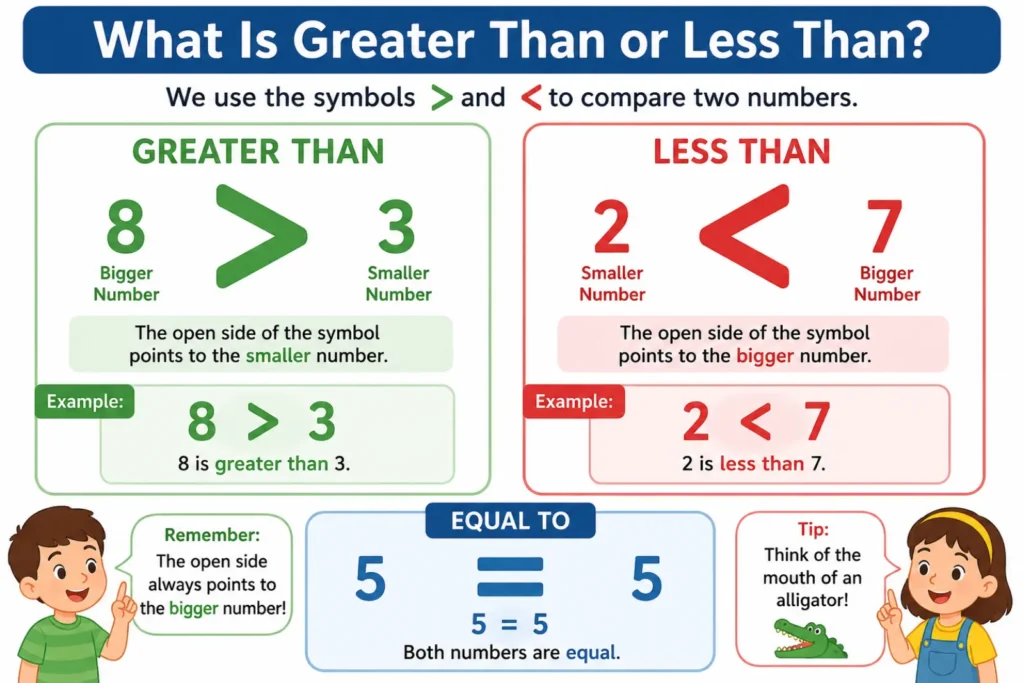
Understanding the Greater Than and Less Than Symbols
The symbols may look similar, but they have different meanings.
| Symbol | Meaning | Example | Read As |
|---|---|---|---|
| > | Greater than | 10 > 6 | 10 is greater than 6 |
| < | Less than | 4 < 9 | 4 is less than 9 |
| = | Equal to | 7 = 7 | 7 equals 7 |
Easy Memory Trick
Think of the symbol as a hungry crocodile.
The crocodile always opens its mouth toward the bigger number because it wants the larger meal.
Example:
8 > 3
The crocodile eats 8 because it is bigger.
What Does Greater Than Mean?
Greater than means one number has a higher value.
Examples
- 20 > 15
- 100 > 90
- 7 > 5
You use the greater than symbol (>) whenever the first number is larger.
What Does Less Than Mean?
Less than means one number has a smaller value.
Examples
- 2 < 9
- 14 < 18
- 50 < 100
Use the less than symbol (<) when the first number is smaller.
Greater Than vs Less Than
Understanding the difference helps avoid mistakes.
| Feature | Greater Than (>) | Less Than (<) |
|---|---|---|
| Meaning | Bigger value | Smaller value |
| Symbol Opens Toward | Larger number | Larger number |
| Example | 9 > 5 | 5 < 9 |
| Read As | Nine is greater than five | Five is less than nine |
| Used For | Comparing larger values | Comparing smaller values |
Real-Life Examples of Greater Than or Less Than
You use comparison symbols more often than you may think.
Shopping
A shirt costs $40.
A hat costs $20.
40 > 20
The shirt is more expensive.
Age Comparison
Emma is 12 years old.
Jack is 10 years old.
12 > 10
Emma is older.
Temperature
Morning: 18°C
Afternoon: 30°C
30 > 18
The afternoon is warmer.
Sports
Team A scored 5 goals.
Team B scored 2 goals.
5 > 2
Team A scored more goals.
Distance
School is 2 km away.
Park is 5 km away.
2 < 5
The school is closer.
How to Compare Numbers Step by Step
Follow these simple steps.
Step 1
Look at both numbers.
Step 2
Find the larger number.
Step 3
Choose the correct symbol.
Step 4
Read the sentence aloud.
Example:
15 and 22
22 is bigger.
15 < 22
Common Mistakes Students Make
Many learners make the same errors.
Mixing Up the Symbols
Some students reverse the signs.
Wrong:
9 < 4
Correct:
9 > 4
Ignoring Place Value
Compare the highest place value first.
Example:
105 > 95
Forgetting Negative Numbers
-2 is greater than -8.
Numbers closer to zero are larger.
Comparing Without Reading
Always read the statement aloud.
This helps catch mistakes quickly.
Tips and Tricks to Remember the Symbols
These tricks make learning easier.
Use the Hungry Crocodile
The crocodile always eats the bigger number.
Remember the Open Side
The open side faces the larger number.
Practice Daily
Compare prices, scores, and ages.
Say It Out Loud
Reading comparisons improves understanding.
Where Do We Use Greater Than or Less Than in Daily Life?
These symbols appear in many situations.
Money
Compare prices before buying.
Cooking
Measure ingredients correctly.
School
Solve math problems faster.
Sports
Compare scores during games.
Business
Compare profits and sales.
Science
Measure weight, temperature, and distance.
Related Terms and Synonyms
Search engines often connect related phrases.
Synonyms
- Bigger than
- Smaller than
- More than
- Fewer than
- Higher than
- Lower than
- Numerical comparison
- Number comparison
- Math comparison symbols
LSI Keywords
- greater than symbol
- less than symbol
- comparison symbols
- compare numbers
- math symbols
- equal to sign
- comparing numbers worksheet
- greater than less than examples
- comparing values
- number comparison for kids
Expert Insights: Why Learning Greater Than or Less Than Matters
Understanding comparison symbols builds strong math skills.
Students use them in almost every math topic. They also help with fractions, decimals, percentages, algebra, and data analysis. Adults use these symbols when comparing prices, salaries, measurements, and financial information. Learning them early makes future math easier and improves problem-solving skills.
Expert Tips
- Learn the meaning before memorizing the symbols.
- Practice with real objects every day.
- Compare numbers from newspapers or shopping lists.
- Read every comparison aloud.
- Check your answer twice before moving on.
(FAQs)
What does greater than mean?
Greater than means one number has a higher value than another number.
What does less than mean?
Less than means one number has a smaller value than another.
Which symbol means greater than?
The greater than symbol is >.
Which symbol means less than?
The less than symbol is <.
How do I remember the symbols?
Think of a hungry crocodile. It always opens its mouth toward the bigger number.
Is 15 greater than 9?
Yes.
15 > 9
Is 6 less than 10?
Yes.
6 < 10
Why are greater than and less than important?
They help compare numbers correctly in math and everyday life.
Conclusion
Understanding greater than or less than is a basic math skill that everyone needs. These simple symbols help compare numbers, prices, ages, distances, and many other values. Once you remember that the open side always faces the larger number, comparing numbers becomes much easier. Regular practice with real-life examples builds confidence and reduces mistakes. Whether you are a student, parent, or teacher, mastering greater than or less than creates a strong foundation for more advanced math concepts. Keep practicing with everyday numbers, and soon these comparison symbols will become second nature.