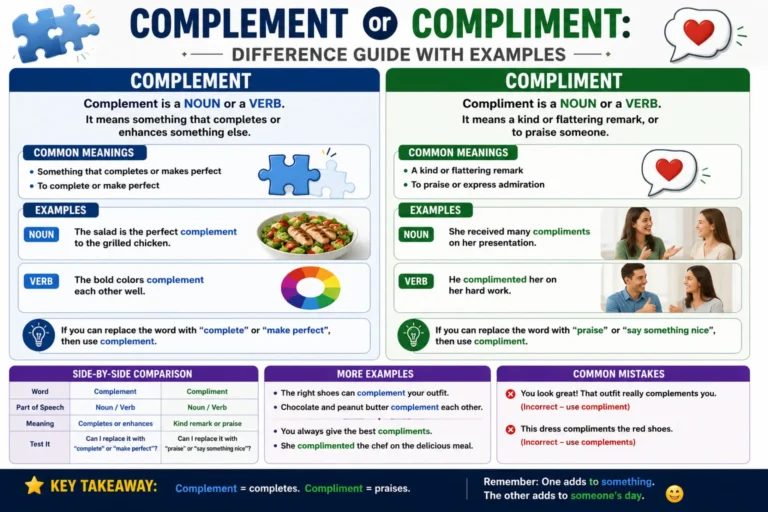
Complement or compliment is one of the most confusing word pairs in English. Many people use these words incorrectly because they sound exactly the same. However, they have very different meanings. Learning the difference will help you write more clearly and speak with confidence.
The good news is that the rule is simple. Once you understand the meaning of each word, you can choose the correct one every time. Whether you are writing an email, completing schoolwork, posting on social media, or speaking at work, using the right word makes your communication stronger.
In this guide, you will learn the meaning of complement and compliment, see easy examples, compare the two words, and discover simple memory tricks. By the end, you will never confuse them again.
Quick Summary Box
- Complement means something that completes, improves, or matches another thing.
- Compliment means praise, admiration, or kind words.
- Both words are homophones, so they sound the same.
- Use complement when two things work well together.
- Use compliment when someone gives praise.
- A simple memory trick can help you remember the difference.
What Does Complement Mean?
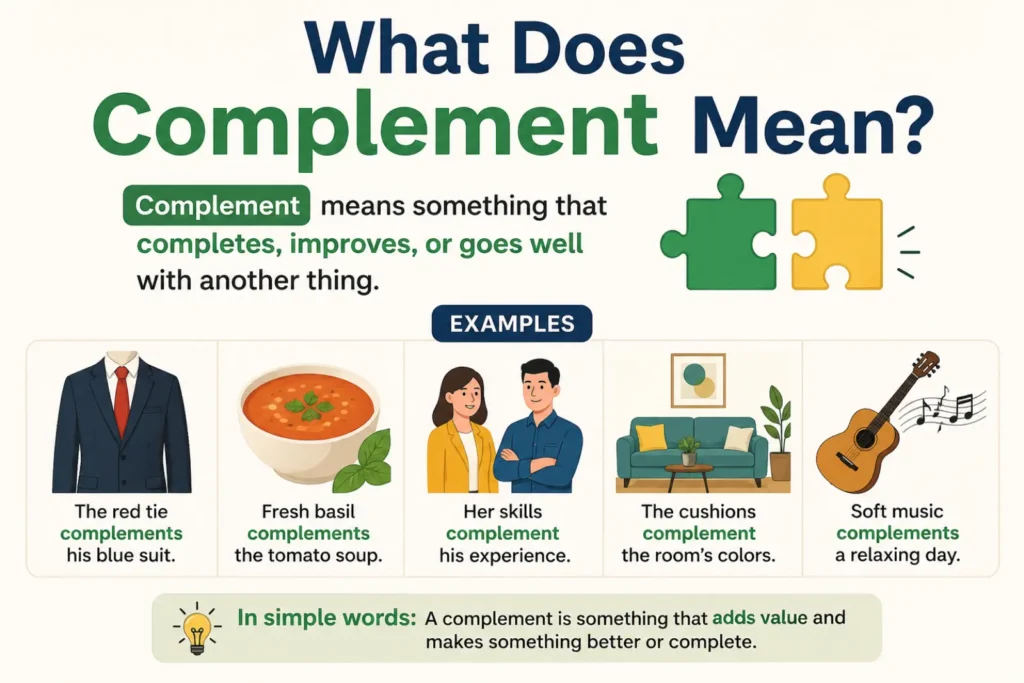
The word complement refers to something that completes, improves, or enhances another thing. It describes two things that fit together perfectly.
Think of complement as adding value. One thing makes another thing look better, work better, or become complete.
Simple Definition
Complement = Something that completes or improves another thing.
Real-Life Examples
- The blue curtains complement the white walls.
- Fresh basil complements tomato soup.
- Her creativity complements his technical skills.
- These shoes complement your outfit.
- The soft music complements the relaxing atmosphere.
- Good communication complements strong leadership.
- Exercise complements a healthy diet.
In every example, one thing makes another better instead of praising it.
Complement as a Verb
Complement can also be used as a verb.
It means to improve, complete, or go well with something.
Examples:
- The artwork complements the office design.
- This sauce complements grilled chicken.
- Their personalities complement each other perfectly.
- Modern technology complements traditional teaching methods.
Where Do We Use Complement?
People often use complement in many situations, including:
- Fashion
- Interior design
- Food and cooking
- Business
- Teamwork
- Relationships
- Art and music
- Marketing
- Sports
Whenever two things fit well together, complement is usually the correct word.
What Does Compliment Mean?
A compliment is a polite expression of praise, admiration, or appreciation. It is something kind that you say to another person.
Compliments make people feel valued and respected. They can improve relationships at home, school, or work.
Simple Definition
Compliment = Praise or kind words.
Real-Life Examples
- She gave me a compliment about my presentation.
- Thank you for the wonderful compliment.
- My teacher complimented my writing skills.
- Everyone complimented the chef after dinner.
- He complimented her beautiful painting.
- Our manager complimented the team’s hard work.
- My friend complimented my new haircut.
Each sentence shows someone giving praise rather than completing something.
Compliment as a Verb
Compliment also works as a verb.
It means to praise someone or express admiration.
Examples:
- I complimented my coworker on her success.
- They complimented the singer after the concert.
- She complimented her friend for helping others.
- The customer complimented the restaurant staff for excellent service.
When Should You Use Compliment?
Use compliment when talking about:
- Praise
- Appreciation
- Positive feedback
- Encouragement
- Admiration
- Good manners
- Friendly conversations
If someone says something nice about another person, the correct word is compliment.
Complement vs Compliment: Key Differences
Although these words sound alike, their meanings are completely different. Understanding the difference is the key to using them correctly.
| Feature | Complement | Compliment |
|---|---|---|
| Meaning | Completes or improves something | Expresses praise or admiration |
| Part of Speech | Noun and Verb | Noun and Verb |
| Used For | Matching, enhancing, completing | Praising or encouraging someone |
| Example | Cheese complements pasta. | She complimented my cooking. |
| Easy Memory Trick | Think complete | Think I admire |
Quick Rule
Use complement when things fit together.
Use compliment when people give praise.
Example Comparison
Complement
- The green tie complements his gray suit.
- Reading complements classroom learning.
- Coffee complements chocolate cake.
Compliment
- She complimented my speech.
- Thank you for the compliment.
- The coach complimented every player after the game.
Easy Memory Tricks to Remember the Difference
Many English learners mix up complement and compliment because they sound the same. Fortunately, a few simple memory tricks can help you remember the correct word every time.
Trick 1: Think of “Complete”
The word complement begins with comple-, just like the word complete.
If something completes or improves another thing, use complement.
Examples
- The sofa complements the living room.
- Fresh herbs complement the flavor of the soup.
- His experience complements the team’s knowledge.
Trick 2: Think of “I Admire”
The word compliment contains the letter I.
Remember the phrase:
I admire you.
When you admire or praise someone, you give them a compliment.
Examples
- She complimented my new jacket.
- I received a nice compliment from my teacher.
- He complimented his friend on her hard work.
Trick 3: Ask Yourself One Question
Before using either word, ask:
Am I talking about praise or about things that go well together?
- If it is praise, use compliment.
- If it is matching or improving, use complement.
This simple question can prevent most grammar mistakes.
Real-Life Examples of Complement and Compliment
Learning through everyday examples makes these words much easier to remember.
At School
Complement
- Pictures complement the lesson.
- Group projects complement classroom learning.
Compliment
- The teacher complimented the student for answering correctly.
- My classmates complimented my science project.
At Work
Complement
- His leadership skills complement our marketing strategy.
- The new software complements our existing system.
Compliment
- The manager complimented the team after completing the project.
- Clients often compliment our customer service.
In Fashion
Complement
- Black shoes complement a navy-blue suit.
- Silver jewelry complements a white dress.
- The scarf complements her winter coat.
Compliment
- Your dress looks amazing.
- I received several compliments on my new jacket.
- She complimented my hairstyle.
In Cooking
Complement
- Lemon complements grilled fish.
- Garlic complements roasted vegetables.
- Honey complements green tea.
Compliment
- The guests complimented the chef.
- Everyone complimented the delicious dessert.
In Relationships
Complement
- Their personalities complement each other.
- Patience complements good communication.
Compliment
- He complimented his wife on her beautiful smile.
- Parents should compliment children for their effort.
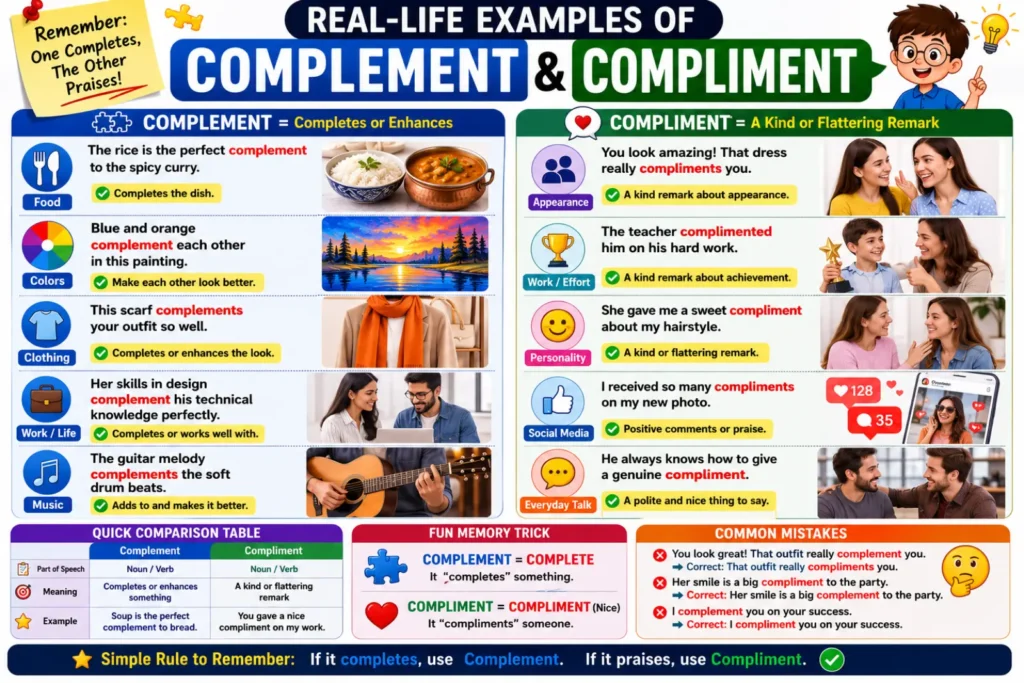
Common Mistakes People Make
Many people use these words incorrectly because they rely only on pronunciation. Here are some of the most common mistakes.
Mistake 1
❌ She complemented my speech.
✅ She complimented my speech.
Why?
She praised your speech.
Mistake 2
❌ These shoes compliment your dress.
✅ These shoes complement your dress.
Why?
The shoes match the dress.
Mistake 3
❌ Thank you for the complement.
✅ Thank you for the compliment.
Why?
Someone gave you praise.
Mistake 4
❌ Salt compliments the flavor.
✅ Salt complements the flavor.
Why?
Salt improves the flavor.
Mistake 5
❌ My coworkers complemented me on my promotion.
✅ My coworkers complimented me on my promotion.
Why?
They congratulated and praised you
When Should You Use Complement?
Use complement whenever one thing improves, completes, balances, or matches another thing.
Common situations include:
- Clothing and fashion
- Interior decorating
- Food pairings
- Business partnerships
- Teamwork
- Education
- Art and design
- Technology
- Music
Examples
- The new logo complements the company’s branding.
- This app complements our project management software.
- Exercise complements a balanced diet.
- Reading complements classroom education.
- Strong leadership complements technical expertise.
When Should You Use Compliment?
Use compliment whenever someone expresses praise, admiration, or appreciation.
People give compliments every day.
Examples include:
- Thanking someone
- Praising good work
- Admiring someone’s appearance
- Appreciating good service
- Encouraging others
Examples
- She complimented the waiter for excellent service.
- I complimented my friend on his new job.
- The audience complimented the speaker after the presentation.
- Customers often compliment friendly employees.
- My parents complimented me for getting good grades.
Tips to Avoid Confusing Complement and Compliment
These simple habits can help you use the correct word every time.
- Think of complete before writing complement.
- Think of praise before writing compliment.
- Read your sentence aloud.
- Ask yourself what the sentence means.
- Practice writing your own examples.
- Review common grammar mistakes regularly.
- Use a dictionary if you are unsure.
The more you practice, the more natural the difference becomes.
Why Do People Confuse These Words?
The main reason is that complement and compliment are homophones.
Homophones are words that sound the same but have different meanings and spellings.
English has many homophones that confuse learners.
Some common examples include:
- Their, There, and They’re
- To, Too, and Two
- Affect and Effect
- Principal and Principle
- Weather and Whether
- Complement and Compliment
Understanding homophones improves both writing and speaking skills. It also helps you avoid common grammar errors in professional and academic communication.
Synonyms and Related Words
Using related words can improve your vocabulary and help you understand the difference between complement and compliment more clearly.
Synonyms for Complement
These words have meanings similar to complement, depending on the context.
- Complete
- Enhance
- Improve
- Match
- Balance
- Support
- Strengthen
- Pair with
- Go well with
- Harmonize with
Example Sentences
- The curtains enhance the room.
- These colors match perfectly.
- Good planning supports business growth.
- Fresh herbs harmonize with roasted vegetables.
Synonyms for Compliment
These words relate to praise or admiration.
- Praise
- Admire
- Appreciate
- Applaud
- Commend
- Congratulate
- Encourage
- Flatter
- Approve
- Celebrate
Example Sentences
- Everyone praised the speaker.
- The teacher commended the students.
- We all admired her dedication.
- The manager appreciated the team’s effort.
Related Search Terms (LSI Keywords)
Search engines also recognize related terms. Including them naturally helps improve SEO.
- complement meaning
- compliment meaning
- complement vs compliment
- difference between complement and compliment
- compliment examples
- complement examples
- English grammar rules
- common grammar mistakes
- homophones in English
- vocabulary tips
- improve English writing
- English language guide
History and Origin of the Words
Understanding where these words come from makes them easier to remember.
The word complement comes from the Latin word complementum, which means something that fills up or completes. This explains why a complement completes or improves another thing.
The word compliment has a different history. It comes from the Italian word complimento and later the French word compliment, both referring to polite expressions of praise or respect.
Although the spellings became similar over time, their meanings stayed different. Today, English speakers continue to use one word for completing something and the other for expressing admiration.
Expert Insights
Grammar experts recommend learning words through context instead of memorizing definitions alone.
When you read books, blogs, newspapers, or emails, pay attention to how writers use complement and compliment. Seeing real examples helps you remember the correct meaning.
Professional writers also proofread their work before publishing. A quick review can catch small mistakes that spell checkers sometimes miss.
Using the correct word builds trust with your readers. It also makes your writing look polished and professional. Whether you are writing an essay, business email, or social media post, choosing the right word improves communication.
Practice Quiz
Test your knowledge with these simple questions.
1. The blue curtains ______ the white walls.
Answer: complement
2. My teacher ______ my presentation.
Answer: complimented
3. Thank you for the lovely ______.
Answer: compliment
4. Fresh herbs ______ tomato soup.
Answer: complement
5. Everyone ______ the chef after dinner.
Answer: complimented
If you answered all five correctly, you now understand the difference between complement and compliment.
(FAQs)
1. What is the main difference between complement and compliment?
Complement means something improves or completes another thing. Compliment means praise or kind words.
2. Is it “compliment someone” or “complement someone”?
Use compliment someone when you praise them.
Example: I complimented my friend on her achievement.
3. Can complement be used as a verb?
Yes. It means to improve or complete something.
Example: This sauce complements grilled chicken.
4. Can compliment be both a noun and a verb?
Yes.
As a noun: She gave me a compliment.
As a verb: She complimented my presentation.
5. Why do these words sound the same?
They are homophones. Homophones have the same pronunciation but different meanings and spellings.
6. Which word should I use for matching colors?
Use complement because the colors work well together.
7. Which word should I use after someone praises me?
Use compliment.
Example: Thank you for the compliment.
Conclusion
Understanding complement or compliment becomes simple once you know what each word means. A complement completes, improves, or matches something else, while a compliment expresses praise or admiration. Even though the two words sound identical, they serve very different purposes in English.
The easiest way to remember the difference is to connect complement with complete and compliment with praise. This small memory trick can help you avoid common grammar mistakes in everyday writing and conversation.
Practice using both words in your own sentences whenever possible. Over time, choosing the correct word will become a natural habit. Whether you are writing emails, school assignments, professional documents, or social media posts, using complement and compliment correctly will make your communication clearer, more accurate, and more professional.