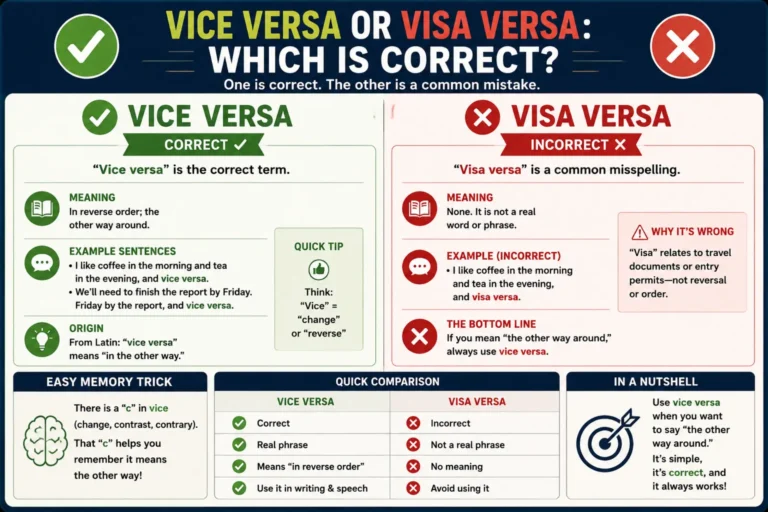
Vice versa or visa versa is a common spelling question in English. Many people hear the phrase in conversations but spell it incorrectly. The correct form is vice versa, not visa versa. This small mistake appears in schoolwork, emails, and online posts.
Knowing the correct spelling improves your writing and communication. It also helps you avoid common grammar errors. In this guide, you will learn the meaning of vice versa, why people confuse it with visa versa, and how to use it correctly. You will also find simple examples, helpful tips, and a comparison table that makes the difference easy to remember.
Quick Summary
Vice Versa or Visa Versa?
- Vice versa is the correct spelling.
- Visa versa is incorrect.
- “Vice versa” means the other way around.
- It shows that the opposite statement is also true.
- The phrase comes from Latin.
- Use it in both formal and informal writing
What Does Vice Versa Mean?
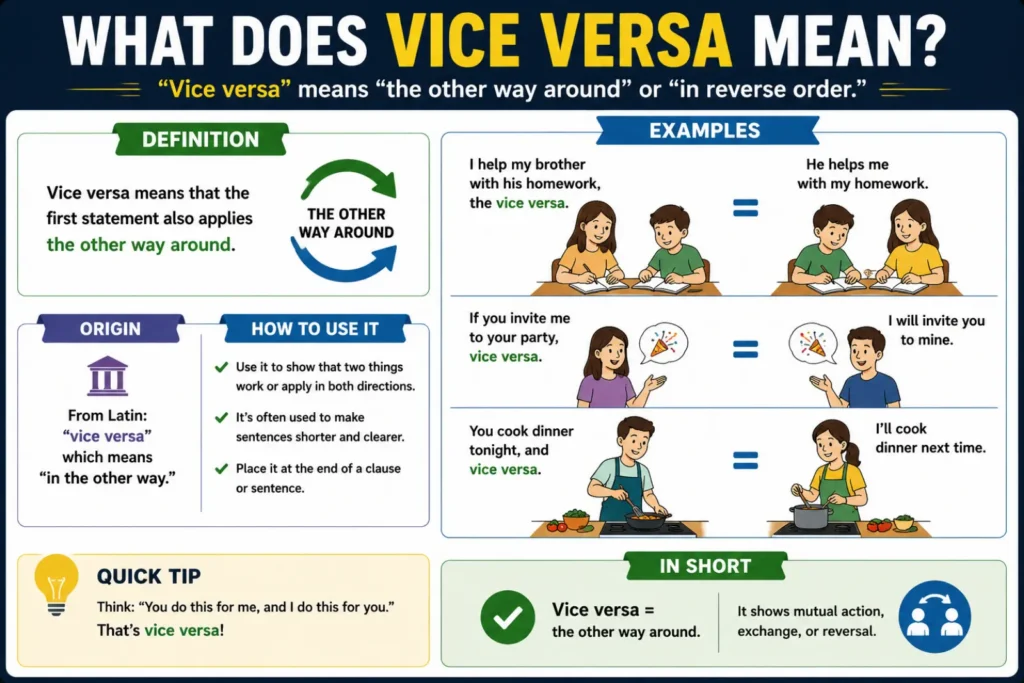
The phrase vice versa means the other way around.
It tells the reader that the opposite statement is also true.
Instead of repeating the same idea, you can simply say vice versa.
Simple Definition
Vice versa = The opposite is also true.
Example
- Sarah helps John.
- John helps Sarah.
Instead of writing both sentences, you can say:
Sarah helps John, and vice versa.
Vice Versa or Visa Versa: Which One Is Correct?
Many people spell the phrase as visa versa because it sounds similar when spoken.
However, visa versa is not a correct English phrase.
Only vice versa is accepted in dictionaries and grammar guides.
Comparison Table
| Phrase | Correct? | Meaning |
|---|---|---|
| Vice versa | ✅ Yes | The other way around |
| Visa versa | ❌ No | Incorrect spelling |
Whenever you write this expression, always use vice versa.
Why Do People Write “Visa Versa”?
This mistake is very common.
People usually learn the phrase by hearing it.
They may never see the correct spelling in writing.
The words vice and visa sound similar in fast speech.
As a result, many people accidentally type visa versa.
Autocorrect tools may also fail to catch the mistake.
Reading books and articles helps you remember the correct spelling.
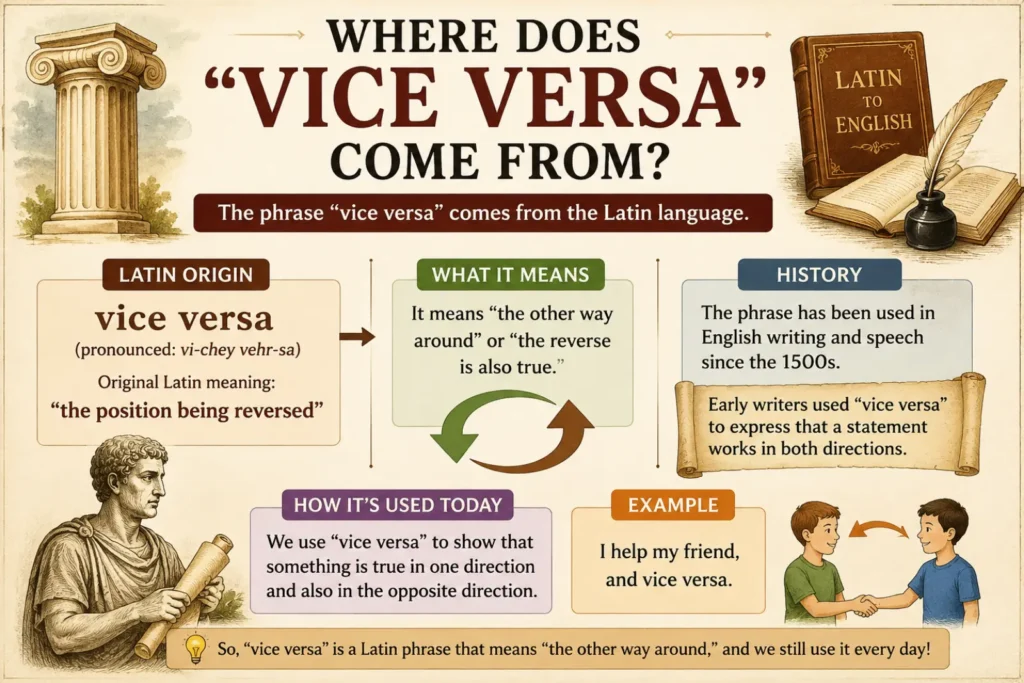
Where Does “Vice Versa” Come From?
The phrase vice versa comes from Latin.
It has been part of the English language for hundreds of years.
The original Latin meaning is:
“The position being reversed.”
Today, English speakers use it to avoid repeating opposite ideas.
The phrase remains popular because it is short, simple, and clear.
How to Use Vice Versa Correctly
Using vice versa is easy.
First, make one statement.
Then use vice versa to show that the opposite is also true.
Examples
- Parents teach children, and vice versa.
- Dogs love their owners, and vice versa.
- Teachers learn from students, and vice versa.
- Good communication builds trust, and vice versa.
- Respect creates friendship, and vice versa.
These sentences sound natural because the opposite meaning is easy to understand.
Real-Life Examples of Vice Versa
You can hear vice versa in everyday conversations.
Here are some common situations.
At School
Students learn from teachers, and vice versa.
At Work
Managers support employees, and vice versa.
In Friendships
Friends help each other, and vice versa.
In Sports
Players motivate coaches, and vice versa.
At Home
Parents care for children, and vice versa as they grow older.
These examples show how the phrase saves time and avoids repeating information.
When Should You Use Vice Versa?
Use vice versa whenever two opposite ideas are both true.
It works well in many situations.
Everyday Conversations
The phrase makes speech shorter and smoother.
Academic Writing
Students use it to explain relationships between ideas.
Business Communication
Professionals use it in reports, emails, and presentations.
Creative Writing
Authors use it to avoid repeating similar sentences.
Using vice versa correctly makes your writing more natural and professional.
Vice Versa in Grammar
Vice versa is an adverbial phrase.
It modifies an entire statement rather than a single word.
It usually appears after a comma.
Example
- You can call me anytime, and vice versa.
It can also appear at the end of a sentence when the meaning remains clear.
Proper punctuation improves readability, especially in formal writing.
Common Sentences Using Vice Versa
Here are some examples you can use in daily life.
- I trust you, and vice versa.
- We support each other, and vice versa.
- Children inspire adults, and vice versa.
- Respect brings kindness, and vice versa.
- Success builds confidence, and vice versa.
- Healthy habits improve sleep, and vice versa.
- Good teamwork creates better results, and vice versa.
These examples help you understand how naturally the phrase fits into English.
Common Mistakes When Using Vice Versa
Many people understand the meaning of vice versa, but they still make mistakes when writing it.
Here are the most common errors.
Writing “Visa Versa”
This is the most common mistake.
Always remember that the correct phrase is vice versa.
Using It Without an Opposite Meaning
Use vice versa only when the reverse statement is also true.
Incorrect Example
I bought a new phone, and vice versa.
This sentence makes no sense because there is no opposite action.
Correct Example
I help my brother, and vice versa.
Both actions are true.
Using It Too Often
The phrase is useful, but do not repeat it in every paragraph.
Mix it with other expressions to keep your writing natural.
Tips to Remember the Correct Spelling
You can remember the correct spelling with a few simple tricks.
Think of “Vice,” Not “Visa”
The phrase starts with vice, not visa.
A visa is a travel document.
It has nothing to do with this expression.
Read It Often
Reading books and articles helps you remember the correct form.
Practice Writing It
Write a few sentences using vice versa.
Practice builds confidence.
Use Grammar Tools
Many writing tools can detect spelling mistakes before you publish your work.
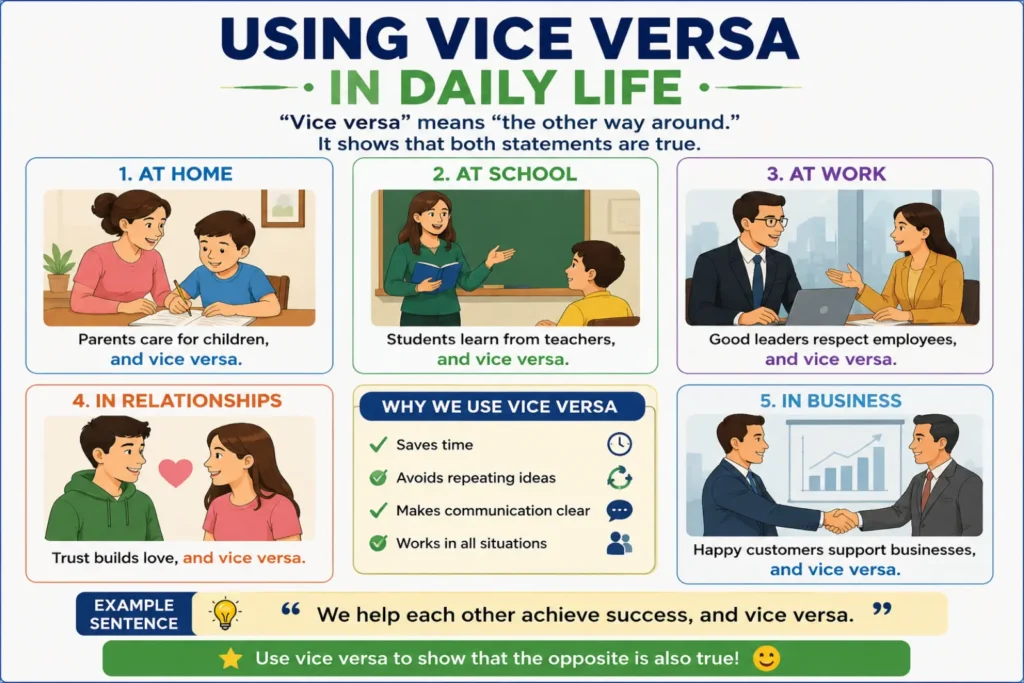
Using Vice Versa in Daily Life
The phrase appears in many everyday situations.
Here are a few examples.
At Home
Parents care for children, and vice versa as parents grow older.
At School
Students ask teachers questions, and vice versa during discussions.
At Work
Good leaders respect employees, and vice versa.
In Relationships
Trust builds love, and vice versa.
In Business
Happy customers support businesses, and vice versa.
Using the phrase correctly makes conversations shorter and easier to understand.
Similar Words and Related Terms
Although vice versa has a unique meaning, several expressions share a similar idea.
Synonyms
- The other way around
- Conversely
- In reverse
- The reverse is true
- Reciprocally
- Likewise, in reverse
- The opposite also applies
Choose the expression that best fits your sentence and writing style.
LSI and Related Keywords
Using related search terms helps improve topical relevance.
Natural LSI keywords include:
- vice versa meaning
- vice versa definition
- vice versa examples
- how to use vice versa
- correct spelling of vice versa
- is visa versa correct
- vice versa grammar
- vice versa in a sentence
- vice versa pronunciation
- common English mistakes
- English grammar guide
- writing tips
Use these terms naturally throughout your content.
Expert Insight
Language experts recommend learning common expressions as complete phrases.
Instead of memorizing individual words, remember vice versa as one unit.
This approach reduces spelling mistakes.
It also improves writing speed and confidence.
Professional writers use vice versa because it avoids repetition and makes sentences more concise.
Using the correct form also builds credibility in academic, business, and professional writing.
Frequently Asked Questions
Is it vice versa or visa versa?
The correct spelling is vice versa. Visa versa is incorrect.
What does vice versa mean?
It means the other way around or the reverse is also true.
Is visa versa a real word?
No. It is a common spelling mistake.
Can I use vice versa in formal writing?
Yes. It is acceptable in academic, business, and professional writing.
Where should I place vice versa in a sentence?
It usually comes at the end of a sentence after a comma.
Example: We support each other, and vice versa.
Is vice versa an English phrase?
The phrase comes from Latin, but it is widely used in modern English.
Can vice versa start a sentence?
Yes, but it is less common.
Make sure the meaning remains clear.
Why do people spell it visa versa?
Most people learn the phrase by hearing it.
Because vice and visa sound similar in quick speech, they confuse the spelling.
Conclusion
If you have ever wondered whether to write vice versa or visa versa, the answer is simple. Vice versa is the only correct spelling. It means the other way around or the reverse is also true. The phrase works well in everyday conversations, academic writing, and professional communication. Using it correctly makes your sentences shorter, clearer, and more natural. Remember that visa versa is a common spelling mistake and should always be avoided. By learning the correct form and practicing with simple examples, you can write with greater confidence and accuracy. Small improvements like this strengthen your English skills and help you communicate more effectively.