Footnote before or after period is a common writing question. Many students, bloggers, and researchers get confused. The good news is that the rule is simple.
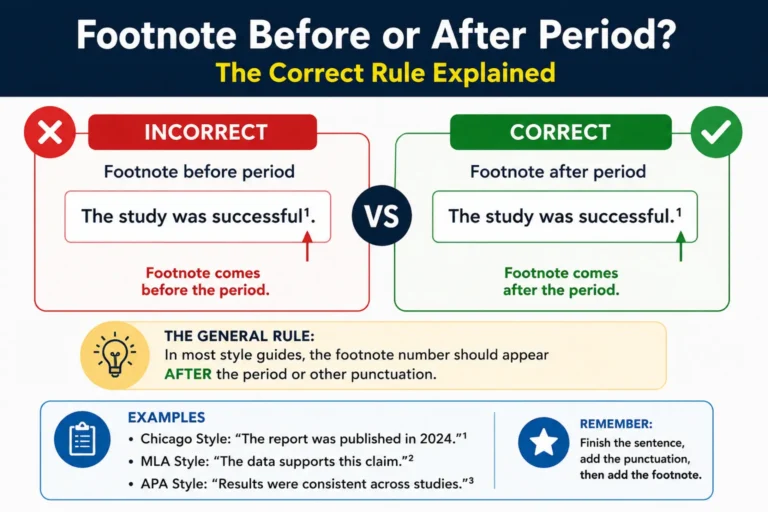
In most style guides, the footnote number goes after the period. This placement keeps the sentence clean and easy to read. It also matches academic and professional writing standards.
For example:
Correct: The study produced reliable results.¹
Writers often place the footnote before the period by mistake. However, most major style guides recommend the opposite.
This guide explains the rule in simple English. You will also see examples, style guide differences, common mistakes, and expert tips.
Quick Summary
- Footnotes usually go after the period.
- Correct: The report was approved.¹
- Incorrect: The report was approved¹.
- Chicago, MLA, and many academic styles use the after-period rule.
- The rule improves readability and consistency.
- Always check your required style guide.
Featured Snippet Answer
Does a footnote go before or after a period?
In most academic and professional writing, a footnote goes after the period. For example: The experiment succeeded.¹ Major style guides, including Chicago, generally place footnote numbers after punctuation marks such as periods and commas.
What Is a Footnote?
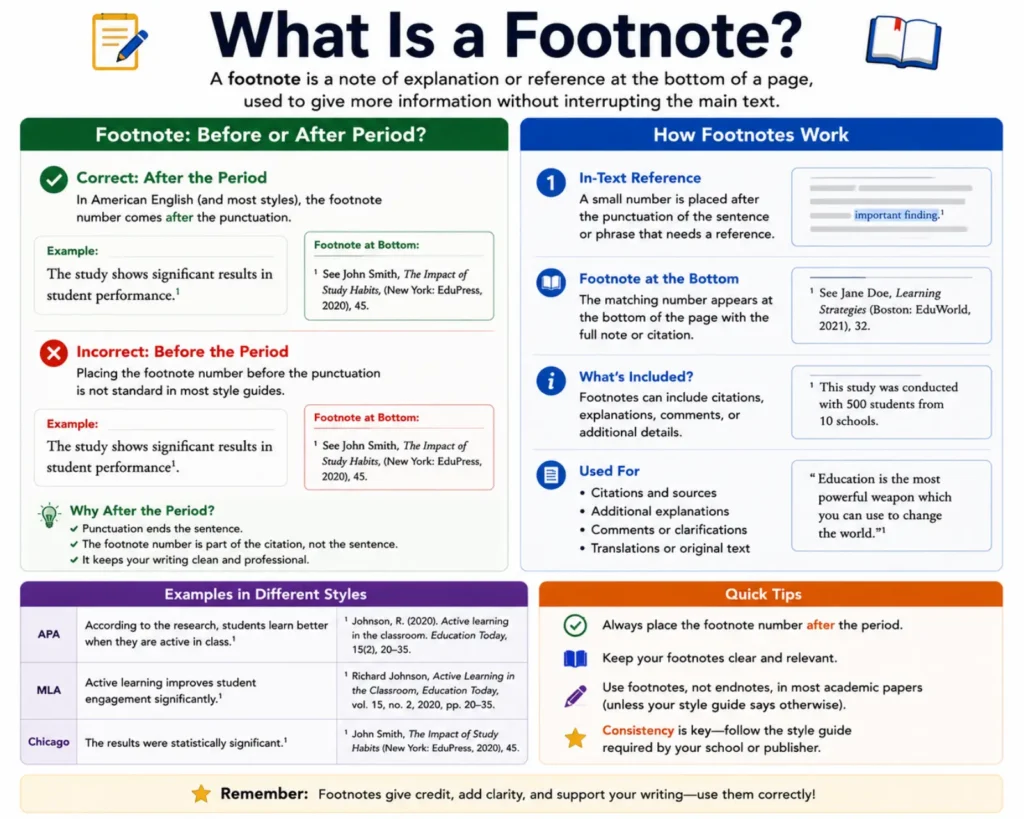
A footnote is a note placed at the bottom of a page. It gives extra information or cites a source.
Writers use footnotes to:
- Credit sources
- Add explanations
- Provide references
- Include side comments
Footnotes usually appear as small superscript numbers.
Example:
The article was widely shared.²
The General Rule: Footnote After the Period
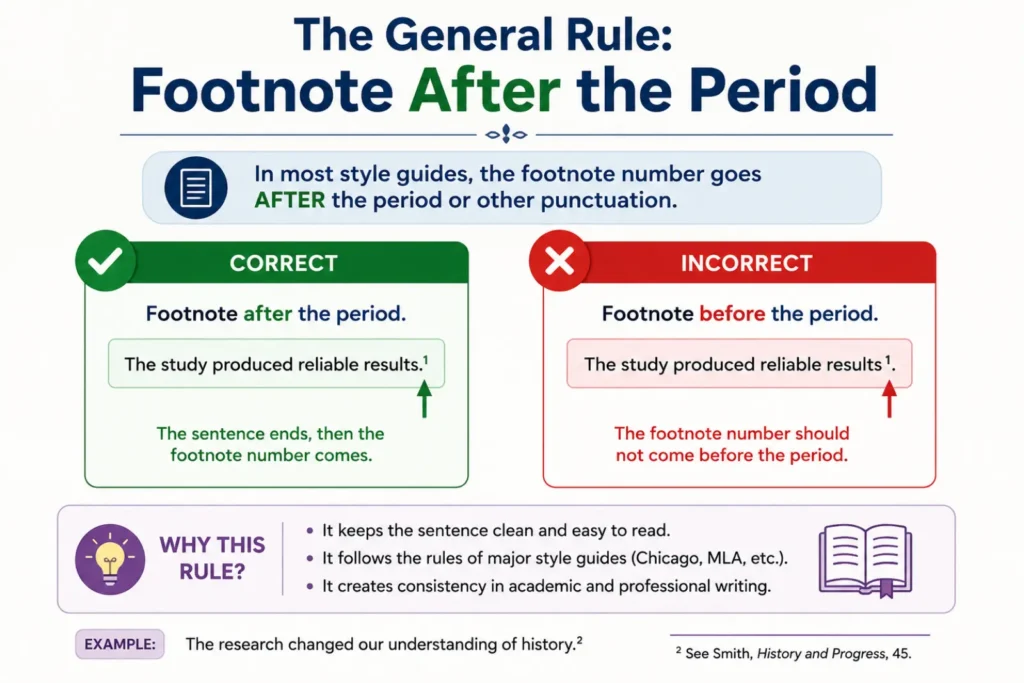
Most modern style guides place footnotes after the period.
Correct Example
The meeting ended early.¹
Incorrect Example
The meeting ended early¹.
This rule keeps punctuation inside the sentence and places the citation marker afterward.
Why Footnotes Go After the Period
The after-period rule improves readability.
Readers can finish the sentence before seeing the reference mark.
Benefits include:
- Cleaner text
- Better reading flow
- Consistent formatting
- Easier source tracking
Comparison Table: Before or After Period?
| Placement | Example |
|---|---|
| Before period | The results were accurate¹. |
| After period | The results were accurate.¹ |
| Recommended | After period |
What Do Major Style Guides Say?
Chicago Style
Chicago style places footnote numbers after punctuation.
Example:
The policy changed in 2025.³
MLA Style
MLA also places footnote numbers after periods and commas.
APA Style
APA rarely uses footnotes for citations. However, when used, note numbers generally follow punctuation.
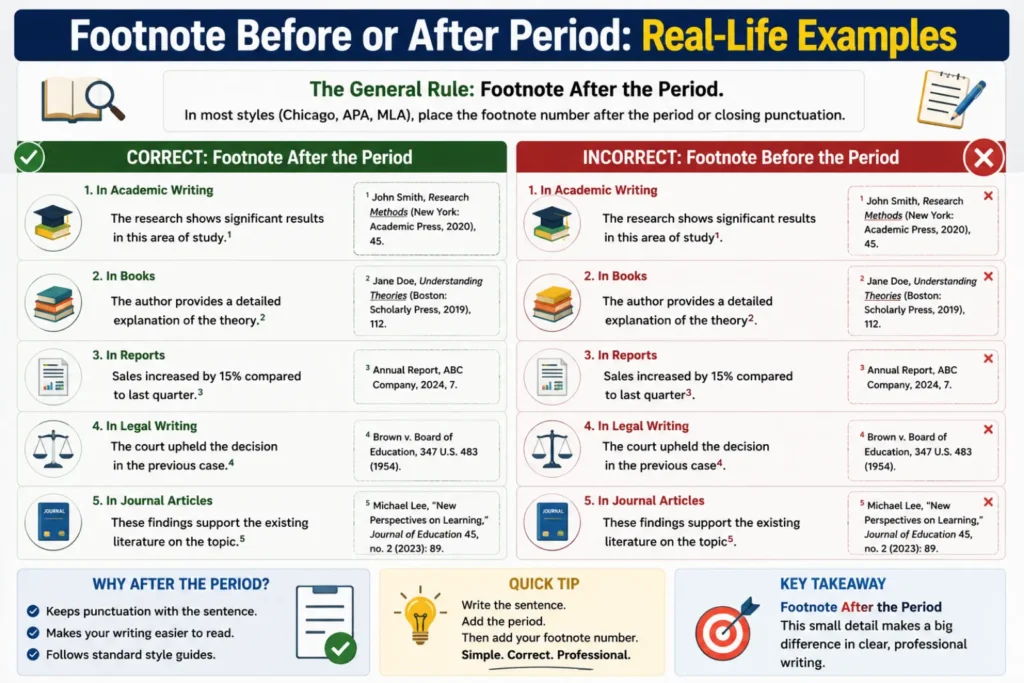
Real-Life Examples
Academic Essay
Climate change affects global agriculture.⁴
History Paper
The treaty ended the conflict.⁵
Business Report
Sales increased by 12%.⁶
Common Mistakes
Avoid These Errors
Mistake 1: Putting the Footnote Before the Period
Wrong: The data was reliable¹.
Mistake 2: Mixing Styles
Do not switch between before-period and after-period placement.
Mistake 3: Using Multiple Footnote Styles
Keep all footnotes formatted the same way.
Footnotes With Commas and Quotation Marks
After Commas
Several studies,¹ including recent reports, support this claim.
After Quotation Marks
She called it a “major breakthrough.”²
Notice that the footnote follows the closing punctuation.
Tips to Remember the Rule
- Finish the sentence first.
- Add the period.
- Insert the footnote number last.
- Stay consistent throughout the document.
- Check your required style guide.
Usage in Daily Writing
You may need footnotes in:
- School essays
- Research papers
- Books
- Legal documents
- Business reports
- Academic blogs
Using the correct placement makes your writing look more professional.
Synonyms and Related Terms
Related search terms include:
- footnote placement
- footnote punctuation
- citation before or after period
- superscript before or after period
- Chicago footnote rule
- MLA footnote formatting
- academic citation punctuation
- footnote style guide
Expert Insight
Why This Rule Matters
Professional editors prefer consistent footnote placement.
Correct formatting improves readability and credibility.
It also helps teachers, reviewers, and publishers evaluate your work quickly.
If you write academic content regularly, learn one style guide thoroughly. Consistency matters more than memorizing dozens of rules.
Frequently Asked Questions
1. Does a footnote go before or after a period?
Usually after the period.
2. Is “The sentence.¹” correct?
Yes. That is the standard format.
3. Is “The sentence¹.” correct?
No. Most style guides consider this incorrect.
4. What about commas?
Place the footnote after the comma.
5. Does Chicago style use after-period placement?
Yes. Chicago generally places footnotes after punctuation.
6. Does MLA use the same rule?
Yes. MLA also places footnotes after punctuation.
7. Should I always follow one style guide?
Yes. Follow the guide required by your teacher, publisher, or organization.
Internal Linking Suggestions
Link this article to related topics such as:
- How to Use Footnotes
- Chicago Style Citation Guide
- MLA Formatting Rules
- APA vs MLA vs Chicago
- How to Cite Sources Correctly
- Common Grammar Mistakes
Conclusion
The answer to “footnote before or after period” is simple. In most academic and professional writing, the footnote goes after the period. This rule appears in major style guides such as Chicago and MLA. It also makes sentences easier to read.
Remember this pattern: Finish the sentence, add the period, then add the footnote number. For example: The research was successful.¹
Using the correct footnote placement improves clarity, consistency, and credibility. Whether you write essays, reports, or articles, this small detail helps your work look polished and professional.