Login or log in is a common question in writing, web design, and everyday communication. Many people use these terms interchangeably. However, they have different grammatical uses.
Understanding the difference helps you write clearly and professionally. It also improves website content, user instructions, and business communication.
If you have ever wondered whether to write “login” as one word or “log in” as two words, this guide is for you.
In this article, you will learn the meaning of each term, when to use them, common mistakes to avoid, and real-life examples. By the end, you will confidently know which form is correct in every situation.
Quick Summary Box
- Login is usually a noun or adjective.
- Log in is a verb phrase.
- Use login page when referring to a page or feature.
- Use log in to your account when describing an action.
- The difference depends on grammar, not meaning.
- Correct usage improves writing clarity and professionalism.
What Does Login Mean?
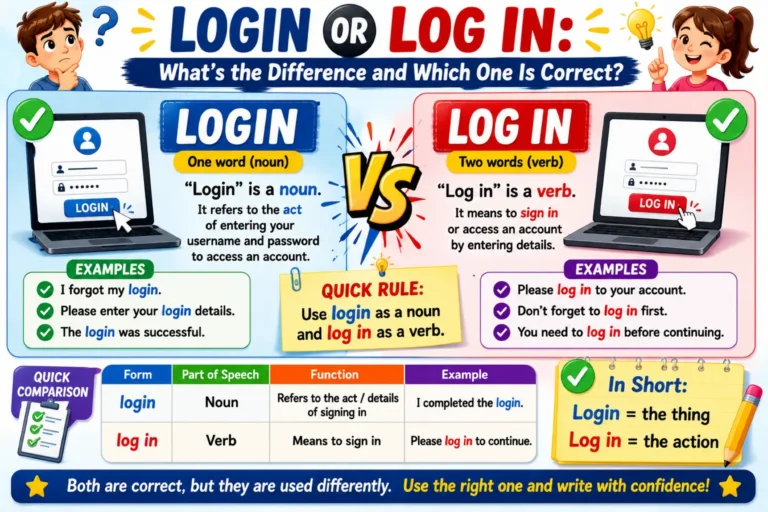
Login is a noun.
It refers to the credentials, process, or page used to access an account.
Examples
- I forgot my login details.
- The login page is unavailable.
- Please update your login information.
- The login screen appears first.
In these examples, “login” names a thing. Therefore, it acts as a noun.
What Does Log In Mean?
Log in is a verb phrase.
It describes the action of accessing a system, website, or application.
Examples
- Please log in to continue.
- Users must log in before making purchases.
- I cannot log in to my account.
- Log in with your email address.
In these examples, “log in” shows an action.
Login vs Log In: Key Difference
The main difference is grammatical usage.
| Term | Part of Speech | Meaning | Example |
|---|---|---|---|
| Login | Noun or adjective | Access credentials or access page | Login page |
| Log In | Verb | Action of entering a system | Log in to your account |
Simple Rule
If you can replace the word with “sign-in page,” use login.
If you are describing an action, use log in.
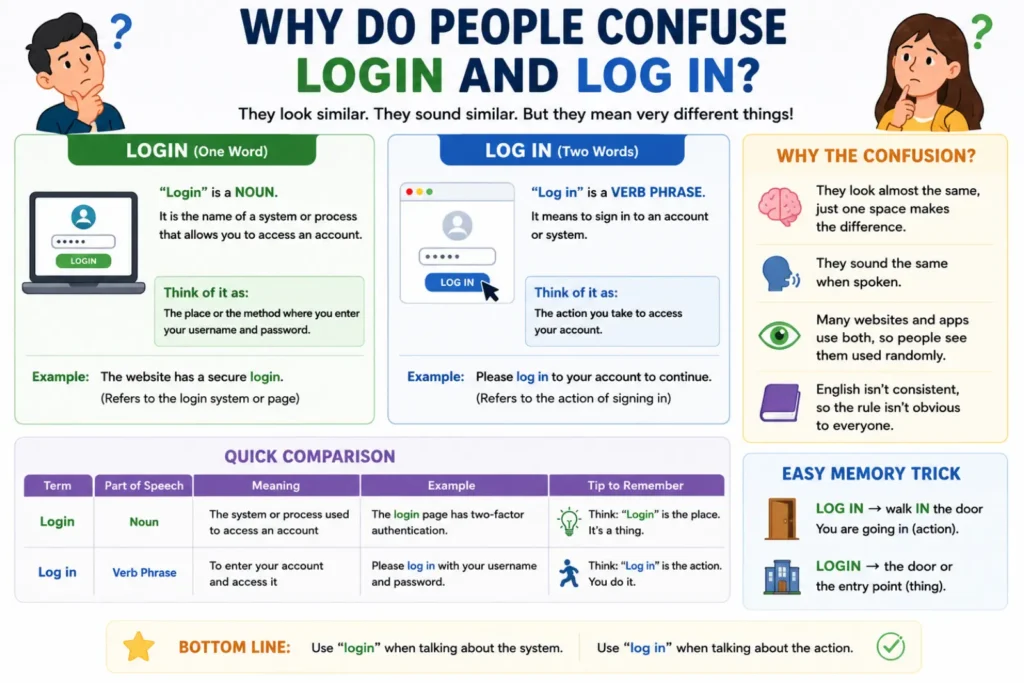
Why Do People Confuse Login and Log In?
Many websites use these terms incorrectly.
Buttons often display “Login” even though they trigger the action “log in.”
Over time, users started treating both forms as identical.
However, grammar guides still recognize a difference between them.
Example
Correct:
- Click the login button.
- Log in using your password.
Incorrect:
- Click the log in button.
- Login to your account.
Real-Life Examples of Login and Log In
Understanding real situations makes the difference easier.
Website Example
Correct:
- Visit the login page.
- Log in with your username.
Mobile App Example
Correct:
- The login screen is loading.
- Users must log in first.
Workplace Example
Correct:
- Employees receive login credentials.
- Employees log in every morning.
When Should You Use Login?
Use login when referring to a thing, feature, page, or information.
Common Uses
- Login page
- Login credentials
- Login system
- Login screen
- Login information
- Login portal
- Login process
Example Sentences
- The login page is secure.
- I updated my login credentials.
- The login portal supports two-factor authentication.
When Should You Use Log In?
Use log in when describing the act of accessing an account.
Common Uses
- Log in to your account
- Log in securely
- Log in using Google
- Log in with your email
- Log in before checkout
Example Sentences
- Please log in before continuing.
- Customers can log in from any device.
- You must log in to view reports.
Common Mistakes People Make
Many writers misuse these terms.
Mistake 1: Using Login as a Verb
Incorrect:
- Login to your account.
Correct:
- Log in to your account.
Mistake 2: Using Log In as a Noun
Incorrect:
- Click the log in page.
Correct:
- Click the login page.
Mistake 3: Mixing Forms
Incorrect:
- Use your log in credentials.
Correct:
- Use your login credentials.
Login or Log In in Website Content
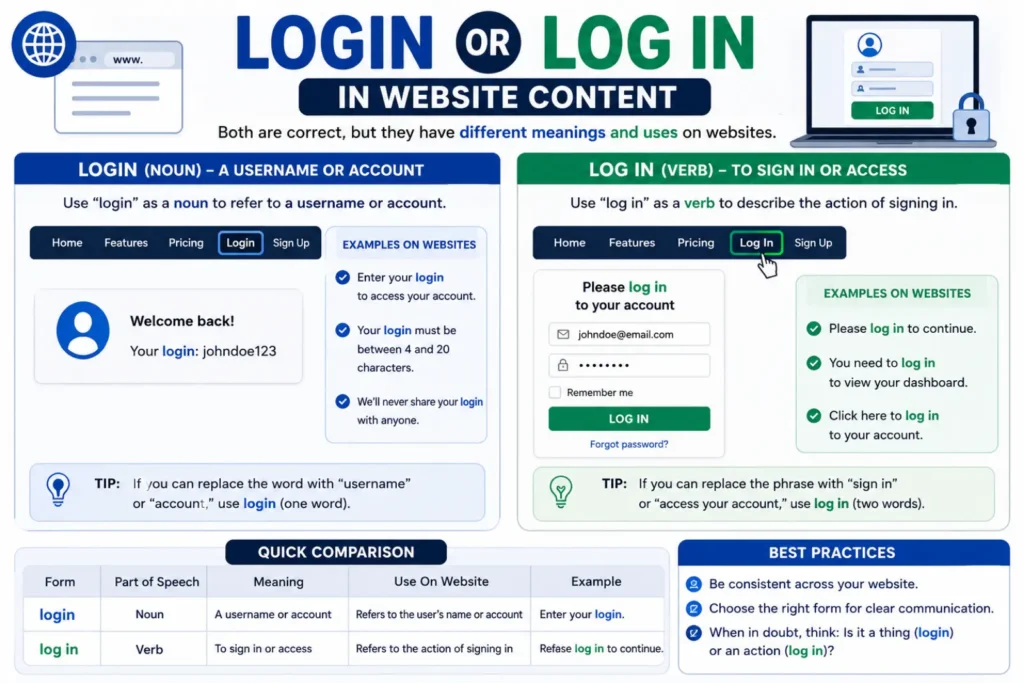
Website owners should use consistent terminology.
Best Practices
- Use “Login” for buttons and navigation labels.
- Use “Log in” in instructions and sentences.
- Follow platform style guides.
- Maintain consistency across pages.
Example
Button:
Login
Instruction:
Log in to access your dashboard.
Login and Log In in SEO Writing
Correct grammar improves readability and trust.
Search engines value user experience. Clear language helps visitors understand content quickly.
SEO Benefits
- Better user engagement
- Improved readability
- Reduced confusion
- Higher content quality signals
Writers should match user search intent while maintaining grammatical accuracy.
Synonyms and Related Terms
These related keywords help improve SEO relevance.
Synonyms
- Sign in
- Sign-on
- User access
- Account access
- Authentication
- User authentication
- Secure access
- Account entry
LSI Keywords
- login credentials
- login page
- user login
- account login
- secure login
- log in account
- member login
- user authentication
- sign in account
- online account access
Usage in Daily Life
People encounter login systems every day.
Common Situations
- Online banking
- Social media accounts
- Email platforms
- E-commerce websites
- Learning portals
- Company systems
In each case, users need login credentials and must log in to gain access.
Expert Insights: Why Correct Usage Matters
Language affects credibility.
Professional writers, marketers, and website owners benefit from correct terminology.
Expert Tips
- Use login as a noun.
- Use log in as a verb.
- Keep website wording consistent.
- Follow grammar style guides.
- Review navigation labels and instructions.
Correct usage creates a better user experience and strengthens trust.
Login vs Sign In: Are They the Same?
Many websites use both terms.
Although they have similar meanings, there are subtle differences.
| Term | Common Meaning |
| Login | Entering a system using credentials |
| Sign In | Accessing an account or service |
| Log Out | Leaving a system |
| Sign Out | Ending a session |
Today, most users treat “login” and “sign in” as interchangeable.
(FAQs)
Is login one word or two words?
Both forms are correct. Use login as a noun and log in as a verb.
What is the difference between login and log in?
Login refers to a page, credential, or feature. Log in describes the action of accessing an account.
Is “login to your account” correct?
No. The correct phrase is “log in to your account.”
Why do websites use Login on buttons?
Buttons often use concise labels. “Login” serves as a short navigation term.
Can login be used as a verb?
Traditional grammar says no. Use “log in” for actions.
Is sign in the same as log in?
Generally yes. Most websites use them interchangeably.
What are login credentials?
They are details such as usernames, emails, and passwords used for account access.
Which form is better for SEO?
Use both naturally. Apply the correct grammatical form based on context.
Conclusion
Understanding login or log in is simple once you know the grammar rule. Use login as a noun when referring to a page, credential, or access feature. Use log in as a verb when describing the action of entering an account.
This small distinction improves clarity, professionalism, and user experience. It also helps writers create more accurate website content and documentation.
Whether you manage a website, write content, or use online platforms daily, knowing when to use login or log in makes communication clearer. Remember the rule: if it is a thing, use login. If it is an action, use log in.