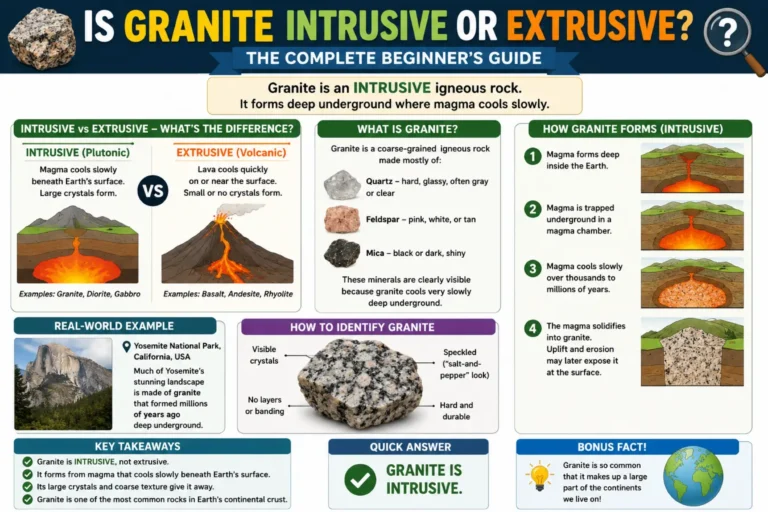
Is granite intrusive or extrusive? This is one of the most common questions in geology. The simple answer is that granite is an intrusive igneous rock.
Granite forms deep beneath Earth’s surface. Magma cools slowly underground and creates large mineral crystals. This slow cooling gives granite its unique appearance.
Many students confuse granite with volcanic rocks. However, granite does not form from lava at the surface.
In this guide, you will learn how granite forms, why it is intrusive, and how it differs from extrusive rocks. You will also see examples, comparison tables, and expert tips.
Quick Summary Box
- Granite is an intrusive igneous rock.
- It forms from magma beneath Earth’s surface.
- Granite cools slowly underground.
- Slow cooling creates large visible crystals.
- Granite is not an extrusive rock.
- Basalt is a common example of an extrusive rock.
- Granite contains quartz, feldspar, and mica.
What Is Granite?
Granite is a coarse-grained igneous rock.
It contains minerals such as:
- Quartz
- Feldspar
- Mica
Granite usually appears gray, pink, white, or black. Builders often use it for countertops, monuments, and buildings.
Is Granite Intrusive or Extrusive?
Granite is an intrusive rock.
Magma remains beneath the ground and cools very slowly. Because cooling takes a long time, large mineral crystals develop.
Simple Answer:
Granite = Intrusive Igneous Rock
What Does Intrusive Mean?
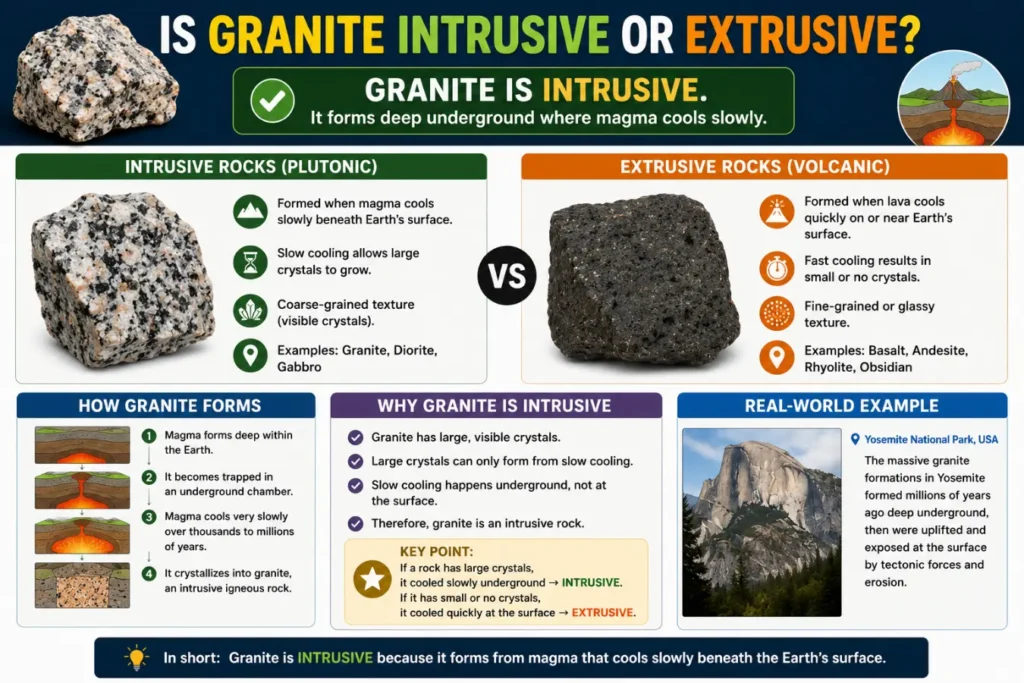
Intrusive rocks form below Earth’s surface.
Magma becomes trapped underground and cools slowly.
As a result:
- Crystals become large.
- The rock develops a coarse texture.
- Minerals become easy to see.
Granite is one of the best examples of an intrusive rock.
What Does Extrusive Mean?
Extrusive rocks form at Earth’s surface.
Volcanoes release lava onto the ground. The lava cools quickly.
Because cooling happens fast:
- Crystals stay very small.
- The texture becomes fine-grained.
- Minerals are difficult to see.
Basalt and obsidian are common extrusive rocks.
How Does Granite Form?
Granite forms through several stages:
Step 1: Magma Forms Underground
Heat melts rock deep inside Earth.
Step 2: Magma Rises Slowly
The molten material moves upward.
Step 3: Cooling Begins
The magma cools beneath the surface.
Step 4: Large Crystals Develop
Slow cooling allows minerals to grow.
Step 5: Granite Forms
The final rock becomes granite.
Why Is Granite Classified as an Intrusive Rock?
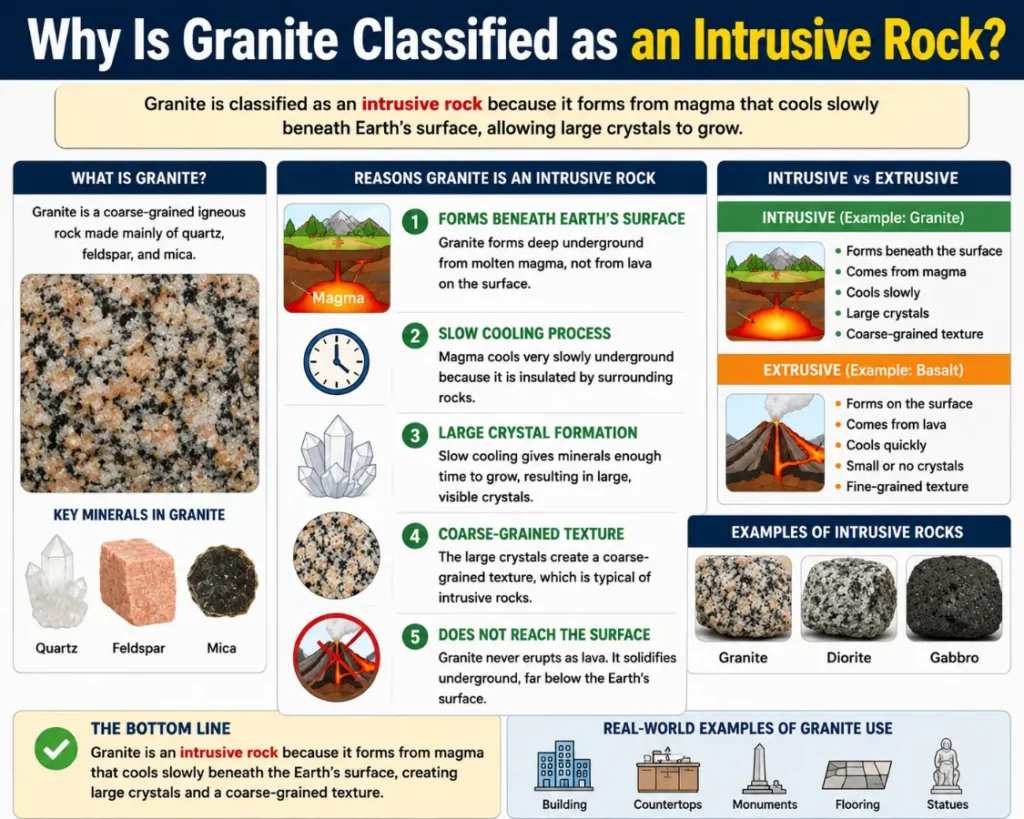
Scientists classify granite as intrusive because of its formation process.
Granite:
- Forms below the surface.
- Comes from magma, not lava.
- Cools slowly.
- Produces large crystals.
These characteristics define intrusive igneous rocks.
Granite vs Extrusive Rocks Comparison Table
| Feature | Granite (Intrusive) | Basalt (Extrusive) |
|---|---|---|
| Formation Location | Underground | Surface |
| Material Source | Magma | Lava |
| Cooling Speed | Slow | Fast |
| Crystal Size | Large | Small |
| Texture | Coarse-grained | Fine-grained |
| Example Use | Countertops | Road construction |
| Visibility of Minerals | Easy to see | Difficult to see |
Real-Life Examples of Granite
Granite appears in many places.
Kitchen Countertops
Many homes use granite surfaces.
Buildings
Granite strengthens walls and foundations.
Monuments
Statues and memorials often contain granite.
Mountain Ranges
Large granite formations exist worldwide.
Examples include:
- Yosemite National Park
- Mount Rushmore
- Sierra Nevada Mountains
Real-Life Examples of Extrusive Rocks
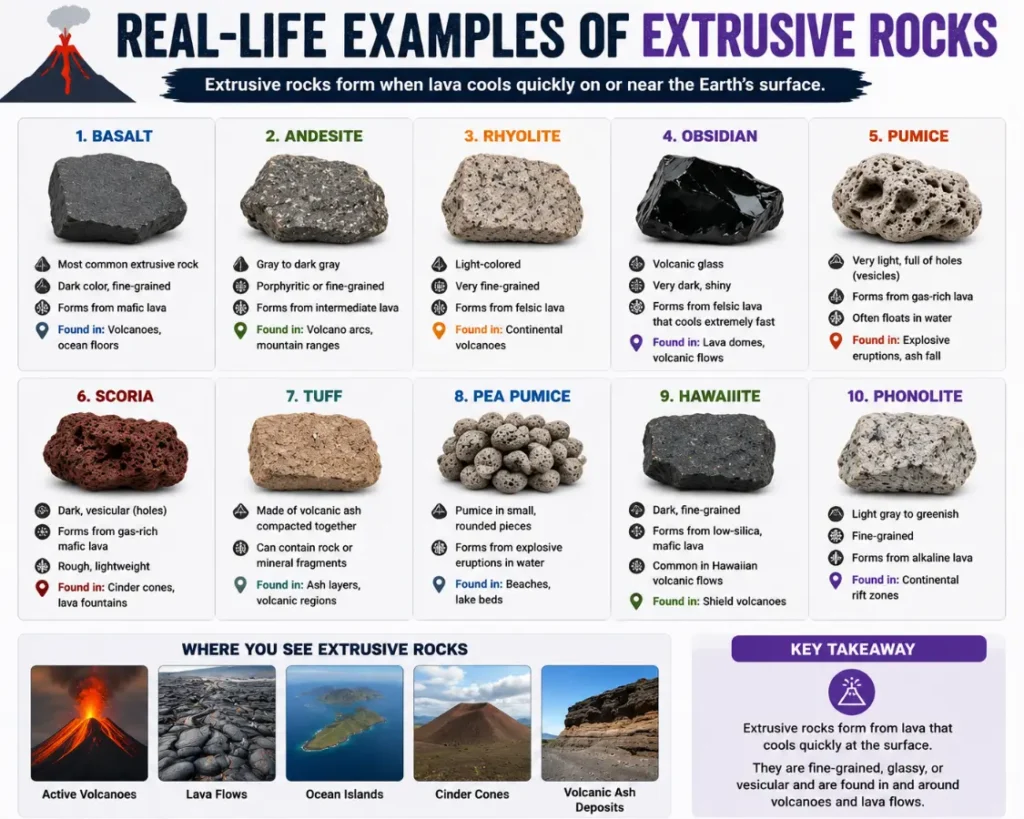
Extrusive rocks are common too.
Examples include:
- Basalt
- Obsidian
- Pumice
- Scoria
People use these rocks in:
- Roads
- Landscaping
- Construction materials
Common Mistakes Students Make
Mistake 1: Thinking Granite Is Extrusive
Granite forms underground, not on the surface.
Mistake 2: Confusing Magma and Lava
Magma stays underground.
Lava reaches Earth’s surface.
Mistake 3: Ignoring Crystal Size
Large crystals usually indicate slow cooling.
Mistake 4: Mixing Granite With Basalt
Granite and basalt form in different environments.
Tips to Remember Granite’s Classification
Use these memory tricks.
Think “G = Ground”
Granite forms inside the ground.
Large Crystals Mean Slow Cooling
Big crystals often indicate intrusive rocks.
Remember Magma vs Lava
- Magma = underground
- Lava = surface
Usage of Granite in Daily Life
Granite plays an important role in modern life.
People use granite for:
- Kitchen countertops
- Flooring
- Bridges
- Monuments
- Decorative stone
- Building materials
Its strength makes it valuable.
Synonyms and LSI Keywords
Related Search Terms
- Granite rock type
- Intrusive igneous rock
- Is granite an igneous rock
- Granite formation process
- Granite vs basalt
- Examples of intrusive rocks
- Extrusive igneous rocks
- Coarse-grained rocks
Semantic Keywords
- Magma cooling
- Earth’s crust
- Volcanic rocks
- Mineral crystals
- Geological classification
- Rock texture
Expert Insight
Geologists identify rocks by studying how they form.
Granite’s large crystals provide clear evidence of slow underground cooling.
Understanding intrusive and extrusive rocks helps students learn:
- Plate tectonics
- Volcanoes
- Earth’s interior
- Geological history
Rock classification also helps engineers and construction experts choose suitable materials.
Why Granite Matters
Granite has scientific and practical value.
Scientists study granite to understand Earth’s history.
Builders value granite because it:
- Resists weathering.
- Lasts for decades.
- Looks attractive.
- Supports heavy loads.
Frequently Asked Questions
Is granite intrusive or extrusive?
Granite is an intrusive igneous rock.
Why is granite intrusive?
It cools slowly beneath Earth’s surface.
Does granite come from magma or lava?
Granite forms from magma.
What texture does granite have?
Granite has a coarse-grained texture.
Which rock is the extrusive equivalent of granite?
Rhyolite is considered the extrusive equivalent of granite.
Why does granite have large crystals?
Slow cooling allows crystals to grow larger.
Is basalt intrusive or extrusive?
Basalt is an extrusive igneous rock.
Can you see minerals in granite?
Yes. Granite contains visible mineral grains.
Conclusion
So, is granite intrusive or extrusive? The answer is simple. Granite is an intrusive igneous rock.
Granite forms deep beneath Earth’s surface from slowly cooling magma. This slow process creates the large crystals that make granite easy to recognize.
Extrusive rocks form differently. They cool quickly at the surface and usually contain tiny crystals.
Understanding this difference helps students learn geology more easily. It also explains why granite looks and behaves differently from volcanic rocks.
The easiest rule to remember is this:
Granite forms underground, so granite is intrusive.