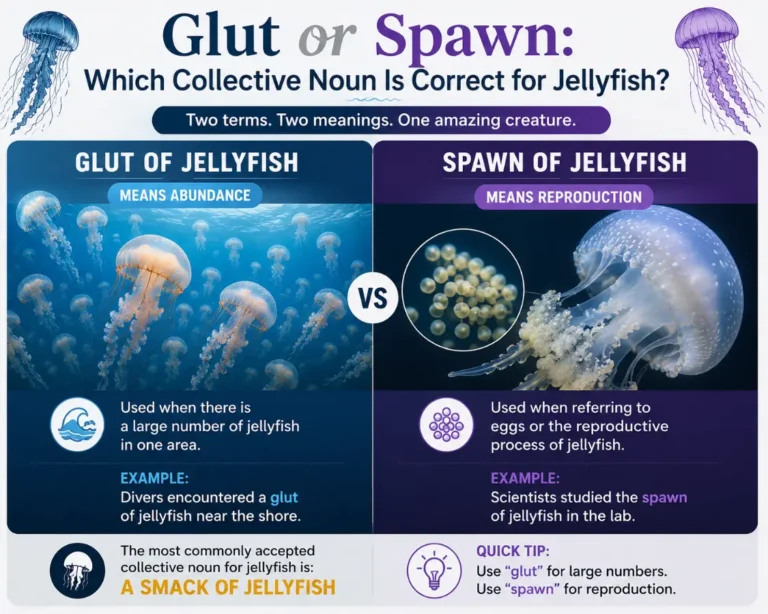
Glut or Spawn is a question many people ask when learning collective nouns for jellyfish. Both words appear in dictionaries and marine discussions. However, they have different meanings and uses.
A group of jellyfish is most commonly called a smack, but some sources also use glut and spawn.
Understanding these terms helps improve vocabulary and writing skills. It also makes science topics easier to understand.
In this guide, you will learn the meaning of glut and spawn, their differences, examples, and when to use each term correctly.
Quick Summary Box
- Glut and spawn are collective nouns linked to jellyfish.
- A glut of jellyfish means a large number gathered together.
- Spawn relates to reproduction or newly produced offspring.
- Both terms are accepted in certain contexts.
- “Smack of jellyfish” remains the most common collective noun.
- Usage depends on meaning and situation.
What Does “Glut or Spawn” Mean?
“Glut or Spawn” refers to two terms sometimes used when describing jellyfish groups.
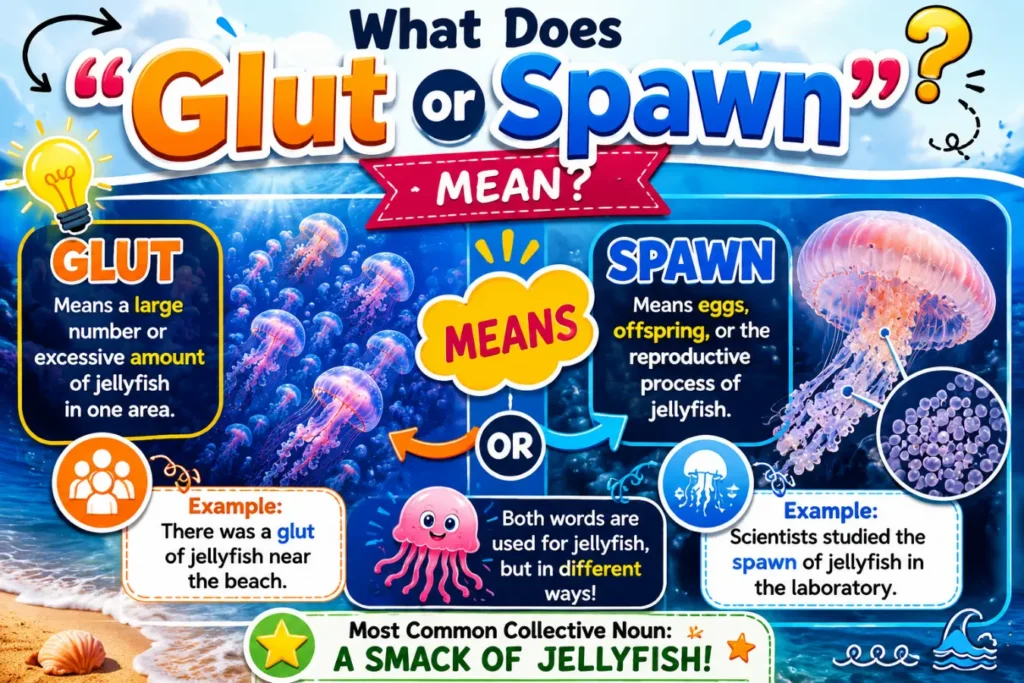
- Glut means an excessive amount or abundance.
- Spawn refers to eggs, offspring, or reproduction.
These words describe different ideas, even though both connect to marine life.
What Is a Glut of Jellyfish?
A glut of jellyfish means a very large number of jellyfish appearing in one area.
People often use this term when jellyfish populations increase quickly.
Example:
- Scientists reported a glut of jellyfish near the coast.
- Tourists avoided the beach because of the jellyfish glut.
The word “glut” emphasizes quantity.
What Is a Spawn of Jellyfish?
A spawn of jellyfish connects to reproduction.
The word “spawn” usually describes eggs or newly produced organisms.
Example:
- Researchers studied the spawn of several jellyfish species.
- Marine experts monitored jellyfish spawn during breeding season.
The word highlights biological growth.
Glut vs Spawn Comparison Table
| Feature | Glut | Spawn |
|---|---|---|
| Main Meaning | Large quantity | Reproduction or offspring |
| Focus | Population size | Breeding process |
| Common Usage | Environmental reports | Marine biology |
| Everyday Use | More common | Less common |
| Related to Growth | No | Yes |
Why Do People Confuse Glut and Spawn?
Many people think both words describe the same thing.
However, they focus on different aspects.
- Glut = abundance.
- Spawn = reproduction.
Because both appear in marine discussions, confusion often happens.
The Most Common Collective Noun for Jellyfish
Although people ask about glut or spawn, the best-known collective noun is:
A Smack of Jellyfish
Examples:
- We spotted a smack of jellyfish near the harbor.
- Divers avoided the large smack of jellyfish.
Other rare terms include:
- Bloom of jellyfish
- Swarm of jellyfish
- Glut of jellyfish
Real-Life Examples
Example 1: Beach News
Officials warned visitors about a glut of jellyfish along the shoreline.
Example 2: Marine Research
Scientists observed jellyfish spawn during the breeding season.
Example 3: Aquarium Studies
Researchers recorded population growth after spawning evets.
Usage in Daily Life
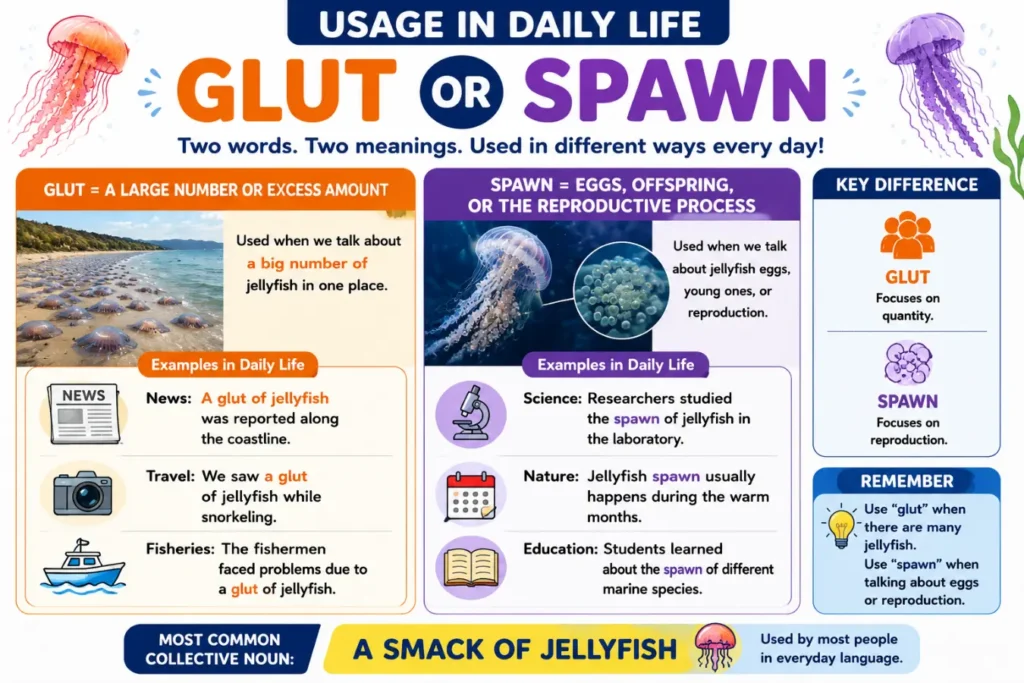
Most people rarely use these words in daily conversation.
However, they appear in:
- Nature documentaries
- Marine biology articles
- News reports
- Educational materials
- Wildlife magazines
Common Mistakes People Make
Mistake 1: Using Spawn for Any Group
Spawn does not always mean a group.
It often refers to reproduction.
Mistake 2: Thinking Glut Means Breeding
Glut describes abundance, not eggs or offspring.
Mistake 3: Ignoring Context
Always consider the topic before choosing the word.
Tips to Remember the Difference
Think About Quantity
Use glut when discussing large numbers.
Think About Reproduction
Use spawn when discussing breeding.
Remember the Popular Term
For general writing, “smack of jellyfish” sounds most natural.
Synonyms and Related Terms
Related Collective Nouns
- smack of jellyfish
- bloom of jellyfish
- swarm of jellyfish
- group of jellyfish
Related Marine Terms
- colony
- cluster
- aggregation
- breeding group
Why Jellyfish Populations Matter
Large jellyfish populations affect marine ecosystems.
They can influence:
- Fishing industries
- Tourism
- Ocean food chains
- Marine biodiversity
Scientists monitor these populations carefully.
Expert Insights
Marine experts choose words based on context.
For educational writing:
- Use glut when discussing abundance.
- Use spawn when discussing reproduction.
- Use smack for general audiences.
Correct terminology improves clarity and authority.
Frequently Asked Questions
What does glut of jellyfish mean?
It means a very large number of jellyfish gathered together.
What does spawn of jellyfish mean?
It refers to reproduction or offspring.
Which term is more common?
Glut appears more often than spawn when discussing populations.
What is the official collective noun for jellyfish?
A smack of jellyfish is the most widely recognized term.
Is spawn always a collective noun?
No. It often refers to eggs or reproduction.
Can glut describe other animals?
Yes. Glut can describe an excessive amount of many things.
Why are jellyfish populations increasing?
Climate changes and environmental factors may contribute.
Internal Linking Suggestions
You can link this article to:
- What Is a Smack of Jellyfish?
- Collective Nouns for Animals
- Types of Marine Animals
- Ocean Ecosystems Explained
- Interesting Animal Group Names
Conclusion
The debate over Glut or Spawn comes down to meaning and context. A glut of jellyfish describes abundance, while spawn relates to reproduction.
Although both terms appear in marine discussions, they serve different purposes. For everyday writing, most people recognize smack of jellyfish more easily.
Understanding these differences improves vocabulary and helps readers communicate clearly.
The simple takeaway is this:
Use “glut” for large numbers and “spawn” for reproduction.