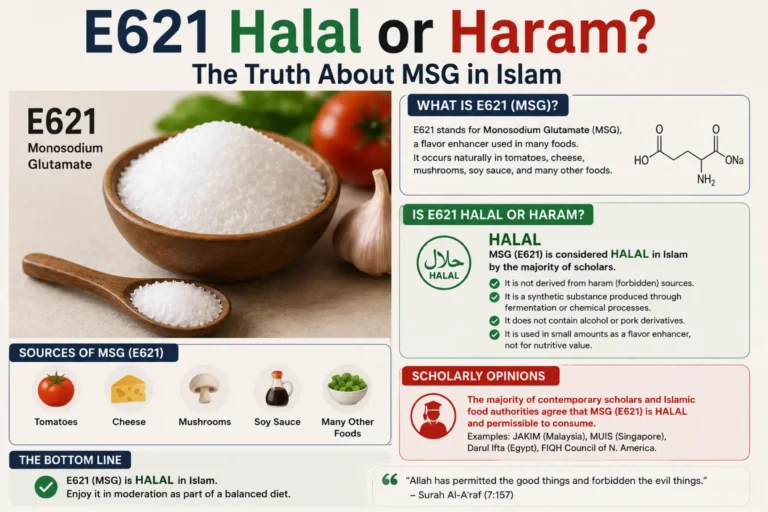
E621 halal or haram is a question many Muslims ask when checking food ingredients. E621 refers to monosodium glutamate, also called MSG. Manufacturers use it to improve flavor in many foods.
Many people worry about whether E621 contains forbidden ingredients. Others wonder if it comes from animal sources.
The answer depends on how the ingredient is produced. In most cases, E621 comes from plant-based fermentation. Because of this, many Islamic scholars consider it halal.
Still, some Muslims prefer to check halal certification before buying products.
This guide explains E621 in simple words. You will learn what it is, how companies make it, and whether Muslims can consume it.
Quick Summary Box
- E621 is another name for monosodium glutamate (MSG).
- Manufacturers use it as a flavor enhancer.
- Most modern E621 comes from plant fermentation.
- Many scholars consider plant-based E621 halal.
- The source of production matters.
- Halal certification provides extra assurance.
- Muslims should check trusted halal authorities when unsure.
What Is E621?
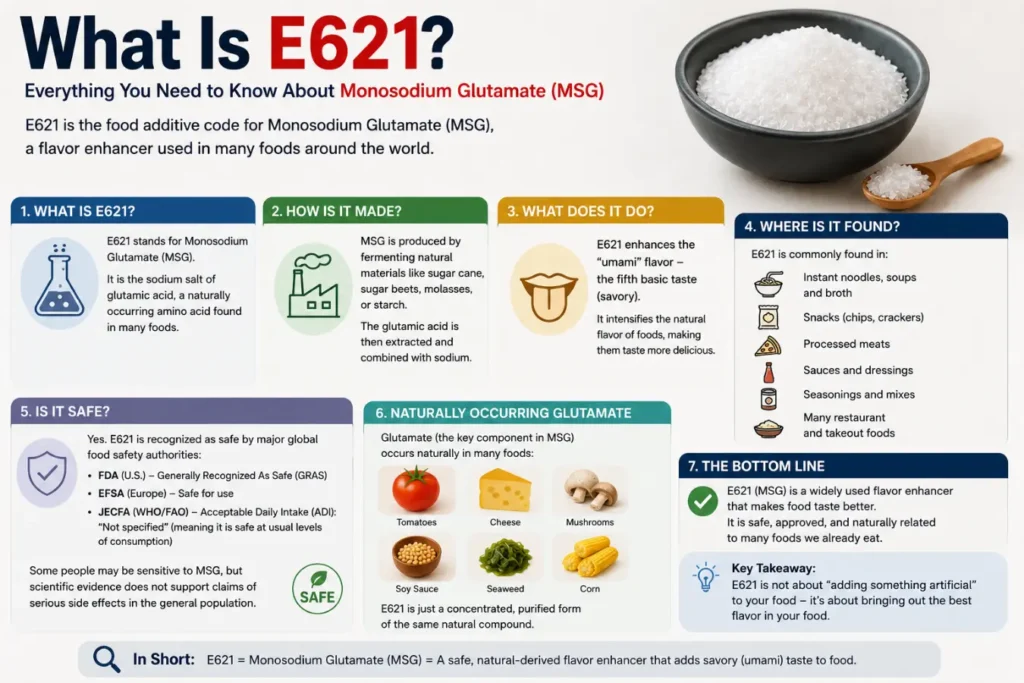
E621 is the food code for monosodium glutamate (MSG).
MSG helps foods taste richer and more savory. People often describe this taste as “umami.”
Food companies add E621 to:
- Instant noodles
- Chips
- Soups
- Seasonings
- Frozen meals
- Snacks
What Does Halal and Haram Mean?
Halal
Halal means permissible under Islamic law.
Haram
Haram means forbidden under Islamic law.
Muslims try to avoid ingredients that come from prohibited sources.
What Is Monosodium Glutamate (MSG)?
Monosodium glutamate combines sodium with glutamic acid.
Glutamic acid exists naturally in many foods, including:
- Tomatoes
- Cheese
- Mushrooms
- Corn
- Soybeans
MSG itself does not automatically make food haram.
The production method determines its halal status.
How Is E621 Produced?
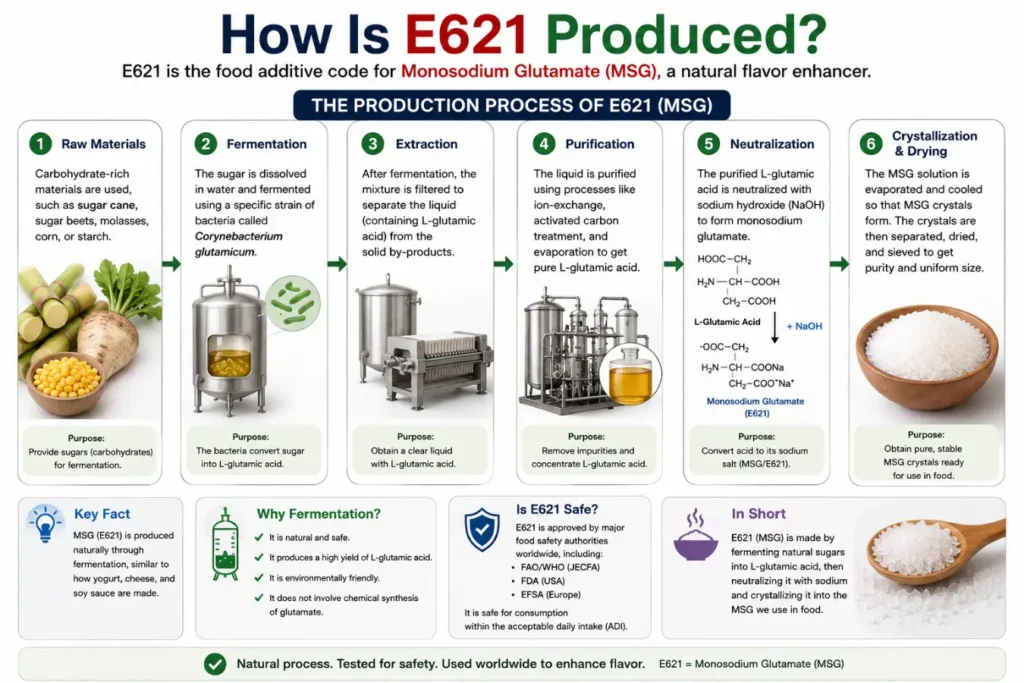
Today, companies usually produce E621 through fermentation.
Common sources include:
- Sugar cane
- Corn
- Beet sugar
- Molasses
The process resembles the way yogurt or vinegar is made.
Because these sources are plant-based, many scholars consider the final product halal.
Is E621 Halal or Haram?
Short Answer
E621 is generally considered halal when manufacturers produce it from plant-based fermentation.
Most commercial MSG no longer comes from animal sources.
However, Muslims should verify ingredients when:
- The source remains unclear.
- Products lack halal certification.
- Local scholars recommend caution.
Why Some Muslims Have Concerns
Some concerns come from:
- Unknown manufacturing sources.
- Confusion about food additives.
- Internet rumors.
- Lack of halal certification.
Not every additive with a number is haram.
Each ingredient requires separate evaluation.
Opinions of Islamic Scholars
Many halal organizations permit MSG produced from lawful sources.
Scholars often examine:
- Source materials.
- Manufacturing process.
- Possible contamination.
- Presence of animal-derived ingredients.
When the process uses plant materials, scholars generally classify E621 as halal.
E621 Halal vs Haram Comparison Table
| Factor | Halal E621 | Haram E621 |
|---|---|---|
| Source | Plant-based | Forbidden animal source |
| Production | Clean fermentation | Contaminated process |
| Certification | Halal approved | No approval |
| Usage | Permissible | Not permissible |
| Muslim consumption | Allowed | Avoided |
Foods That Commonly Contain E621
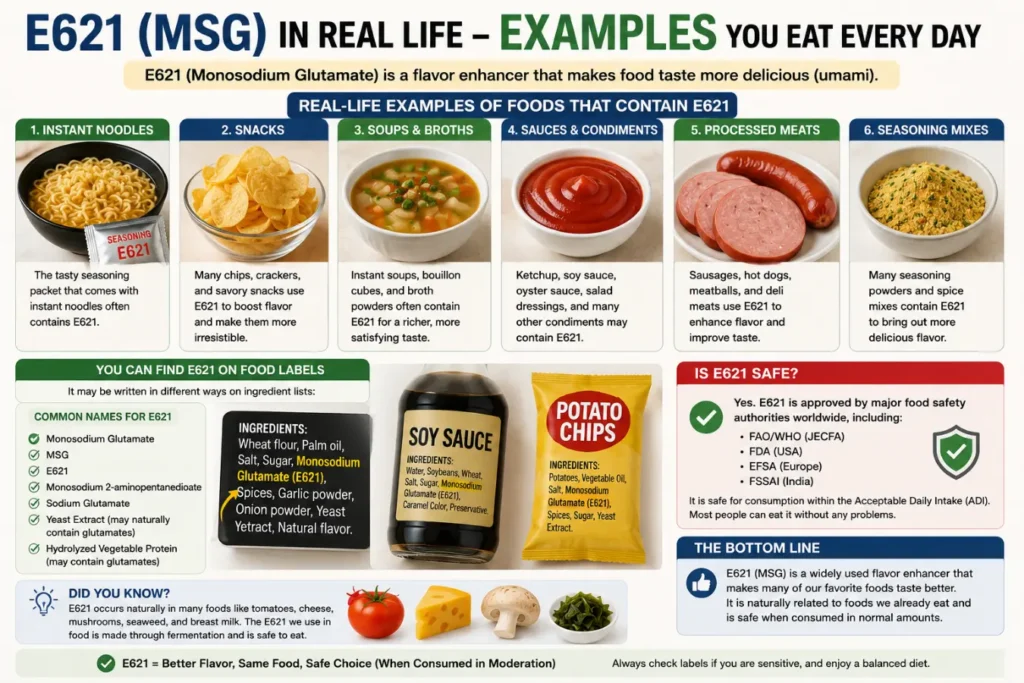
You may find E621 in:
- Flavored chips
- Instant noodles
- Bouillon cubes
- Packaged soups
- Frozen foods
- Seasoning powders
- Fast food products
Always read labels carefully.
Real-Life Example
Ahmed buys instant noodles.
He notices E621 on the ingredient list.
He checks whether the brand carries halal certification.
After confirming the product’s halal status, he feels comfortable consuming it.
This simple habit helps many Muslims make informed choices.
Common Mistakes People Make
Assuming All Additives Are Haram
Food numbers do not automatically mean forbidden ingredients.
Believing Internet Rumors
Not every online claim comes from reliable sources.
Ignoring Halal Certification
Certification can provide additional confidence.
Confusing Health Issues With Religious Issues
Health debates about MSG differ from halal rulings.
Tips for Muslims Checking Food Ingredients
Read Labels Carefully
Always review ingredient lists.
Look for Halal Logos
Certified products provide extra assurance.
Ask Manufacturers
Many companies answer ingredient questions.
Consult Trusted Scholars
Seek guidance from qualified Islamic authorities.
Usage in Daily Life
Muslims encounter E621 regularly.
Examples include:
- Grocery shopping.
- Dining at restaurants.
- Buying snacks.
- Preparing instant meals.
- Choosing imported foods.
Understanding ingredients helps Muslims make better decisions.
Related Terms and LSI Keywords
Synonyms
- MSG
- Monosodium glutamate
- Flavor enhancer 621
Related Search Terms
- Is MSG halal?
- E621 ingredients halal
- MSG haram or halal
- Food additive E621
- Monosodium glutamate Islamic ruling
- Halal food additives list
- Is MSG vegetarian?
- E numbers halal guide
Expert Insight
Ingredient sources matter more than ingredient numbers.
Modern food science shows that most commercial E621 comes from fermentation.
Reliable halal certification remains one of the best ways to verify food products.
Muslims should combine scientific information with guidance from trusted scholars.
This approach supports informed and responsible choices.
Frequently Asked Questions
Is E621 the same as MSG?
Yes. E621 is the food code for monosodium glutamate.
Is E621 halal?
Most scholars consider plant-based E621 halal.
Can E621 come from animals?
Modern production usually uses plant sources.
Is MSG haram in Islam?
Not necessarily. The source determines the ruling.
Does every food containing E621 become haram?
No. The ingredient itself is generally permissible when produced lawfully.
Should Muslims look for halal certification?
Yes. Certification provides additional confidence.
Is E621 vegetarian?
Most commercial E621 is vegetarian.
Why do some Muslims avoid E621?
Some people prefer caution when ingredient sources remain unclear.
Internal Linking Suggestions
Link this article with:
- Halal Food Additives Guide
- Is Gelatin Halal or Haram?
- E471 Halal or Haram?
- Is Vinegar Halal in Islam?
- Understanding Halal Certification
Conclusion
The question “e621 halal or haram” concerns many Muslims who want to make informed food choices. In most cases, E621 comes from plant-based fermentation. Because of this, many scholars consider it halal.
Still, the manufacturing source remains important. Muslims should check labels and seek halal certification when possible.
Reliable information helps believers avoid confusion and unnecessary worry.
The simplest takeaway is this:
Most modern E621 products are considered halal, but checking trusted halal sources always provides extra peace of mind.