Is BF3 polar or nonpolar? This is one of the most common chemistry questions students ask. The answer is simple. BF3 is a nonpolar molecule.
Many learners feel confused because BF3 contains polar bonds. However, the overall molecule behaves differently.
Understanding molecular polarity helps explain chemical reactions and physical properties. It also makes chemistry easier to understand.
In this guide, you will learn why BF3 is nonpolar. You will also discover its molecular shape, bond polarity, common mistakes, and real-life applications.
By the end, you will clearly understand the polarity of boron trifluoride.
Quick Summary Box
- BF3 stands for boron trifluoride.
- BF3 contains three polar B–F bonds.
- BF3 has a trigonal planar shape.
- The bond dipoles cancel each other.
- BF3 is a nonpolar molecule.
- Symmetry determines its overall polarity.
- BF3 has a bond angle of 120°.
What Is BF3?
BF3 is the chemical formula for boron trifluoride.
It contains:
- One boron atom (B)
- Three fluorine atoms (F)
The boron atom sits at the center. The three fluorine atoms surround it evenly.
Scientists often use BF3 in chemical manufacturing and laboratory reactions.
Is BF3 Polar or Nonpolar?
BF3 is nonpolar.
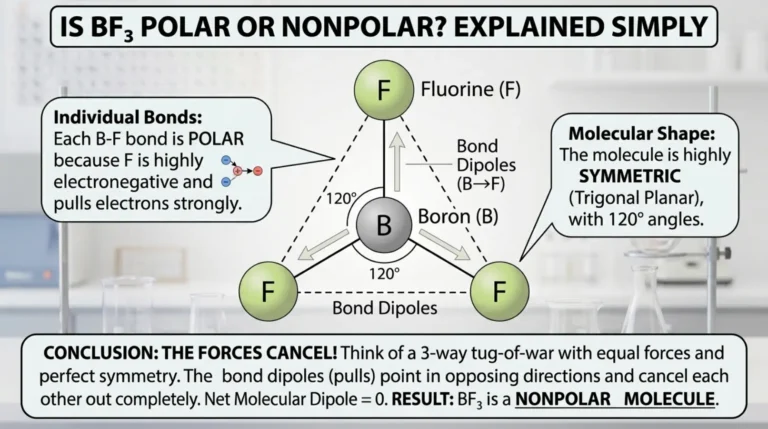
Although each boron-fluorine bond is polar, the molecule has a symmetrical shape.
Because of this symmetry, all bond dipoles cancel each other.
Therefore, BF3 has:
- No net dipole moment
- Equal charge distribution
- Nonpolar behavior
Final Answer:
BF3 is a nonpolar molecule.
Why Does BF3 Have Polar Bonds?
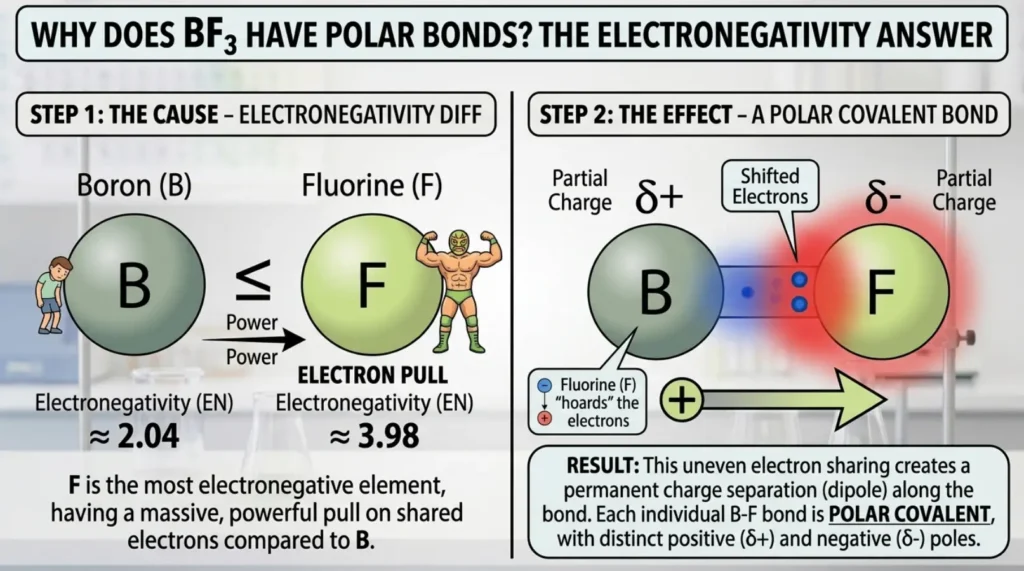
Fluorine is highly electronegative.
Boron has lower electronegativity.
This difference causes electrons to move closer to fluorine atoms.
As a result:
- Each B–F bond becomes polar.
- Fluorine carries a partial negative charge.
- Boron carries a partial positive charge.
However, bond polarity does not always mean molecular polarity.
Understanding Molecular Polarity in Simple Words
Molecular polarity depends on two factors:
1. Bond Polarity
Atoms with different electronegativities create polar bonds.
2. Molecular Shape
The arrangement of atoms determines whether dipoles cancel.
If dipoles cancel, the molecule becomes nonpolar.
If dipoles do not cancel, the molecule becomes polar.
What Is the Shape of BF3?
BF3 has a trigonal planar geometry.
Characteristics include:
- Three bonding pairs
- No lone pairs on boron
- Bond angle of 120°
- Flat triangular arrangement
Because the fluorine atoms sit evenly around boron, the molecule remains perfectly symmetrical.
Why Is BF3 Nonpolar?
The three bond dipoles point outward equally.
Since the molecule has a symmetrical trigonal planar structure, the dipoles balance one another.
As a result:
- Net dipole moment = zero
- Charge distribution remains uniform
- BF3 becomes nonpolar
This symmetry explains why BF3 behaves differently from many other molecules.
BF3 Polarity Diagram Explanation
Imagine three equal arrows pointing away from boron.
Each arrow represents a polar bond.
Because the arrows are equally spaced at 120°, they cancel.
This cancellation produces a nonpolar molecule.
BF3 vs NH3 Comparison Table
| Feature | BF3 | NH3 |
|---|---|---|
| Shape | Trigonal planar | Trigonal pyramidal |
| Lone pairs on central atom | None | One |
| Symmetry | Symmetrical | Asymmetrical |
| Bond polarity | Polar bonds | Polar bonds |
| Overall polarity | Nonpolar | Polar |
| Dipole moment | Zero | Present |
Real-Life Example
Two molecules may contain polar bonds. However, shape determines the final polarity.
That is why BF3 is nonpolar while NH3 is polar.
Which Is More Polar, BF₃ or BH₃?
Neither BF₃ (boron trifluoride) nor BH₃ (borane) is polar as a molecule. Although the B–F bonds in BF₃ are much more polar than the B–H bonds in BH₃, both molecules have a trigonal planar shape with three identical bonds arranged symmetrically around the central boron atom. Because of this symmetrical arrangement, the bond dipoles cancel each other out, giving both molecules a net dipole moment of zero.
The key difference is that BF₃ has more polar individual bonds due to fluorine’s high electronegativity, while BH₃ has nearly nonpolar B–H bonds. However, molecular polarity depends on both bond polarity and molecular geometry, not just the polarity of individual bonds.
Why Does BF₃ Violate the Octet Rule?
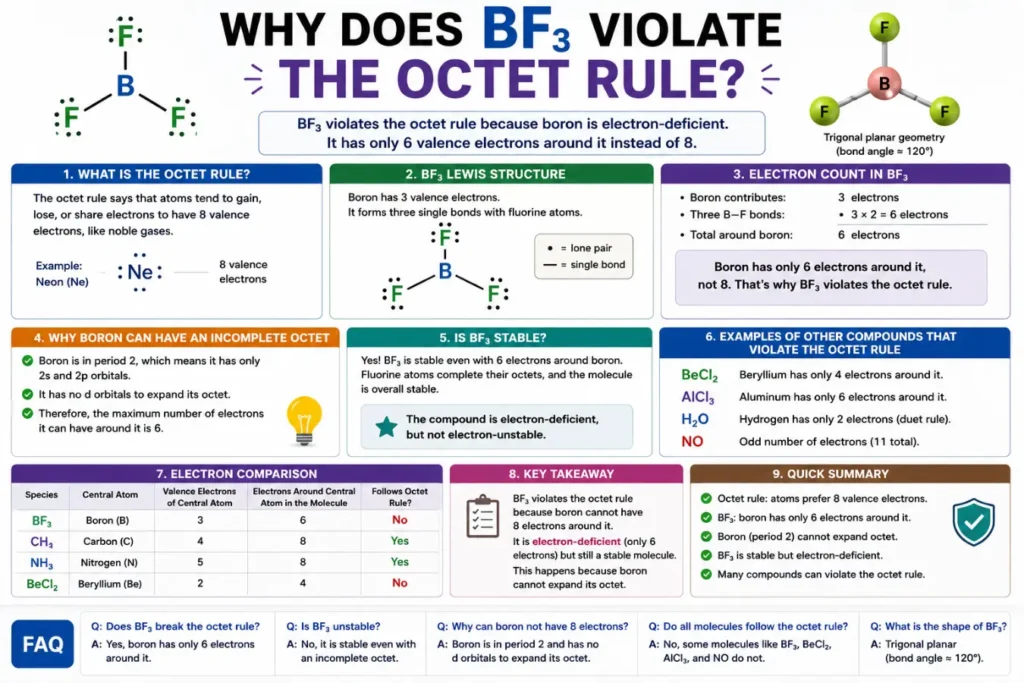
Boron trifluoride (BF₃) violates the octet rule because the central boron atom has only six valence electrons instead of the usual eight. Boron forms three single covalent bonds with three fluorine atoms. Each bond contributes two shared electrons, giving boron a total of six electrons around it. Unlike most atoms, boron is stable with an incomplete octet in BF₃ because it is an electron-deficient molecule.
Although boron does not achieve a full octet, BF₃ remains stable due to its strong B–F bonds and symmetrical trigonal planar structure. However, because boron lacks two electrons, BF₃ readily accepts an electron pair from other molecules, making it a Lewis acid.
Why Does Boron Have Only Six Electrons?
Boron has three valence electrons. In BF₃, it uses all three to form single bonds with fluorine atoms.
The electron count around boron is:
- Three B–F single bonds
- Each bond contains two shared electrons
- Total electrons around boron = 6
Since boron has only six electrons instead of eight, BF₃ is an octet-rule exception.
Why Is BF₃ Still Stable?
BF₃ is stable because:
- The B–F bonds are very strong.
- The molecule has a trigonal planar shape with 120° bond angles.
- Fluorine atoms help stabilize the molecule through strong bonding.
- Boron can function effectively with an incomplete octet.
Despite its stability, BF₃ remains electron-deficient and can react with molecules that donate a pair of electrons.
Why Is BF₃ a Lewis Acid?
Because boron has only six electrons, it has room to accept one lone pair of electrons from another atom or molecule.
For example:
- BF₃ + NH₃ → F₃B←NH₃
In this reaction, ammonia donates a lone pair to boron, allowing boron to complete its octet.
Key Facts
| Property | BF₃ |
|---|---|
| Central atom | Boron (B) |
| Number of B–F bonds | 3 |
| Electrons around boron | 6 |
| Octet satisfied? | No |
| Molecular shape | Trigonal planar |
| Lewis acid? |
Real-Life Uses of BF3
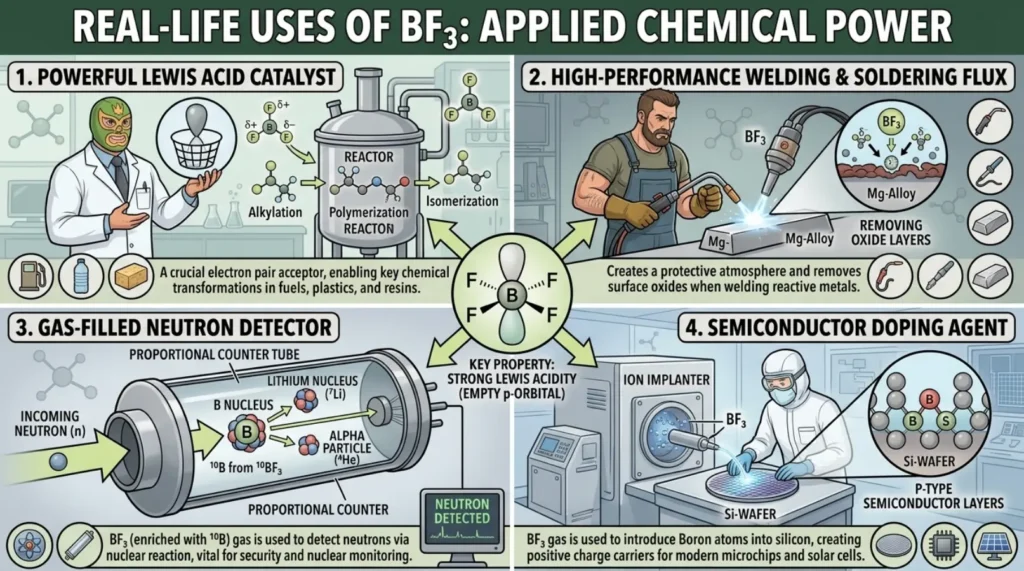
Boron trifluoride has several industrial uses.
Chemical Manufacturing
Companies use BF3 to produce organic compounds.
Petroleum Industry
BF3 helps refine fuels and chemicals.
Laboratory Reactions
Scientists use BF3 as a catalyst.
Polymer Production
Manufacturers use it to create plastics and specialty materials.
Common Mistakes Students Make
Mistake 1: Assuming Polar Bonds Mean Polar Molecules
Polar bonds do not always create polar molecules.
Mistake 2: Ignoring Molecular Shape
Shape determines whether dipoles cancel.
Mistake 3: Forgetting Symmetry
Symmetrical molecules often become nonpolar.
Mistake 4: Confusing BF3 with NH3
Both have three outer atoms, but their shapes differ.
Tips and Tricks to Remember BF3 Polarity
Use these simple tricks:
Remember the Shape
Trigonal planar molecules with identical atoms are often nonpolar.
Check for Lone Pairs
No lone pairs usually increase symmetry.
Look for Dipole Cancellation
Equal dipoles cancel each other.
Think “Symmetry Equals Nonpolarity”
This rule helps solve many chemistry questions.
Usage of Polarity in Daily Life
Polarity affects many things around us.
Examples include:
- Dissolving substances
- Cleaning products
- Medicines
- Plastics
- Chemical reactions
- Industrial manufacturing
Chemists use polarity to predict how substances behave.
Synonyms and LSI Keywords
Related Keywords
- BF3 polarity
- boron trifluoride polarity
- is boron trifluoride polar
- BF3 molecular geometry
- BF3 dipole moment
- trigonal planar molecule
- polar vs nonpolar molecules
- molecular polarity examples
- BF3 Lewis structure
- why is BF3 nonpolar
Semantic Variations
- polarity of BF3
- BF3 shape and polarity
- boron trifluoride structure
- BF3 bond polarity
Expert Insight
Chemistry experts determine polarity by studying:
- Electronegativity differences
- Molecular geometry
- Dipole moments
Students often focus only on bond polarity. However, molecular shape provides the final answer.
Understanding symmetry helps solve many chemistry problems quickly.
This concept appears frequently in school exams and competitive tests.
Frequently Asked Questions
Is BF3 polar or nonpolar?
BF3 is nonpolar.
Why is BF3 nonpolar?
Its trigonal planar shape causes dipoles to cancel.
Does BF3 have polar bonds?
Yes. Each B–F bond is polar.
What is the geometry of BF3?
BF3 has trigonal planar geometry.
Does BF3 have a dipole moment?
No. Its net dipole moment equals zero.
Why is NH3 polar but BF3 nonpolar?
NH3 contains a lone pair, which creates asymmetry.
What is the bond angle in BF3?
The bond angle is 120 degrees.
Is boron trifluoride symmetrical?
Yes. BF3 has a symmetrical arrangement.
Conclusion
If you are wondering is BF3 polar or nonpolar, the answer is clear. BF3 is a nonpolar molecule.
Although boron trifluoride contains polar B–F bonds, its trigonal planar geometry creates perfect symmetry. Because of this arrangement, the bond dipoles cancel each other.
Understanding polarity requires more than checking electronegativity. You must also examine molecular shape and symmetry.
Remember this simple rule:
Polar bonds do not always mean polar molecules.
Once you understand this concept, identifying molecular polarity becomes much easier.