Is usted formal or informal? Many Spanish learners ask this question when they start speaking Spanish. Understanding the difference helps you sound polite and natural.
In Spanish, words change depending on who you speak to. Some words show respect. Others show familiarity. “Usted” is one of the most important words to learn.
Knowing when to use usted can help you avoid awkward situations. It also makes conversations easier.
This guide explains everything in simple terms. You will learn the meaning of usted, see examples, compare it with tú, and discover common mistakes to avoid.
Quick Summary Box
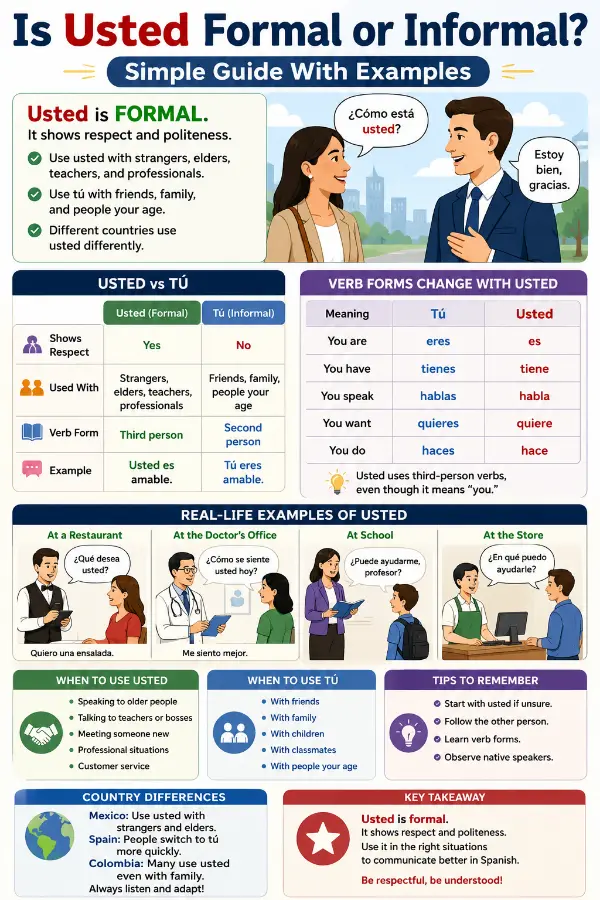
- Usted is formal.
- Spanish speakers use usted to show respect.
- Use usted with strangers, elders, teachers, and professionals.
- Tú is the informal version of “you.”
- Different countries use usted differently.
- Learning when to use usted helps you sound polite.
What Does Usted Mean?
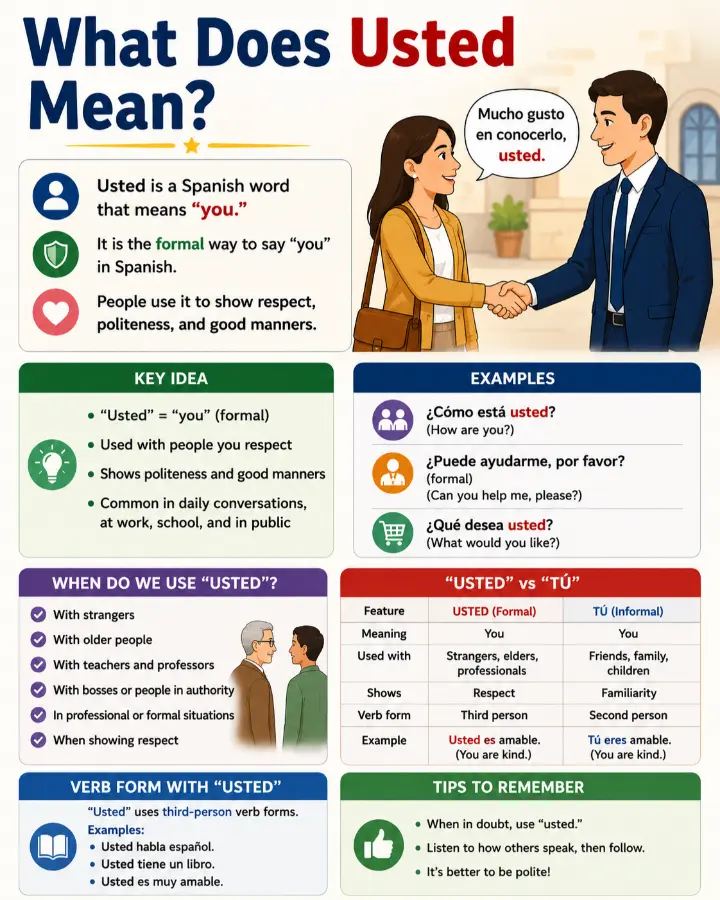
Usted means “you” in Spanish.
However, it is the formal form of “you.”
People use it when they want to show:
- Respect
- Politeness
- Professionalism
Example
- ¿Cómo está usted?
- How are you?
This sentence sounds polite and respectful.
Is Usted Formal or Informal?
The answer is simple:
Usted is formal.
Spanish speakers use it when speaking to:
- Older people
- Teachers
- Doctors
- Bosses
- Customers
- Strangers
Using usted shows good manners.
Why Does Spanish Have Formal and Informal “You”?
Spanish separates conversations into two styles:
- Formal speech
- Informal speech
This system helps speakers show:
- Respect
- Social distance
- Friendliness
Many languages have similar systems.
For example:
- French uses vous and tu.
- German uses Sie and du.
Usted vs Tú Comparison Table
| Feature | Usted | Tú |
|---|---|---|
| Type | Formal | Informal |
| Meaning | You | You |
| Shows Respect | Yes | Usually No |
| Used With | Strangers and professionals | Friends and family |
| Verb Form | Third person | Second person |
| Example | Usted es amable. | Tú eres amable. |
When Should You Use Usted?
Use usted in these situations:
Speaking to Older People
Example:
- ¿Necesita ayuda, señora?
- Do you need help, ma’am?
Talking to Teachers
Example:
- ¿Puede explicarlo otra vez?
- Can you explain it again?
Meeting Someone New
Example:
- Mucho gusto en conocerlo.
- Nice to meet you.
Professional Settings
Example:
- ¿Tiene una cita hoy?
- Do you have an appointment today?
When Should You Use Tú Instead?
Use tú with:
- Friends
- Brothers and sisters
- Children
- Classmates
- Close relatives
Example
- ¿Cómo estás?
- How are you?
This sounds friendly and casual.
Real-Life Examples of Usted
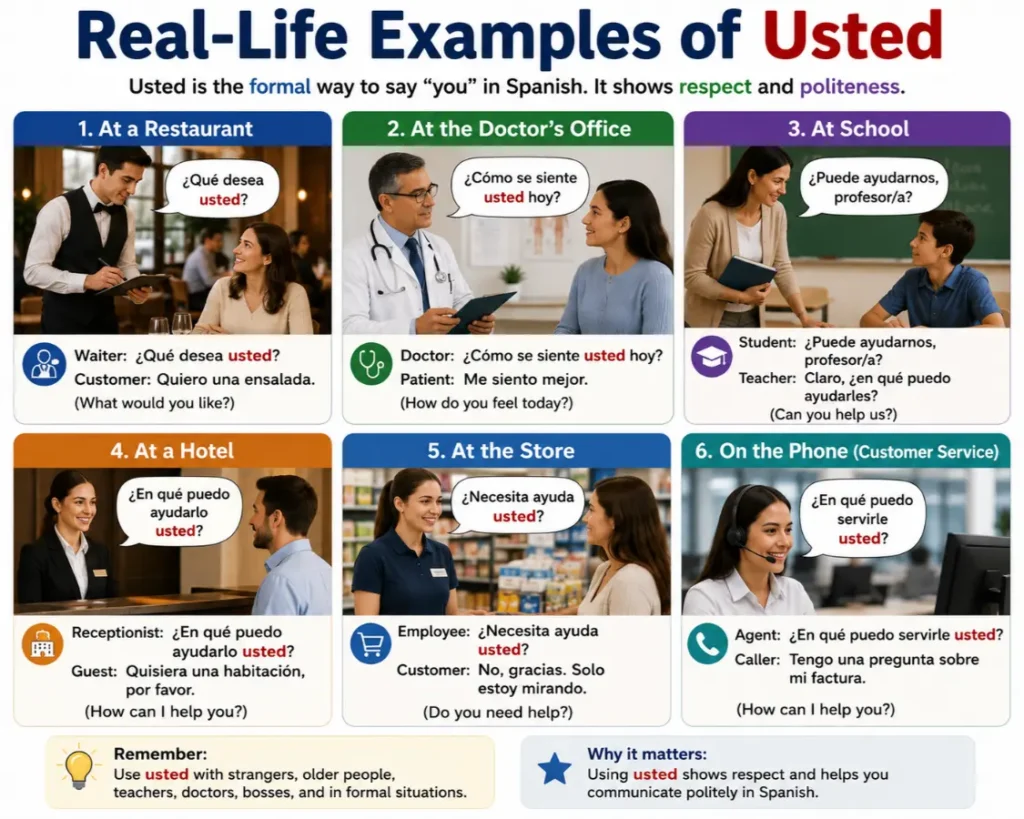
At a Restaurant
Mesero: ¿Qué desea usted?
Customer: Quiero una ensalada.
At the Doctor’s Office
Doctor: ¿Cómo se siente usted hoy?
Patient: Me siento mejor.
At School
Student: ¿Puede ayudarme, profesor?
These examples show polite communication.
How Verb Forms Change With Usted
One important rule surprises many learners.
Even though usted means “you,” it uses third-person verbs.
Examples
| Subject | Verb |
|---|---|
| Tú | eres |
| Usted | es |
| Tú | tienes |
| Usted | tiene |
| Tú | hablas |
| Usted | habla |
Example
- Usted habla español.
- You speak Spanish.
Does Every Spanish-Speaking Country Use Usted the Same Way?
No.
Different countries have different customs.
Mexico
People often use usted with strangers and elders.
Spain
People switch to tú more quickly.
Colombia
Many people use usted even with family members.
Because customs vary, listen carefully to native speakers.
Common Mistakes Learners Make
Using Tú With Everyone
This may sound rude in some places.
Mixing Verb Forms
Incorrect:
- Usted eres amable.
Correct:
- Usted es amable.
Forgetting Cultural Differences
Rules change between countries.
Tips for Using Usted Correctly
Start Formal
Begin with usted if you are unsure.
Follow the Other Person
If they switch to tú, you can usually do the same.
Learn Verb Conjugations
Practice common verbs like:
- ser
- estar
- tener
- hablar
Observe Native Speakers
Listening helps you understand real-life usage.
Usage of Usted in Daily Life
You may hear usted in:
- Hospitals
- Hotels
- Restaurants
- Stores
- Offices
- Schools
- Customer service calls
Formal speech remains important in many Spanish-speaking cultures.
Synonyms and Related Terms
LSI Keywords
- formal you in Spanish
- usted meaning
- tú vs usted
- Spanish formal pronouns
- polite Spanish words
- formal Spanish language
- when to use usted
- Spanish grammar for beginners
- informal you in Spanish
- Spanish pronouns
Expert Insight: Why Understanding Usted Matters
Language is more than vocabulary.
It also reflects culture and respect.
Using usted correctly helps you:
- Build better relationships.
- Avoid misunderstandings.
- Sound more natural.
- Show cultural awareness.
Many Spanish teachers recommend starting with usted and becoming less formal later.
This approach keeps conversations polite.
Frequently Asked Questions
Is usted formal or informal?
Usted is formal.
What is the informal version of usted?
The informal version is tú.
Can I use usted with friends?
Usually no. Friends often use tú.
Why does usted use third-person verbs?
Spanish grammar treats usted as a respectful form.
Is using tú rude?
Not always. It depends on culture and context.
Do people in Spain use usted often?
Yes, but many people switch to tú quickly.
Should beginners start with usted?
Yes. Starting formally is usually safer.
Can family members use usted?
Yes. In some countries, family members use it to show respect.
Internal Linking Suggestions
Link this article to:
- Spanish Pronouns Explained
- Tú vs Usted: Complete Comparison
- Common Spanish Greetings
- Spanish Verb Conjugation Guide
- Beginner Spanish Grammar Tips
Conclusion
So, is usted formal or informal? The answer is clear: usted is formal. Spanish speakers use it to show respect and politeness.
You should use usted when speaking with strangers, teachers, doctors, older adults, and professionals. In contrast, tú works better with friends and family.
Learning when to use usted improves your Spanish and helps you understand different cultures. If you are unsure, start with usted first. You can always become more informal later.
Respectful communication makes conversations smoother and more natural.