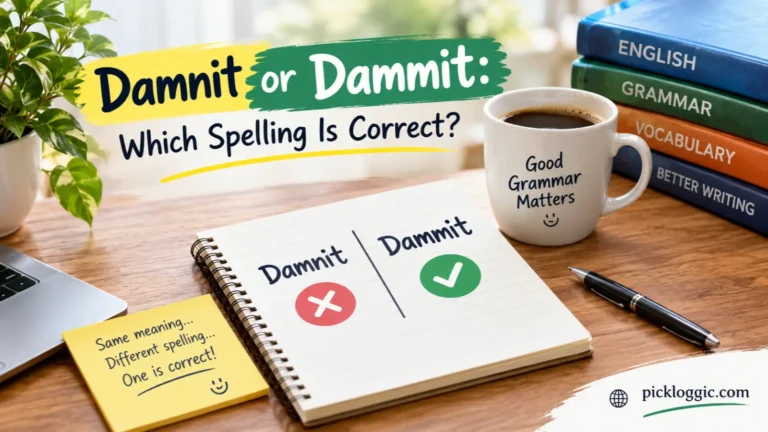
Damnit or dammit, which spelling should you use? Both spellings appear in everyday writing, online chats, and social media posts. They express frustration, anger, disappointment, or surprise. However, their spelling and usage can confuse many English learners. You may have seen both forms in text messages, movies, or casual conversations.
The good news is that you can understand the difference with a few simple rules. Dammit is a widely recognized informal spelling of an expression used to show frustration. Damnit is also common, especially in casual online writing. Neither form suits every situation, particularly formal or professional writing.
In this guide, you’ll learn what each spelling means, how people use it, and which option works best. You’ll also see real-life examples, common mistakes, and simple alternatives for different situations.
Quick Answer:
- Dammit is a widely recognized informal spelling used to express frustration or anger.
- Damnit is also used informally and is understood by many English speakers.
- Both forms appear in everyday writing, but usage varies.
- Neither spelling is appropriate for most formal or professional documents.
- Use dammit when you want a familiar, informal spelling.
- Choose a milder expression when writing for a professional or sensitive audience.
What Does Dammit Mean?
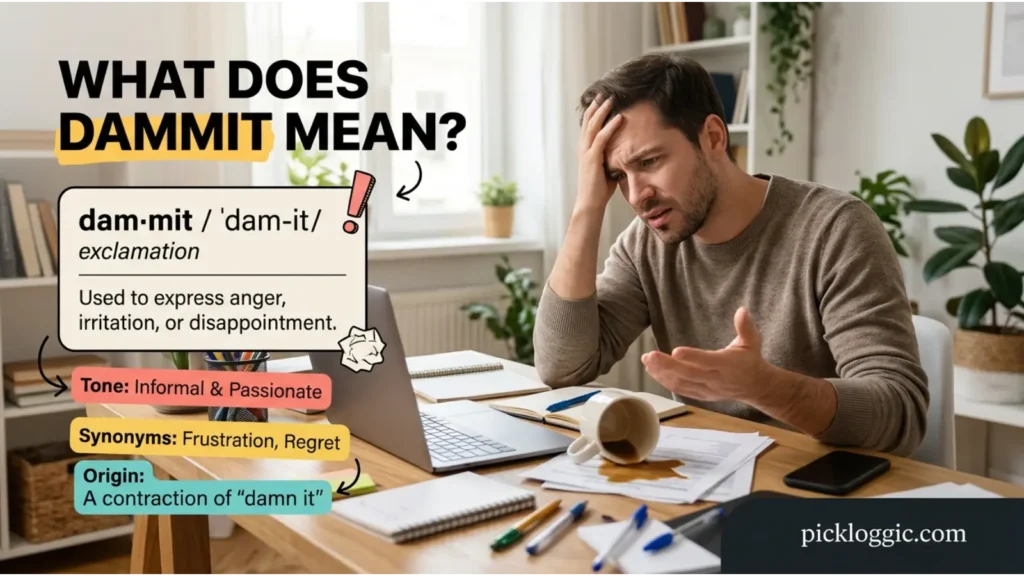
Dammit is an informal exclamation that expresses strong feelings, such as frustration, anger, annoyance, or disappointment.
People often use it when something goes wrong or when a situation does not meet their expectations.
For example:
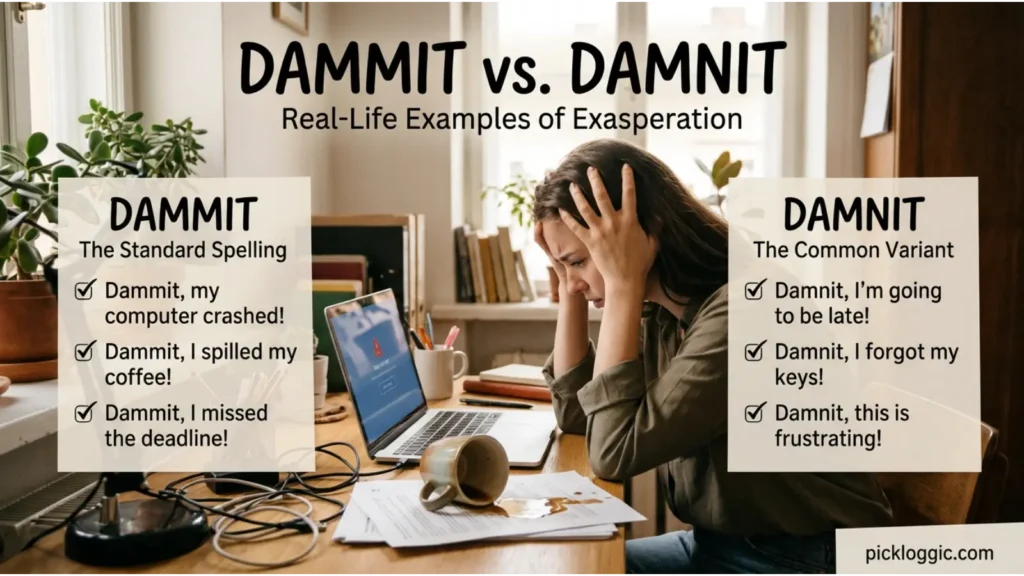
- “Dammit, I forgot my keys!”
- “Oh, dammit! I missed the bus.”
- “Dammit, this computer keeps freezing.”
In these examples, the speaker expresses frustration about an unexpected problem.
The word comes from the phrase “damn it.” Over time, speakers began writing the expression as one word. This shortened form became common in informal English.
Although people use it in conversation and casual messages, it can sound rude or aggressive. Consider your audience before using it.
What Does Damnit Mean?
Damnit is an informal spelling variant of dammit. People use it to express the same feelings, including irritation, anger, and disappointment.
For example:
- “Damnit, I left my wallet at home!”
- “Damnit, why did the lights go out?”
- “I tried my best, but damnit, it still didn’t work.”
Readers generally understand the intended meaning from context.
However, spelling references and individual style guides may prefer one form over the other. Some readers may also view damnit as a less standard variant.
If you want a widely recognized spelling for general informal writing, dammit is a sensible choice. If you’re quoting someone or following a particular publication’s style, preserve its preferred spelling.
Damnit vs. Dammit: What’s the Difference?
The main difference lies in spelling and convention, not meaning. Both forms can express frustration, but dammit is a widely recognized written form.
| Feature | Dammit | Damnit |
|---|---|---|
| Meaning | Expresses frustration or anger | Expresses frustration or anger |
| Usage | Common in informal writing | Common in informal writing |
| Recognition | Widely recognized | Understood, but may be treated as a variant |
| Formal writing | Usually unsuitable | Usually unsuitable |
| Text messages | Common | Also used |
| Recommended choice | A good general informal option | Acceptable in casual contexts |
Neither spelling changes the basic meaning of the expression.
The best choice depends on your writing purpose. For general use, choose dammit for a familiar spelling. For formal work, consider a more polite alternative.
Why Do People Spell It Damnit or Dammit?
English spelling often changes as people shorten phrases or represent spoken language in writing.
The expression dammit developed from “damn it.” In rapid speech, the words often blend together. Informal spelling reflects that pronunciation.
The form damnit also appears in everyday writing. It may reflect how writers interpret the spoken expression or how they prefer to spell it.
Online communication helps both forms spread. People encounter different spellings in comments, messages, entertainment, and social media posts.
Unlike words with completely different meanings, these two forms generally communicate the same message. The variation mostly reflects informal spelling habits and editorial preferences.
For that reason, consistency matters more than trying to assign a different meaning to each spelling.
How to Use Dammit in a Sentence
You can use dammit as an exclamation at the beginning or middle of a sentence. It often stands alone when someone reacts to a frustrating event.
At the Beginning of a Sentence
Use it to express an immediate reaction.
- “Dammit, I forgot the meeting!”
- “Dammit, the train is already leaving.”
- “Dammit, I lost my favorite pen.”
In the Middle of a Sentence
Use it to add emotional emphasis to a statement.
- “I tried to fix it, but dammit, nothing worked.”
- “We were so close to winning, dammit.”
- “I told you to be careful, dammit.”
At the End of a Sentence
Use it when the expression emphasizes frustration.
- “I can’t believe I made that mistake, dammit.”
- “This should have worked, dammit.”
- “I need a break from this problem, dammit.”
These examples suit informal conversations and fictional dialogue. Avoid this expression when a polite or professional tone matters.
Real-Life Examples of Damnit and Dammit
Understanding real situations makes the difference easier to remember.
Example 1: Forgetting something
“Dammit, I left my phone at home!”
The speaker expresses annoyance after forgetting an important item.
Example 2: A technical problem
“Damnit, my laptop just shut down.”
The writer uses an informal spelling to show frustration.
Example 3: Missing a deadline
“Dammit, I should have submitted the assignment earlier.”
The expression emphasizes regret.
Example 4: A casual text message
“Dammit, we’re going to be late again.”
The sender expresses annoyance about a delay.
Example 5: A polite workplace message
Instead of writing, “Dammit, the file is missing,” write, “The file appears to be missing. I’ll check again.”
The final example shows why audience and tone matter. You can communicate the same problem without using profanity.
Is Dammit a Bad Word?
Dammit is generally considered mild profanity or an informal swear expression. It is less severe than many stronger English swear words, but some people still find it offensive.
Its impact depends on the situation, audience, and tone.
Among close friends, it may sound like a normal expression of frustration. In a workplace, classroom, or formal meeting, it may appear unprofessional.
Parents may also discourage children from using it. Some online platforms and publications restrict profanity, even when the expression is relatively mild.
If you are unsure whether someone will find it acceptable, choose a neutral alternative. Words such as darn, shoot, or frustrating can communicate annoyance with less risk of offending anyone.
Common Mistakes When Using Damnit or Dammit
Writers often make a few simple mistakes when choosing between these spellings.
- Assuming they have different meanings: Both generally express frustration or anger.
- Using either form in formal writing: Both can sound too informal for professional documents.
- Treating damnit as a completely different word: It is generally a spelling variant of the same expression.
- Ignoring the audience: A word that feels normal among friends may offend someone else.
- Changing spelling within one article: Choose a preferred form and use it consistently.
- Confusing spelling with pronunciation: Both spellings represent essentially the same expression in ordinary use.
To avoid these mistakes, understand the meaning first. Then choose the spelling and tone that suit your audience.
Polite Alternatives to Damnit
Sometimes, you want to express frustration without sounding rude. English offers many alternatives that work in different situations.
| Alternative | Best Use | Example |
|---|---|---|
| Darn it | Mild frustration | “Darn it, I forgot my keys.” |
| Shoot | Casual surprise or annoyance | “Shoot, I missed the call.” |
| Oh no | Concern or disappointment | “Oh no, the file is gone.” |
| What a shame | Disappointment | “What a shame we missed it.” |
| That’s frustrating | Calm expression of annoyance | “That’s frustrating, but we’ll fix it.” |
| Unfortunately | Professional communication | “Unfortunately, the delivery is delayed.” |
| I can’t believe it | Surprise or disappointment | “I can’t believe it happened again.” |
These alternatives help you express emotions without relying on profanity.
For work emails, school assignments, and formal writing, unfortunately or that’s frustrating often works better.
Expert Tips for Choosing the Right Spelling
When deciding between damnit and dammit, focus on clarity, consistency, and audience.
1. Prefer a familiar spelling. Use dammit for general informal writing because it is a widely recognized form.
2. Follow your style guide. If a publisher, teacher, or editor specifies a spelling, follow that preference.
3. Keep quotations accurate. When quoting a person or reproducing dialogue, preserve the original spelling when appropriate.
4. Match the tone to the audience. Casual messages allow more informal language than business documents.
5. Avoid unnecessary profanity. If the expression does not add meaning or emotional force, remove it.
6. Check the full sentence. Punctuation can make an exclamation easier to read. For example, “Dammit, I forgot!” clearly separates the reaction from the statement.
These tips help you write naturally without making a simple spelling choice more complicated than necessary.

FAQs:
Is damnit or dammit correct?
Both spellings appear in informal English. Dammit is a widely recognized form, while damnit is commonly treated as a variant.
Is dammit one word or two?
Dammit is written as one word. It developed from the expression “damn it.”
Is damnit a real word?
Damnit is an established informal spelling variant. However, some dictionaries and style guides may prefer dammit.
Does damnit mean the same as dammit?
Yes. Both generally express anger, frustration, annoyance, or disappointment.
Is dammit considered profanity?
Yes. Many people consider it mild profanity. Its acceptability depends on the audience and situation.
Should I use dammit in a formal email?
Usually, no. Use alternatives such as unfortunately, that’s frustrating, or I apologize for the inconvenience.
Which spelling should I use in a text message?
Either spelling can work in a casual text. Choose dammit if you prefer a widely recognized informal form.
What is a polite alternative to dammit?
Darn it, shoot, and oh no are common alternatives. For professional writing, try unfortunately or that’s frustrating.
Conclusion
When comparing damnit or dammit, remember that both spellings generally express frustration, anger, or disappointment. They do not have separate meanings in ordinary informal use. However, dammit is a widely recognized spelling and makes a sensible choice for general casual writing.
You may still encounter damnit in text messages, online comments, and informal dialogue. Its use does not necessarily make the intended meaning unclear. The important thing is to choose a form that fits your purpose and remain consistent.
Keep your audience in mind, especially when writing professionally. If profanity feels unsuitable, choose a milder alternative such as darn it or that’s frustrating.
The simple takeaway: Use dammit for a familiar informal spelling, recognize damnit as a common variant, and choose polite language when the situation calls for it.