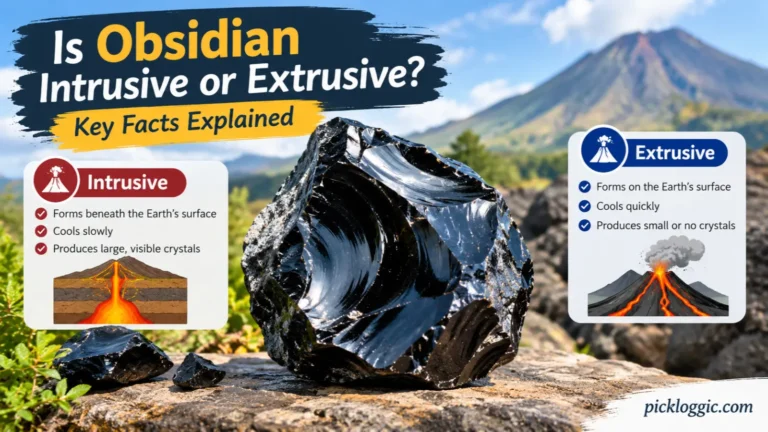
Is obsidian intrusive or extrusive? Obsidian is an extrusive igneous rock that forms when lava cools quickly at Earth’s surface. Unlike many other rocks, it has a smooth, glass-like texture and usually lacks visible crystals. However, its formation tells us even more about how volcanoes work.
When lava reaches the surface, it loses heat quickly. This rapid cooling prevents crystals from growing large enough to see. As a result, obsidian develops a natural volcanic glass structure. It often appears black, but some samples show brown, gray, green, or reddish colors.
Understanding obsidian helps explain the difference between intrusive and extrusive rocks. It also reveals how cooling speed affects a rock’s texture. In this guide, you’ll learn how obsidian forms, how it compares with other igneous rocks, and how to identify it correctly.
Quick Summary:
- Obsidian is an extrusive igneous rock.
- It forms when lava cools rapidly at or near Earth’s surface.
- Rapid cooling prevents crystals from growing large.
- It has a glassy texture rather than a typical crystalline structure.
- It commonly forms near volcanoes and lava flows.
- Its sharp edges have made it useful for cutting tools throughout history.
What Is Obsidian?
Obsidian is a natural volcanic glass that forms from rapidly cooled lava. Geologists classify it as an extrusive igneous rock because it develops at or near Earth’s surface.
Most igneous rocks contain mineral crystals. Obsidian differs because its atoms do not arrange into a well-developed crystalline structure during cooling. Scientists describe this material as amorphous volcanic glass.
Obsidian often looks black because of its chemical composition and tiny inclusions. However, its color can vary with impurities and other features.
People have used obsidian for thousands of years. Its sharp edges made it valuable for blades, arrowheads, and other cutting tools. Today, collectors prize it for its natural shine and striking appearance.
Why Is Obsidian an Extrusive Igneous Rock?
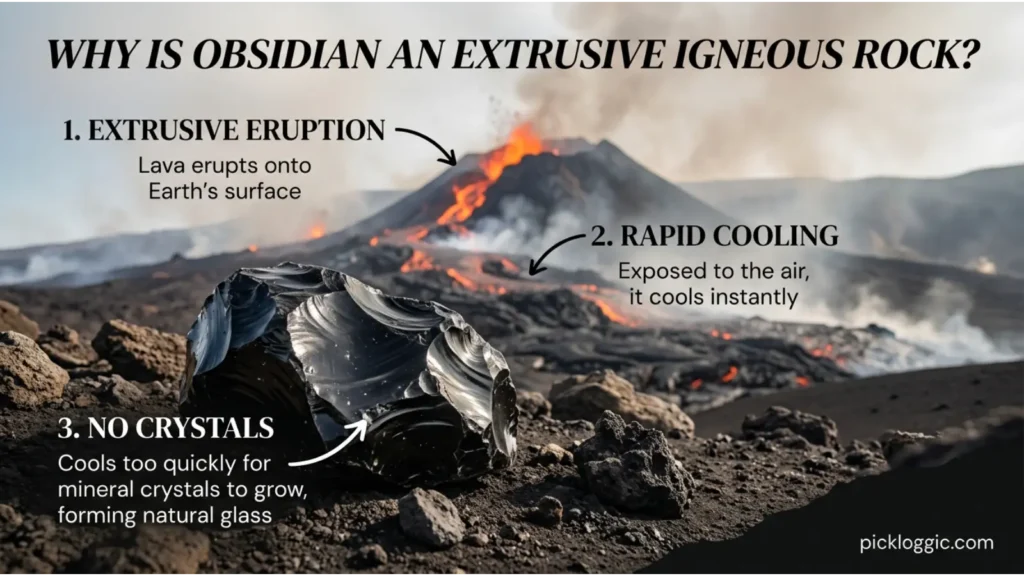
Obsidian belongs to the extrusive group because it forms from lava that cools at or near Earth’s surface.
When magma rises through a volcano, it may erupt as lava. The lava then releases heat into the surrounding air, water, and ground. This process can cool the material very quickly.
Fast cooling gives mineral crystals little time to grow. In obsidian, the melt becomes glass before a typical crystalline texture develops.
Intrusive rocks form differently. They develop when magma cools slowly beneath Earth’s surface. This longer cooling period usually allows larger mineral crystals to form.
Therefore, obsidian’s formation process places it in the extrusive category. Its glassy texture provides an important clue about its cooling history.
How Does Obsidian Form?
Obsidian forms when lava cools so quickly that it becomes volcanic glass. The process usually involves several stages.
- Magma develops: Heat melts rock beneath Earth’s surface.
- Lava reaches the surface: A volcanic eruption brings molten material into the open.
- Cooling begins: The lava loses heat to the surrounding environment.
- Crystal growth remains limited: Atoms have little time to form an organized mineral structure.
- Volcanic glass develops: The rapidly cooled material forms obsidian under suitable chemical conditions.
Obsidian commonly forms from silica-rich lava. However, not every lava flow produces obsidian. Its formation depends on the lava’s composition, cooling conditions, and ability to develop crystals.
The key factor is rapid cooling. This process explains why obsidian looks different from many other volcanic rocks.
What Is the Difference Between Intrusive and Extrusive Rocks?
Intrusive and extrusive rocks both form when molten rock cools. The main difference is where cooling occurs and how quickly it happens.
| Feature | Intrusive Rocks | Extrusive Rocks |
|---|---|---|
| Where they form | Beneath Earth’s surface | At or near Earth’s surface |
| Molten material | Magma | Lava |
| Cooling speed | Usually slow | Usually fast |
| Crystal size | Often large | Usually small or invisible |
| Common examples | Granite, gabbro | Basalt, obsidian |
| Typical texture | Coarse-grained | Fine-grained or glassy |
Granite is a common intrusive rock. Its visible crystals develop because magma cools slowly underground.
Basalt is a common extrusive rock. It usually contains very small crystals because lava cools much faster.
Obsidian is also extrusive, but its texture differs from basalt. Instead of developing a typical fine-grained crystalline structure, it forms natural volcanic glass.
Obsidian vs. Intrusive and Extrusive Rocks
Comparing obsidian with other igneous rocks makes its classification easier to understand.
| Rock | Classification | Cooling Process | Typical Texture |
|---|---|---|---|
| Obsidian | Extrusive | Very rapid | Glassy |
| Basalt | Extrusive | Relatively rapid | Fine-grained |
| Pumice | Extrusive | Rapid, often with trapped gas | Highly porous |
| Granite | Intrusive | Slow | Coarse-grained |
| Gabbro | Intrusive | Slow | Coarse-grained |
These examples show that extrusive rocks do not all look alike. Cooling speed, gas content, and chemical composition influence their final textures.
Obsidian stands out because it forms glass rather than a typical collection of visible mineral crystals.
What Makes Obsidian Different From Other Volcanic Rocks?
Obsidian has several features that distinguish it from other volcanic rocks.
Glassy appearance: Its surface often looks like dark glass. Freshly broken pieces can have smooth, curved fracture surfaces.
Sharp edges: Obsidian can break into extremely sharp edges. This feature made it useful for cutting tools in ancient societies.
Few visible crystals: Most samples lack visible mineral crystals. Some specimens may contain crystals or develop small crystalline areas.
Variable colors: Black is common, but brown, gray, green, and reddish varieties also occur.
Rapid formation: Its glassy structure reflects rapid cooling under suitable conditions.
These traits make obsidian easy to recognize in many cases. However, appearance alone cannot always confirm a rock’s identity.
Where Can You Find Obsidian in Nature?
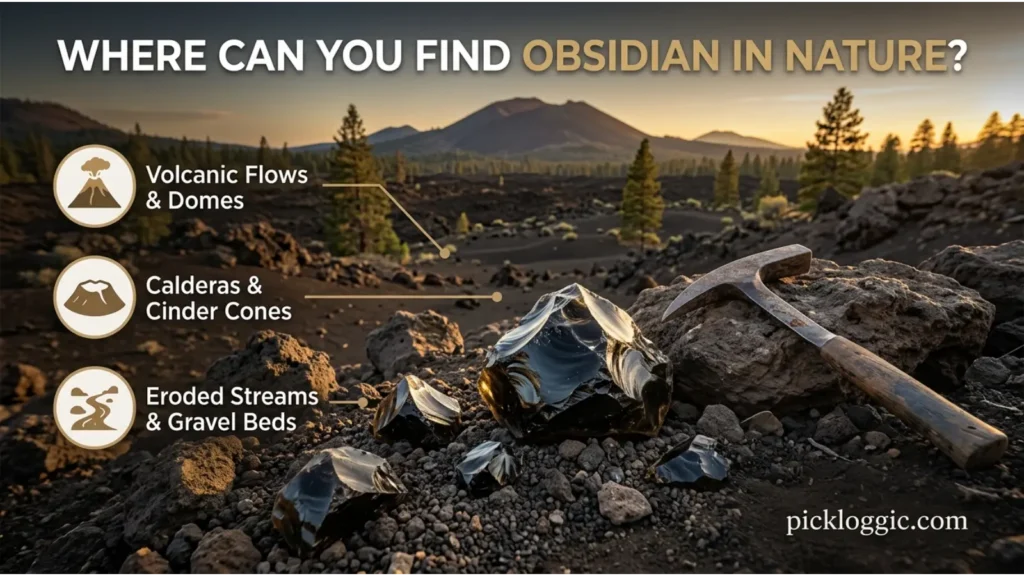
Obsidian commonly occurs in volcanic regions where suitable lava cools rapidly. It often forms near lava domes, volcanic vents, and the edges of certain lava flows.
Famous locations include parts of the western United States, Mexico, Iceland, Japan, and other volcanic areas.
One well-known example is Obsidian Cliff in Yellowstone National Park. Its volcanic glass formed during ancient volcanic activity.
Obsidian can also occur in archaeological sites far from its original source. Ancient communities traded it because its sharp edges were useful for making tools.
Finding obsidian depends on local geology. It does not occur in every volcanic region because the lava must have suitable conditions for glass formation.
Common Mistakes About Obsidian
Students often confuse obsidian with other igneous rocks. These mistakes can lead to incorrect answers in geology assignments and exams.
- Calling obsidian intrusive: Obsidian is generally classified as extrusive volcanic glass.
- Assuming all volcanic rocks look alike: Basalt, pumice, and obsidian have different textures.
- Thinking obsidian contains no crystals at all: Typical obsidian lacks visible crystals, but some specimens contain small crystals.
- Believing obsidian always looks black: Natural obsidian can also appear brown, green, gray, or reddish.
- Confusing magma with lava: Molten rock beneath Earth’s surface is magma. It becomes lava when it reaches the surface.
- Assuming cooling speed explains everything: Composition, viscosity, and gas behavior also influence volcanic glass formation.
Remember these distinctions when identifying rocks. They help you understand both obsidian’s classification and its unusual appearance.
How Can You Identify Obsidian?
You can use several visible features to recognize a possible obsidian sample. However, a field identification may require confirmation from a geology expert.
Look for these common features:
- Glassy shine: The surface often reflects light like dark glass.
- Smooth fracture surfaces: Broken pieces may show curved, shell-like patterns.
- Sharp edges: Fresh fractures can create very sharp cutting edges.
- Few visible crystals: Most typical samples lack obvious mineral grains.
- Dark color: Black is common, although other colors occur.
Never handle broken obsidian carelessly. Its sharp edges can cause serious cuts. Avoid testing its sharpness with your fingers.
Also, do not rely on color alone. Other materials can look like obsidian, so consider several features together.
Real-Life Examples of Obsidian
Obsidian connects geology with human history, archaeology, and modern science.
Ancient cutting tools: People shaped obsidian into blades, arrowheads, and scraping tools. Its sharp edges made it useful for many daily tasks.
Yellowstone National Park: Obsidian Cliff contains large deposits of volcanic glass. Ancient communities collected and traded material from this source.
Jewelry and decoration: Craftspeople use polished obsidian in beads, pendants, and decorative objects.
Geology education: Students examine obsidian to understand volcanic glass and the effects of crystallization.
Scientific research: Researchers study obsidian to learn how magma cools, how crystals develop, and how volcanic materials change over time.
These examples show why obsidian matters beyond its classification as an extrusive rock.
How Is Obsidian Used in Daily Life?
Obsidian has several practical and decorative uses.
- Jewelry: Makers turn polished obsidian into pendants, beads, and earrings.
- Decorative objects: Collectors display polished stones and carved pieces.
- Historical study: Archaeologists examine obsidian tools to study ancient technology and trade.
- Scientific research: Geologists study its glassy structure and volcanic origins.
- Specialized cutting tools: Carefully manufactured obsidian blades have applications in some research and specialized settings.
Obsidian is not a common construction material like granite. Its brittle nature and sharp fractures make it less suitable for many everyday building tasks.
Although its edges can become extremely sharp, obsidian can also break easily. Handle specimens carefully, especially when they have rough or fractured surfaces.
Obsidian Synonyms and Related Geological Terms
Understanding related terms can help you explore the topic more deeply and recognize useful search phrases.
| Term | Meaning |
|---|---|
| Volcanic glass | Natural glass formed through volcanic processes |
| Extrusive igneous rock | Rock that forms when molten material solidifies at or near the surface |
| Intrusive igneous rock | Rock that forms when magma solidifies underground |
| Lava | Molten rock that reaches Earth’s surface |
| Magma | Molten rock beneath Earth’s surface |
| Rhyolite | A silica-rich volcanic rock that often has a fine-grained texture |
| Amorphous material | Material without a well-developed, repeating crystal structure |
| Conchoidal fracture | A smooth, curved break often seen in glass and obsidian |
Obsidian is not an exact synonym for every type of volcanic glass. It refers to a particular glassy rock, commonly associated with silica-rich volcanic material.
Useful related search phrases include obsidian rock classification, how obsidian forms, obsidian cooling process, intrusive vs. extrusive rocks, and why obsidian has no visible crystals.
Expert Insights: What Geology Tells Us About Obsidian
Obsidian offers an important lesson: a rock’s texture can reveal clues about its formation.
Geologists examine mineral composition, crystal size, glass content, and the rock’s setting. Together, these features help explain how molten material changed into solid rock.
One important detail deserves attention. Textbooks often describe obsidian as the result of rapid cooling that prevents crystals from growing. This is a useful introduction, but current research shows that its formation can be more complex.
A 2026 study in Nature Communications examined how gas bubbles behave during obsidian formation. The researchers argued that bubble-free obsidian can require relatively slow cooling to allow bubbles to shrink or disappear. Their findings challenge the simplest explanation of obsidian’s cooling history.
This does not change the standard classification of obsidian as extrusive volcanic glass. Instead, it shows that scientists continue to refine their understanding of how it forms.
For accurate geology writing, distinguish between the basic classification and the more detailed scientific debate. This approach gives readers a clearer, more balanced explanation.
FAQs:
1. Is obsidian intrusive or extrusive?
Obsidian is an extrusive igneous rock. It usually forms when silica-rich lava solidifies near Earth’s surface.
2. Why is obsidian an extrusive rock?
Obsidian forms in volcanic settings rather than deep underground. Its glassy texture develops when conditions prevent the formation of a typical crystalline structure.
3. Is obsidian a volcanic rock?
Yes. Obsidian is a type of volcanic glass associated with volcanic activity. It belongs to the igneous rock group.
4. Does obsidian have crystals?
Typical obsidian lacks visible crystals because it contains abundant volcanic glass. However, some specimens contain small crystals or crystalline features.
5. Is obsidian the same as basalt?
No. Both are extrusive igneous rocks, but their textures differ. Basalt usually contains tiny mineral crystals, while obsidian has a glassy texture.
6. Why does obsidian look like glass?
Obsidian looks like glass because its material lacks the well-developed crystal structure found in most ordinary rocks. Its smooth surface can also produce a shiny appearance.
7. Can obsidian form underground?
Obsidian usually forms in volcanic settings at or near Earth’s surface. Glassy material can also develop in some shallow underground settings, so its formation is not limited to exposed lava flows.
8. What type of magma forms obsidian?
Obsidian commonly forms from silica-rich, viscous magma, often with a rhyolitic composition. Suitable chemical and cooling conditions allow volcanic glass to develop.
Conclusion
Is obsidian intrusive or extrusive? The answer is extrusive. Obsidian is a natural volcanic glass that usually forms in volcanic settings at or near Earth’s surface.
Its glassy texture sets it apart from many other igneous rocks. Unlike granite, which develops large crystals during slow underground cooling, obsidian lacks a typical crystalline structure. Its sharp edges have also made it valuable for ancient tools and modern decorative objects.
However, obsidian’s formation involves more than a simple cooling rule. Its chemical composition, viscosity, and gas behavior can influence how volcanic glass develops. Recent research continues to improve our understanding of this process.