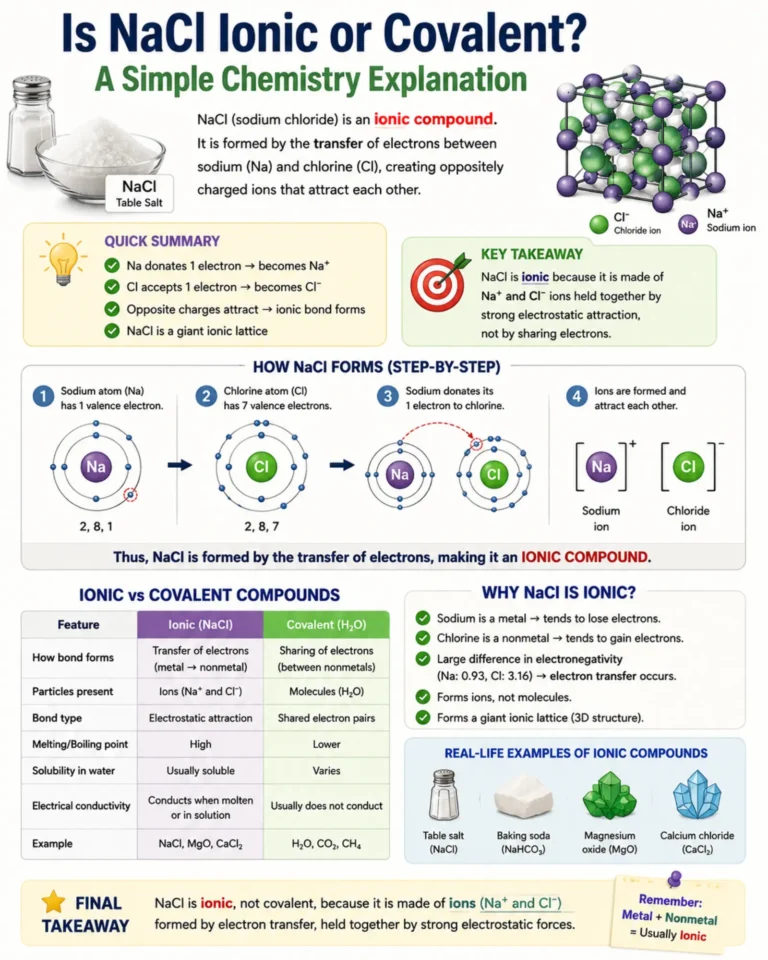
Is NaCl ionic or covalent? NaCl is an ionic compound made from sodium and chlorine. Sodium gives one electron to chlorine. This electron transfer creates charged particles called ions. Sodium becomes a positive ion, or Na⁺. Chlorine becomes a negative ion, or Cl⁻. Opposite charges then attract each other strongly. This attraction forms an ionic bond.
You may know NaCl as table salt. It appears in food, kitchens, laboratories, and many science lessons. However, many students still confuse ionic and covalent compounds. The key difference involves how atoms handle electrons. Ionic bonds involve electron transfer. Covalent bonds involve electron sharing.
In this guide, you will learn why NaCl is ionic. You will also see its structure, properties, examples, and common mistakes.
Quick Summary
- NaCl is an ionic compound.
- NaCl contains sodium ions, Na⁺.
- NaCl also contains chloride ions, Cl⁻.
- Sodium transfers one electron to chlorine.
- The ions attract through electrostatic forces.
- NaCl forms a repeating ionic crystal lattice.
- Solid NaCl does not conduct electricity well.
- Molten or dissolved NaCl conducts electricity.
- NaCl is also called sodium chloride or table salt.
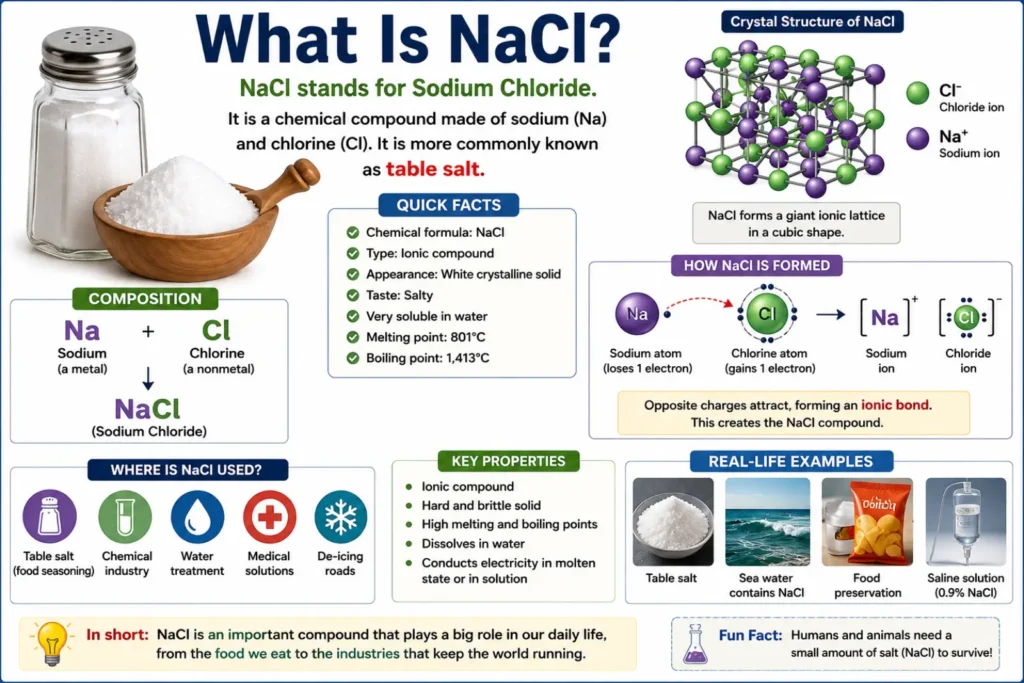
What Is NaCl?
NaCl is the chemical formula for sodium chloride.
People commonly call sodium chloride table salt. It contains two elements:
- Na means sodium.
- Cl means chlorine.
Sodium belongs to the alkali metal group. Chlorine belongs to the halogen group.
These two elements have different electron needs. Sodium has one outer electron. Chlorine needs one more electron to complete its outer shell.
Therefore, sodium transfers one electron to chlorine.
This process creates two ions:
- Sodium loses one electron and becomes Na⁺.
- Chlorine gains one electron and becomes Cl⁻.
The positive and negative ions attract each other. This attraction creates the ionic bond in NaCl.
Is NaCl Ionic or Covalent?
NaCl is ionic, not covalent.
The bond forms through electron transfer.
Sodium gives one electron to chlorine. The atoms then become charged ions. These ions attract because they have opposite charges.
The basic process looks like this:
Na → Na⁺ + e⁻
Cl + e⁻ → Cl⁻
Then:
Na⁺ + Cl⁻ → NaCl
This process explains the ionic nature of sodium chloride.
A covalent bond works differently. In a covalent bond, atoms share electrons. NaCl does not form through electron sharing.
Therefore, NaCl is classified as an ionic compound.
Why Does NaCl Form an Ionic Bond?
NaCl forms an ionic bond because sodium and chlorine have different chemical properties.
Sodium has one electron in its outer shell. Losing this electron gives sodium a more stable electron arrangement.
Chlorine has seven outer electrons. Gaining one electron gives chlorine a full outer shell.
Both atoms become more stable after electron transfer.
The result creates:
- Na⁺, a positively charged sodium ion.
- Cl⁻, a negatively charged chloride ion.
Opposite charges attract strongly. This attraction holds the ions together.
So, the main reason involves electron transfer and electrostatic attraction.
How Does Electron Transfer Work in NaCl?
Let us examine the process step by step.
Step 1: Sodium starts with one outer electron
Sodium has the electron arrangement:
2, 8, 1
The final electron sits alone in its outer shell.
Sodium can lose this electron easily.
Step 2: Sodium loses one electron
After losing one electron, sodium becomes:
Na⁺
It now has a positive charge.
Step 3: Chlorine gains one electron
Chlorine has the electron arrangement:
2, 8, 7
It needs one more electron for a full outer shell.
Chlorine gains the electron from sodium.
Step 4: Chlorine becomes a chloride ion
Chlorine becomes:
Cl⁻
It now has a negative charge.
Step 5: The ions attract
Na⁺ and Cl⁻ have opposite charges.
They attract strongly and form sodium chloride.
This electron transfer gives NaCl its ionic character.
What Type of Bond Does NaCl Have?
NaCl has an ionic bond.
An ionic bond forms between oppositely charged ions. The bond results from electrostatic attraction.
In NaCl:
- Sodium forms a cation.
- Chlorine forms an anion.
- The ions attract each other.
A cation has a positive charge.
An anion has a negative charge.
The Na⁺ ion acts as the cation. The Cl⁻ ion acts as the anion.
Together, they form a neutral compound.
The total charge equals zero:
+1 + −1 = 0
That balance explains the formula NaCl.
NaCl Ionic vs Covalent: Key Differences
| Feature | NaCl | Covalent Compound |
|---|---|---|
| Bond type | Ionic | Covalent |
| Electron action | Electrons transfer | Electrons share |
| Common elements | Metal + nonmetal | Usually nonmetal + nonmetal |
| Particles | Ions | Molecules or atoms |
| Example | NaCl | H₂O |
| Solid structure | Crystal lattice | Molecular or network structure |
| Electricity | Conducts when molten or dissolved | Usually poor conductor |
| Melting point | Often high | Often lower for molecular compounds |
This comparison shows why NaCl belongs to the ionic compound category.
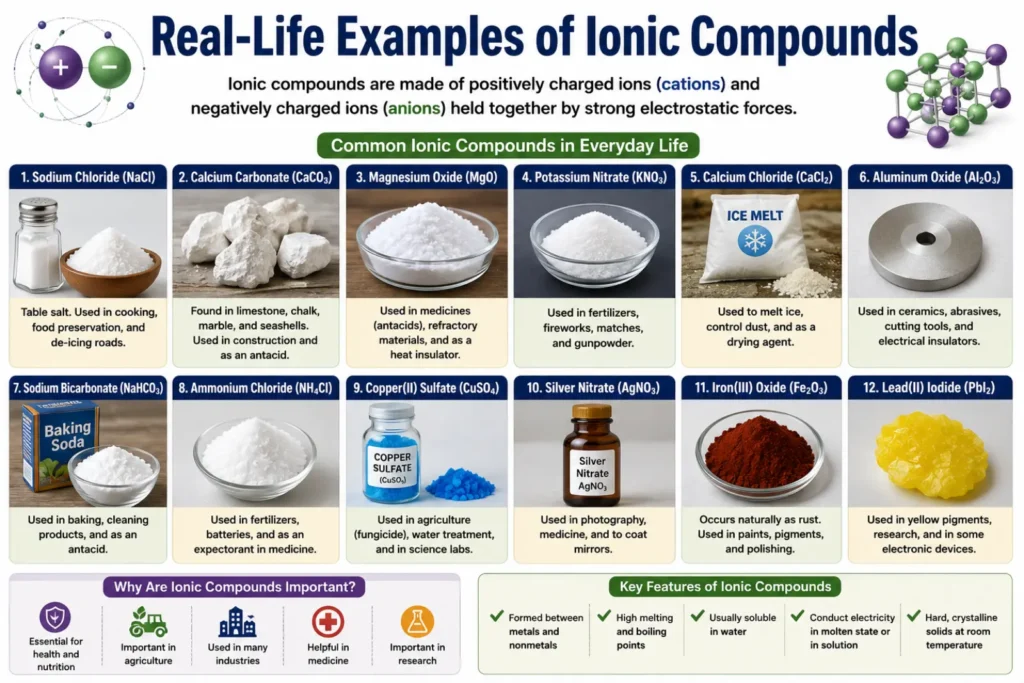
Real-Life Examples of Ionic Compounds
NaCl is one of many ionic compounds.
Other common examples include:
Magnesium oxide, MgO
Magnesium transfers electrons to oxygen.
This creates Mg²⁺ and O²⁻ ions.
Calcium chloride, CaCl₂
Calcium transfers electrons to chlorine.
This compound appears in some de-icing applications.
Potassium bromide, KBr
Potassium transfers an electron to bromine.
This creates K⁺ and Br⁻ ions.
Sodium fluoride, NaF
Sodium transfers one electron to fluorine.
This compound contains Na⁺ and F⁻ ions.
These examples follow the same basic pattern as NaCl.
NaCl vs Covalent Compounds: Real-Life Examples
Understanding examples makes the difference clearer.
NaCl: Ionic
Table salt contains Na⁺ and Cl⁻ ions.
The ions arrange themselves in a repeating crystal structure.
Water, H₂O: Covalent
Water contains hydrogen and oxygen atoms.
These atoms share electrons.
Therefore, water contains covalent bonds.
Carbon dioxide, CO₂: Covalent
Carbon shares electrons with oxygen.
Therefore, CO₂ is a covalent compound.
Sugar: Mostly covalent
Sugar contains many covalent bonds.
It does not form a simple ionic lattice like NaCl.
The key difference involves electron transfer versus electron sharing.
What Is the Structure of Solid NaCl?
Solid NaCl does not contain separate NaCl molecules.
Instead, it forms a large ionic lattice.
The lattice contains repeating Na⁺ and Cl⁻ ions.
Each sodium ion sits near several chloride ions. Each chloride ion sits near several sodium ions.
This repeating arrangement creates a strong crystal structure.
That structure explains several properties of table salt.
For example, solid NaCl:
- Has a regular crystal shape.
- Has a high melting point.
- Breaks along certain planes.
- Does not conduct electricity as a solid.
The ions cannot move freely inside solid NaCl.
Does NaCl Conduct Electricity?
Solid NaCl does not conduct electricity well.
Its ions remain fixed in the crystal lattice. They cannot move freely.
However, NaCl conducts electricity when:
- It melts.
- It dissolves in water.
When NaCl dissolves, the ions separate:
NaCl → Na⁺ + Cl⁻
The charged ions can then move through the solution.
Moving charged particles carry electric current.
This explains why saltwater can conduct electricity.
However, saltwater usually conducts less effectively than metals.
Why Does NaCl Have a High Melting Point?
NaCl has a high melting point because its ions experience strong attractions.
Positive sodium ions attract negative chloride ions.
These attractions hold the crystal lattice together.
A large amount of energy must break many ionic attractions.
Therefore, NaCl requires strong heating before it melts.
This property is common among many ionic compounds.
The exact melting point depends on the compound’s structure and ion charges.
Higher ionic charges often create stronger attractions.
Common Mistakes About NaCl Bonding
Many students make similar mistakes when studying NaCl.
Mistake 1: Calling NaCl covalent
Some students see two elements together and assume they share electrons.
However, sodium transfers an electron to chlorine.
Therefore, NaCl is ionic.
Mistake 2: Saying NaCl contains molecules
Solid NaCl forms a crystal lattice.
It does not contain separate NaCl molecules like many molecular compounds.
Mistake 3: Saying solid salt conducts electricity
Solid NaCl has fixed ions.
The ions cannot move freely.
Therefore, solid salt does not conduct electricity well.
Mistake 4: Confusing chlorine with chloride
Chlorine refers to the neutral atom or element.
Chloride refers to the negative ion, Cl⁻.
This distinction matters.
Mistake 5: Thinking all compounds with two elements are ionic
Some two-element compounds are covalent.
For example, CO₂ contains two elements.
However, carbon and oxygen share electrons.
Always check the bonding behavior.
Easy Tips to Identify Ionic Compounds
Use these simple chemistry tips.
Tip 1: Check the elements
A metal plus a nonmetal often forms an ionic compound.
NaCl contains:
- Sodium, a metal.
- Chlorine, a nonmetal.
This strongly suggests ionic bonding.
Tip 2: Look for electron transfer
Ask whether one atom loses electrons.
Then ask whether another atom gains electrons.
If yes, the compound probably has ionic bonding.
Tip 3: Look for charged ions
Ionic compounds contain cations and anions.
NaCl contains Na⁺ and Cl⁻.
Tip 4: Check physical properties
Many ionic compounds have:
- High melting points.
- Crystal structures.
- Electrical conductivity when dissolved.
These clues can help identify ionic compounds.
How Is NaCl Used in Daily Life?
NaCl appears in many everyday situations.
The most familiar use involves food.
People use table salt to add flavor.
Salt also helps preserve certain foods.
The human body needs sodium and chloride ions for important biological processes.
However, people should follow healthy dietary guidance when consuming salt.
NaCl also appears in science and industry.
For example, sodium chloride helps make other chemicals.
It also plays a role in some industrial processes.
Its useful properties come from its ionic structure.
NaCl Synonyms and Related Chemistry Terms
People may use several terms when discussing NaCl.
Sodium chloride
The official chemical name for NaCl.
Table salt
The common everyday name.
Salt
A general term for many ionic compounds.
However, “salt” does not always mean sodium chloride.
Ionic compound
A compound containing positive and negative ions.
Ionic bond
The electrostatic attraction between oppositely charged ions.
Electrostatic attraction
The force between opposite electrical charges.
Cation
A positively charged ion.
Na⁺ is a cation.
Anion
A negatively charged ion.
Cl⁻ is an anion.
These terms work as useful semantic keywords for understanding NaCl chemistry.
Expert Insight
NaCl provides one of the clearest examples of ionic bonding.
It shows how atoms can become more stable through electron transfer.
It also demonstrates the relationship between structure and properties.
The ionic lattice explains NaCl’s crystal form.
The fixed ions explain its poor solid-state conductivity.
The mobile ions explain its conductivity in water.
This connection matters beyond basic chemistry.
Scientists use similar ideas to understand minerals, salts, electrolytes, and biological ions.
A strong chemistry explanation should connect electron behavior with observable properties.
That connection creates deeper understanding
FAQs
Is NaCl an ionic compound?
Yes. NaCl is an ionic compound.
Sodium transfers one electron to chlorine.
This creates Na⁺ and Cl⁻ ions.
Why is NaCl not covalent?
NaCl is not covalent because sodium does not share an electron with chlorine.
Instead, sodium transfers an electron to chlorine.
The resulting ions attract each other.
Is NaCl an ionic molecule?
No. Solid NaCl does not form separate molecules.
It forms a repeating ionic crystal lattice.
People often use “NaCl unit” to describe its simplest ratio
What ions are present in NaCl?
NaCl contains:
- Sodium ions, Na⁺.
- Chloride ions, Cl⁻.
These ions have opposite charges.
Does NaCl conduct electricity?
Solid NaCl conducts electricity poorly.
Molten NaCl conducts electricity.
Dissolved NaCl also conducts electricity.
Mobile ions carry the electric current.
Is saltwater ionic or covalent?
Saltwater contains ionic and covalent substances.
Dissolved NaCl separates into Na⁺ and Cl⁻ ions.
Water molecules contain covalent bonds.
Therefore, the solution contains both types of bonding.
Is NaCl polar or nonpolar?
NaCl is an ionic compound.
The ions have full electrical charges.
The terms polar and nonpolar usually describe covalent molecules.
Therefore, calling NaCl simply “polar” can cause confusion.
What is the difference between NaCl and H₂O?
NaCl forms through ionic bonding.
H₂O forms through covalent bonding.
NaCl involves electron transfer.
H₂O involves electron sharing.
Conclusion
NaCl is ionic, not covalent. Sodium transfers one electron to chlorine. This process creates Na⁺ and Cl⁻ ions. The opposite charges attract and form an ionic bond. These ions then arrange themselves in a repeating crystal lattice.
This structure explains many properties of sodium chloride. Solid NaCl has fixed ions and conducts electricity poorly. Molten or dissolved NaCl has mobile ions and conducts electricity. Its high melting point also comes from strong ionic attractions.
The easiest way to remember the answer is simple: NaCl forms through electron transfer between a metal and a nonmetal. Therefore, NaCl is an ionic compound.