
“To late or too late” is a common English mistake. The correct phrase is usually “too late.” Many English learners confuse to and too because they sound alike. However, they have different meanings and uses. Too late means something cannot happen in time. For example, “It is too late to call him.” The word to usually shows direction or introduces a verb. The word too means “more than needed” or “also.” This guide explains the difference in simple English. You will learn the correct spelling, meaning, grammar rules, and real-life examples. By the end, you will know exactly when to use too late and when to late is incorrect.
Quick Summary
- Too late is the correct phrase in most situations.
- Too late means something happens after the right time.
- To late is usually a spelling or grammar mistake.
- Too can mean “more than needed.”
- To often shows direction or introduces a verb.
- Example: It is too late to change the plan.
- Remember: too late = not in time.
What Does “Too Late” Mean?
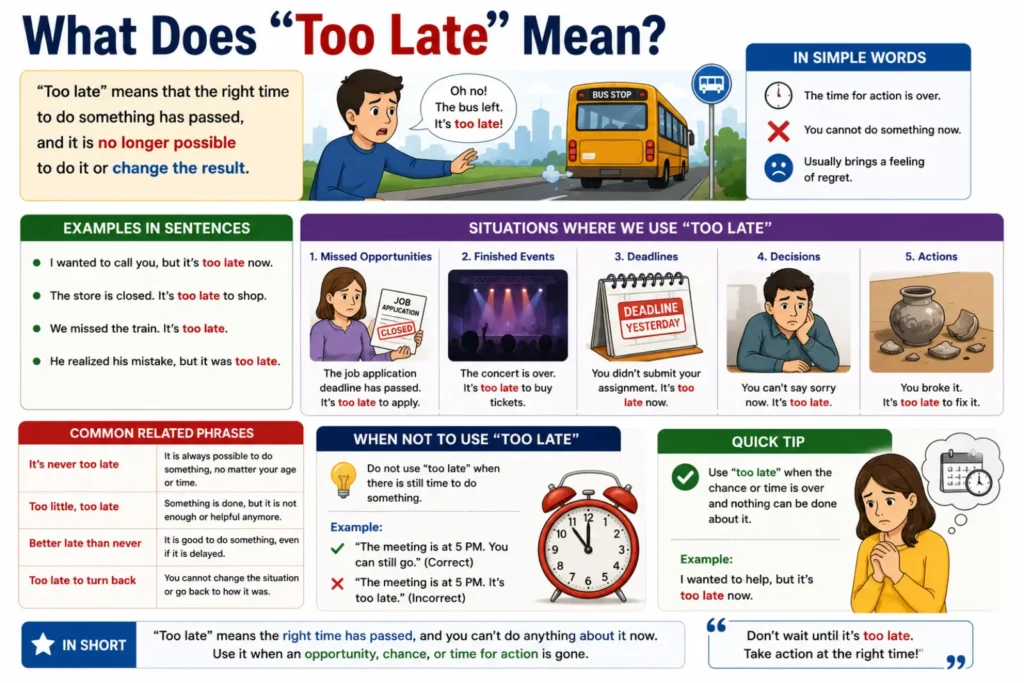
Too late means something happens after the best or allowed time.
It can also mean that an opportunity has passed.
Examples:
- It is too late to catch the bus.
- She arrived too late for the meeting.
- Is it too late to apply?
- We realized the mistake too late.
In each example, the action happens after the right time.
The phrase can describe a real time problem.
It can also describe a missed opportunity.
For example:
I wanted to apologize, but it was too late.
This means the chance to apologize had already passed.
Is “To Late” Correct?
In most cases, “to late” is incorrect.
English speakers usually mean “too late” when they write “to late.”
Incorrect:
I arrived to late.
Correct:
I arrived too late.
The word to does not mean “after the right time.”
The word too gives the correct meaning.
However, to can appear before the word late in a longer sentence.
For example:
I went to Late Night Café.
Here, Late Night Café is a name.
So, the phrase “to late” can appear by chance.
But it does not normally mean “after the correct time.”
“Too Late” vs “To”: What Is the Difference?
The words to and too sound similar.
However, they have different jobs in a sentence.
| Word | Main Meaning | Example |
|---|---|---|
| to | Direction or verb marker | I went to school. |
| too | More than needed | The bag is too heavy. |
| too | Also | I want to come too. |
Now look at the phrase too late.
The word too means “more than acceptable.”
Therefore, too late means later than acceptable.
Example:
The train was too late.
This means the train arrived after the expected time.
Why Is “Too Late” the Correct Phrase?
The word too often shows an excessive amount.
For example:
- too hot
- too cold
- too expensive
- too difficult
- too early
- too late
The phrase too late follows the same pattern.
It means the timing went beyond what was acceptable.
Compare these examples:
- The movie starts late.
- The movie starts too late.
The first sentence simply describes the time.
The second sentence shows a problem with the time.
For example, a movie may start at 10 p.m.
That time may be too late for a young child.
Real-Life Examples of “Too Late”
You can use too late in many everyday situations.
At School
I submitted my homework too late.
The student missed the deadline.
At Work
She arrived too late for the interview.
She missed part or all of the interview.
While Traveling
We reached the airport too late.
The travelers may have missed their flight.
In Relationships
He apologized too late.
The apology came after the situation became difficult.
In Daily Conversation
Is it too late to order food?
The speaker wants to know if ordering remains possible.
“Too Late” in Questions
People often use too late in questions.
These questions usually ask about deadlines or missed opportunities.
Common examples:
- Is it too late to apply?
- Is it too late to call?
- Is it too late to change my mind?
- Is it too late to join?
- Is it too late to start?
These questions often show doubt.
They ask whether an action remains possible.
Example:
Is it too late to register for the course?
This means:
Can I still register, or has the deadline passed?
“Too Late” in Negative Sentences
You can also use too late with negative words.
Examples:
- It is never too late to learn.
- It is not too late to try again.
- You are not too late for the meeting.
The phrase never too late is especially common.
It means an opportunity may still exist.
Example:
It is never too late to improve your English.
This sentence encourages action.
It says you can still begin.
Common Mistakes With “To Late” and “Too Late”
Many learners make similar mistakes.
Here are the most common ones.
Mistake 1: Writing “to late” for time
❌ I came to late.
✅ I came too late.
The correct phrase is too late.
Mistake 2: Confusing “too” with “two”
❌ I arrived two late.
✅ I arrived too late.
Two refers to the number 2.
Too means “excessively” or “also.”
Mistake 3: Using “too late” when “late” works
Sometimes, late is enough.
Compare:
The train arrived late.
This simply describes the timing.
The train arrived too late.
This shows that the timing caused a problem.
Mistake 4: Forgetting the difference between “late” and “too late”
Late means after the expected time.
Too late means after the acceptable or useful time.
That difference matters.
Late vs Too Late: What Is the Difference?
The words late and too late have related meanings.
However, they do not always express the same idea.
| Phrase | Meaning | Example |
|---|---|---|
| late | After the expected time | He arrived late. |
| too late | After the acceptable time | He arrived too late to enter. |
The word too adds a stronger meaning.
It shows that the delay caused a problem.
Example:
I arrived late.
You arrived after the expected time.
I arrived too late to see the doctor.
You arrived after the appointment became impossible.
“Too Late” vs “Very Late”
These phrases also have different meanings.
Very late
Very late describes a high degree of lateness.
She came very late.
This means she came much later than expected.
Too late
Too late means the timing caused a problem.
She came too late to join the meeting.
The meeting had already ended or moved forward.
Simple rule:
- Very late = extremely late.
- Too late = later than acceptable.
Synonyms and Related Expressions
Several phrases have similar meanings.
These semantic variations can help you understand the topic.
Common synonyms:
- after the deadline
- not in time
- past the deadline
- after the right time
- beyond the acceptable time
- behind schedule
- past the opportunity
Related expressions:
- better late than never
- at the last minute
- just in time
- miss the deadline
- run out of time
- time is running out
However, these phrases do not always mean exactly the same thing.
For example, just in time means you arrived before it became too late.
How to Remember “Too Late”
Use this simple memory trick:
Too late = too much delay.
The word too often means “more than needed.”
Examples include:
- too much
- too many
- too fast
- too slow
- too early
- too late
So, when you mean after the right time, use:
too late
Easy memory sentence:
It is too late because there is too much delay.
This connection can help you remember the correct spelling.
“Too Late” in Daily English
Native speakers use too late often.
You may hear it at home, school, work, and while traveling.
home:
It is too late to watch another movie.
school:
I handed in my project too late.
work:
We discovered the issue too late.
While traveling:
We arrived too late to board the plane.
In conversations:
Sorry, I called too late.
These examples show how useful the phrase is.
“Too Late to” Grammar Pattern
A common sentence pattern is:
too late + to + verb
Formula:
Subject + be + too late + to + verb
Examples:
- It is too late to leave.
- It is too late to change the order.
- She was too late to catch the bus.
- We were too late to buy tickets.
Notice the difference between the two words:
It is too late to leave.
The first too means “after the right time.”
The second to introduces the verb leave.
This sentence contains both words correctly.
“Too Late for” Grammar Pattern
You can also use:
too late for + noun
Examples:
- I am too late for class.
- She was too late for dinner.
- We arrived too late for the show.
- He was too late for the appointment.
Use for before a noun.
Use to before a verb.
Compare:
It is too late to leave.
It is too late for the meeting.
This rule helps you build correct sentences.
Common Search Questions About “To Late or Too Late”
Is “to late” grammatically correct?
Usually, no. The correct phrase is “too late” when you mean after the right or acceptable time.
Is it “too late” or “to late”?
Use too late for timing. For example, “I arrived too late.” To late is usually incorrect.
What does “too late” mean?
Too late means something happens after the right, useful, or allowed time.
Can I say “too late to”?
Yes. Use too late to + verb. For example, “It is too late to call.”
Can I say “too late for”?
Yes. Use too late for + noun. For example, “She was too late for class.”
What is the difference between “late” and “too late”?
Late means after the expected time. Too late means after the acceptable time.
Is “it’s too late” correct?
Yes. It’s too late is a correct and common sentence.
Is “better late than never” related to “too late”?
Yes. The expression means doing something late is better than not doing it at all.
Expert Insight
Small grammar mistakes can change how clear your writing sounds.
The words to, too, and two sound alike.
However, their meanings differ greatly.
Strong writers check these words carefully.
This matters in emails, schoolwork, websites, and professional writing.
Correct word choice also improves readability.
Search engines understand natural language better when sentences use correct grammar.
However, keyword use should always sound natural.
Do not repeat “to late or too late” unnaturally.
Instead, answer the reader’s question clearly.
A helpful grammar article should provide:
- a direct answer
- simple examples
- clear comparisons
- common mistakes
- related phrases
- practical usage advice
That approach improves both reader trust and content quality.
Conclusion
The correct phrase is usually “too late,” not “to late.” Use too late when something happens after the right, useful, or acceptable time. For example, “I arrived too late for the meeting.” The word to has different uses. It often shows direction or introduces a verb. The word too can mean “more than needed.” That is why we say too late. Remember this simple rule: too late means not in time. Once you understand this difference, the choice becomes easy. Use too late for timing problems and missed opportunities. With regular practice, this common English mistake becomes much easier to avoid.