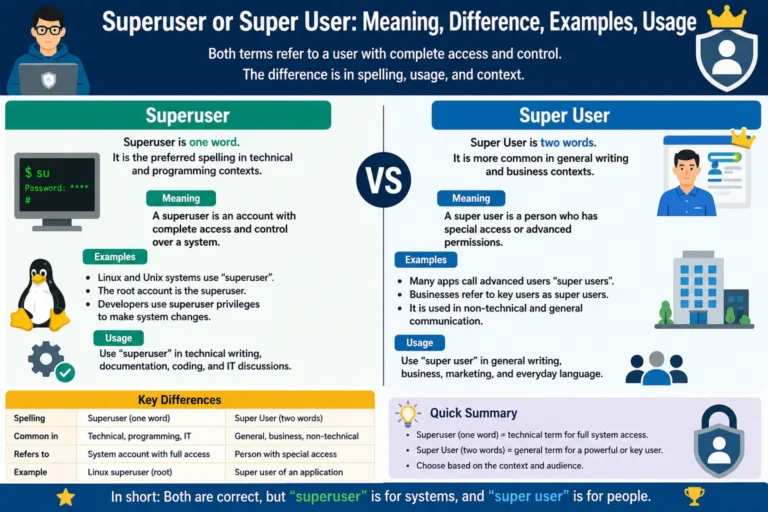
Superuser or super user usually means a person with more access than a normal user. The term appears often in technology, software, websites, and online communities. It can also describe an advanced or highly skilled user.
The correct meaning depends on the context. In computer systems, superuser often means an account with powerful control. In general English, super user may describe someone who uses a product very well.
This guide explains the difference in simple terms. You will learn the correct spelling, meaning, examples, and common mistakes. You will also see how experts use the term in real life.
By the end, you will know when to write superuser and when to write super user. You will also understand related terms, such as administrator, root user, power user, and advanced user.
Quick Summary:
- Superuser usually means a user with special system permissions.
- Super user can describe an extremely skilled or active user.
- Superuser is common in Linux, Unix, databases, and software.
- A root user is a famous example of a superuser.
- A power user has advanced skills but may lack full system control.
- Use superuser for technical roles and privileged accounts.
- Use super user when describing a person informally.
- Always check the context before choosing the spelling.
What Does Superuser or Super User Mean?
The term superuser or super user describes someone with unusual power, access, or skill.
The exact meaning changes based on the situation.
In technology, a superuser usually has special permissions. This user can change settings, manage accounts, and control system resources.
For example, a Linux superuser can perform actions that regular users cannot perform.
In everyday language, a super user may simply mean an advanced user. This person understands a product deeply and uses it often.
Therefore, both forms can appear in English. However, the single-word form has a stronger technical meaning.
Superuser Definition in Simple English
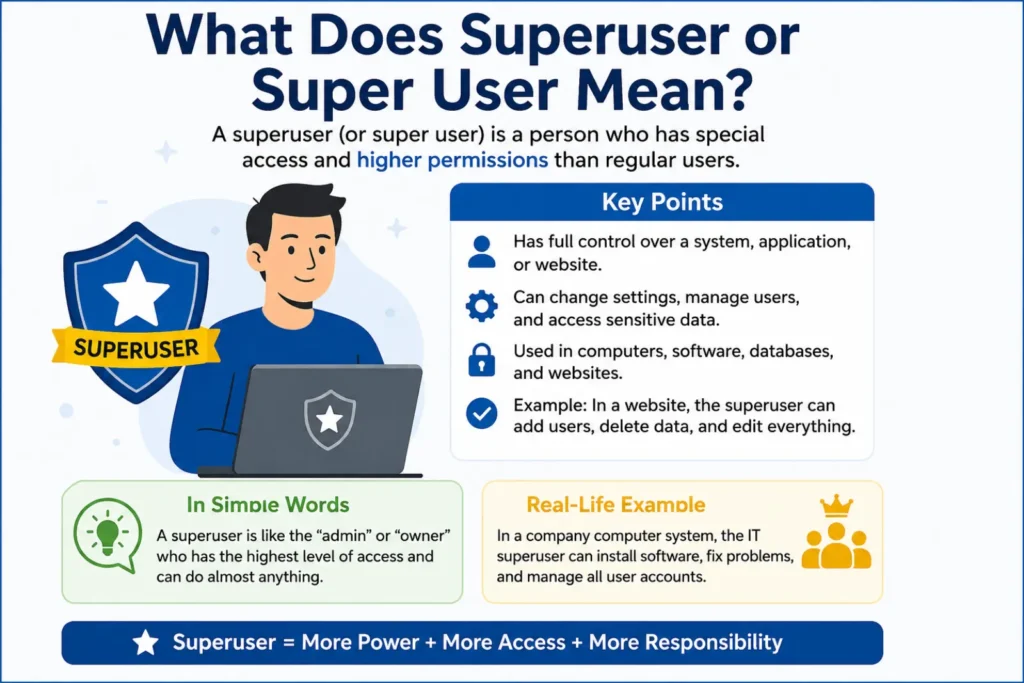
A superuser is a user with higher permissions than ordinary users.
A superuser can often:
- Change system settings
- Create or remove user accounts
- Access protected files
- Install software
- Manage security settings
- Control important system functions
The exact powers depend on the platform.
For example, a website may give a superuser full control over content and users.
A computer system may give a superuser complete administrative access.
What Is a Super User in General English?
A super user can mean a person with exceptional experience.
This meaning often appears in marketing, customer research, and product communities.
For example:
Sarah is a super user of project management software.
This sentence means Sarah uses the software frequently and understands its advanced features.
The term may also describe highly active customers or community members.
These users often provide feedback, help others, and test new features
Superuser vs Super User: What Is the Difference?
The main difference involves meaning and context.
| Term | Common Meaning | Typical Use |
|---|---|---|
| Superuser | A user with special system permissions | Technology |
| Super user | A highly skilled or active user | General English |
| Root user | A top-level system account | Linux and Unix |
| Administrator | A person who manages a system | IT and software |
| Power user | An advanced user with strong skills | Software and technology |
However, English usage can vary.
Some organizations use super user for a special employee role. Others use superuser for the same role.
Always follow the style guide of your organization or software platform.
Why Do People Write Superuser as One Word?
Technical language often combines words into one term.
The word superuser follows this pattern.
The prefix super- means “above,” “greater,” or “more powerful.”
The word user describes someone who uses a system or product.
Together, superuser describes a user with greater power or ability.
Similar examples include:
- Superadmin
- Superhuman
- Superstar
- Supercomputer
- Superpower
In technology, superuser has become a standard term.
Real-Life Examples of a Superuser
A superuser can appear in many digital environments.
Example 1: Linux
A Linux superuser can manage the entire operating system.
The root account provides very high system privileges.
Example 2: Website Management
A superuser may control users, settings, content, and security.
This role usually has more access than a regular administrator.
Example 3: Database Systems
A database superuser can manage databases and permissions.
The account may create users and change access rules.
Example 4: Online Communities
A superuser may have advanced moderation or management rights.
This person may manage members and community settings.
Example 5: Customer Research
A company may call its most active customers “super users.”
These customers often use advanced features regularly.

Superuser vs Administrator: Are They the Same?
A superuser and an administrator can have similar roles.
However, they are not always identical.
A superuser often has the highest possible permissions.
An administrator may have powerful but limited permissions.
For example, a system may have several administrators.
Only one account may have complete superuser access.
The difference depends on the software or operating system.
Therefore, never assume that every administrator is a superuser.
Superuser vs Power User: Key Differences
A power user has advanced knowledge and skills.
A superuser usually has elevated permissions.
These terms describe different things.
A power user may know every feature in an application.
However, that person may not manage other users.
A superuser may control the system without using every advanced feature.
Simple Example
A graphic designer may be a power user of design software.
A system root account may be a superuser.
One term focuses on skill.
The other focuses on access.
How Is Superuser Used in Daily Life?
The term appears in many modern workplaces.
Companies use superusers to support software adoption.
For example, a business may select one superuser from each department.
These employees learn new software first.
Then, they help other team members.
This approach can reduce training costs.
It can also improve software adoption.
Superusers often act as a bridge between users and technical teams.
Common Mistakes When Using Superuser or Super User
Many writers make simple mistakes with this term.
Mistake 1: Treating Both Spellings as Identical
The two forms can have different meanings.
Always consider the context.
Mistake 2: Calling Every Skilled User a Superuser
Technical superuser status usually involves permissions.
Skill alone does not always create a superuser.
Mistake 3: Assuming Every Administrator Is a Superuser
Some administrators have limited access.
The software determines the actual permissions.
Mistake 4: Ignoring Platform Terminology
Different systems use different terms.
Always check official documentation when accuracy matters.
Mistake 5: Overusing the Keyword
Good SEO writing should sound natural.
Use related terms instead of repeating one phrase.
Tips for Using Superuser Correctly
Follow these simple tips.
Use “Superuser” for Technical Access
Choose superuser for privileged system accounts.
This usage works well in IT and software content.
Use “Super User” for General Descriptions
Choose super user when describing an exceptionally active person.
This usage often appears in business and customer research.
Check the Official Style
Some products use a specific spelling.
Follow their official terminology.
Explain the Term for Beginners
Not every reader understands technical jargon.
Add a short definition when needed.
Use Related Terms Naturally
Include terms such as:
- Root user
- Privileged user
- System administrator
- Power user
- Advanced user
- Admin account
These terms improve clarity and topical relevance.
Superuser Synonyms and Related Keywords
The best synonym depends on the context.
Technical Synonyms
- Privileged user
- Root user
- Administrator
- System administrator
- Admin user
- Elevated user
- Master user
Skill-Based Synonyms
- Power user
- Advanced user
- Expert user
- Experienced user
- Heavy user
- Advanced customer
Related SEO Keywords
- superuser meaning
- super user meaning
- superuser definition
- superuser vs administrator
- superuser vs power user
- what is a superuser
- what does super user mean
- root user meaning
- privileged user definition
- superuser access
These semantic variations help search engines understand the topic.
Superuser Examples in Sentences
Here are simple examples.
Technical Examples
- The superuser can change system permissions.
- Only the superuser can access this setting.
- The system blocks regular users from this command.
- The administrator granted superuser privileges.
General Examples
- Mark is a super user of the new software.
- Our super users helped test the new feature.
- The company selected five super users for training.
The correct spelling depends on the intended meaning.
Expert Insight:
The term matters because access levels affect security.
A superuser can often make major system changes.
Therefore, organizations should protect superuser accounts carefully.
Experts recommend using strong authentication and limited access.
Teams should also monitor privileged accounts.
A user should receive only the permissions they need.
This approach follows the principle of least privilege.
In simple terms, fewer unnecessary permissions create fewer security risks.
From an SEO perspective, clear terminology also improves content quality.
Readers need accurate explanations.
Search engines reward helpful content that answers user questions directly.
How to Explain Superuser to Beginners
Use a simple comparison.
Imagine a building with different keys.
A regular user has one room key.
An administrator has keys for several rooms.
A superuser has a master key.
The master key opens almost everything.
This example makes the concept easy to understand.
However, real systems may use different permission structures.
The exact access level always depends on the platform.
Frequently Asked Questions About Superuser or Super User
Is “superuser” one word?
Yes. Superuser is commonly written as one word in technical contexts.
It usually describes a user with elevated system permissions.
Is “super user” also correct?
Yes. Super user can be correct in general English.
It often describes an extremely skilled or active user.
Is a superuser the same as an administrator?
Not always.
A superuser often has greater permissions than a standard administrator.
The exact meaning depends on the system.
Is a root user a superuser?
Usually, yes.
In Unix-like systems, the root account commonly has superuser privileges.
What is another word for superuser?
Common alternatives include privileged user, root user, administrator, and power user.
The best choice depends on the context.
What does super user mean in business?
A business super user is usually an advanced employee or customer.
This person often understands a product deeply.
Should I write superuser or super user?
Use superuser for technical permissions.
Use super user for a general description of an advanced user.
What is a superuser account?
A superuser account has unusually high permissions.
It can often manage users, settings, files, and system functions.
Conclusion:
The correct choice between superuser or super user depends on context.
Use superuser when discussing technical permissions and privileged accounts.
Use super user when describing someone with advanced skills or heavy product usage.
A superuser often has greater system control.
A super user may simply have greater experience.
The terms can overlap in some workplaces.
However, the technical spelling usually appears as one word.
When writing for SEO, focus on clear definitions and natural language.
Use related terms such as root user, administrator, power user, and privileged user.
Most importantly, follow the terminology used by the platform or organization..